Tarrasch - Richter
                      |
|
|
Chernev writes:
"Tarrasch plays a combination which ends in the pin of the Queen ---
and then gets the shock of his young life!"
[ See the book, {The}
"1000 Best Short Games of Chess,"
by {the late, great} Irving Chernev.
Game # 696, pg. # 359. ]
***
This is a very pretty little game of chess. It has a very surprising
turn-around at the end of the game.
1. c4 f5; 2. d4 e6; A Dutch Defense. (By transposition.)
3. Nf3, Obviously there is nothing wrong with this very good and
straight-forward development of the Knight. It controls the center,
develops a piece and prepares castling.
But the more modern treatment
of the Dutch involves a King-side fianchetto of White's KB.
[ The modern
{'Book'} line runs:
3.g3
Nf6; 4.Bg2
Be7;
5.Nf3
0-0;
6.0-0
d6; 7.Nc3
Qe8; 8.b3,
("+/=") ].
3...Nf6; 4.
e3, Again, there is nothing wrong with this classical development.
But now it is too late to consider a fianchetto.
[ 4.g3!?
].
4...b6; A standard idea in the Dutch. Black already has his Knight on f6
and his Pawn on f5 hitting the e4-square. A fianchetto of this Bishop will
add to his control of this vital central square.
5. Bd3
Bb7; 6.
0-0
Bd6!?; (Maybe -
'?!/?') This is far too artificial to
be any good here.
This is an extremely aggressive development of the Bishop.
(But the piece is also really pretty vulnerable here, too.)
[ Much safer was:
6...Be7; or 6...c5!?;
hitting the center. ].
7. Nc3
Nc6; 8.
e4!
fxe4; 9.
Nxe4, White is clearly a little better here. ("+/=")
9...Be7!?; This is a key loss of time.
(And a virtual admission that Black's sixth move was an inaccuracy.)
[
Black should play 9...0-0!?;
or maybe 9...Nb4!?
].
10. Ne5?!, (Probably - '?')
Premature.
White has a significant advantage here,
(Nearly - "+/-"); but this move dissolves almost all of White's advantage.
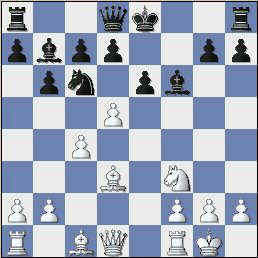
[10.Nxf6+ Bxf6; 11.d5!, ("+/=" White is clearly - at least - a bit better.)
(See the diagram directly below.)
|
(Maybe even - "+/") White has a clear advantage
and a lasting initiative. ].
10...Nxd4; ("=")
11. Nxf6+!?,
(Maybe - '?!') This doesn't look quite right.
Usually Tarrasch was remorseless when he had an advantage. [Normally.]
(But here he seems intent on blowing it!)
[ White should probably play: 11.Ng5!, ("+/=") ].
11...Bxf6; 12. Qh5+!?, (Probably - '?!') I am not sure about this move, either.
There is such a thing as being too aggressive!
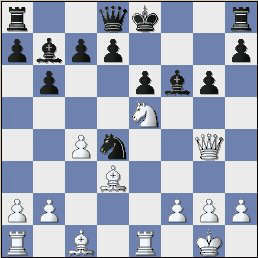
[White had to play: 12.Re1 g6!?; (Maybe 12...c5! "=") 13.Qg4~, {Unclear?}
(See the diagram directly below.)
|
when White still may hope for an advantage out of the opening. ].
12...g6; 13.
Bxg6+
hxg6; 14.
Qxg6+
Ke7; 15.
Ng4, (Risky!?)
White continues with his plan, but he has already passed the point of no return!
[15.Rd1!?
].
15...Qf8!; (Maybe - '!!')
The first move given an exclam by Chernev.
In reality the move is extremely subtle and perhaps even deserving
of a double-exclam.
[
Tarrasch may have spent all his time and energy calculating the following
variation:
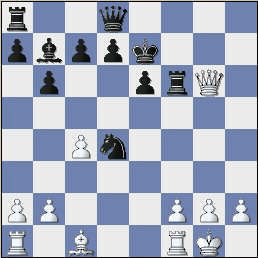
15...Rf8?!; ('?') 16.Nxf6
Rxf6;
(See the diagram directly below.)
|
It ugly to see the Black King out in the open like this!
17.Qg7+, The best.
(Definitely not: 17.Bg5?,
and it looks like White is winning, but ... 17...Ne2+!;
18.Kh1
Bxg2+!; 19.Kxg2[]
Nf4+!;
20.Bxf4
Rxg6+; and Black is winning!)
17...Kd6; 18.Bg5,
("+/") White is clearly a lot better.
(Maybe "+/-")
and White is close to winning.
This was probably the line
Tarrasch was counting on!
White could also have tried, (instead): 18.Rd1!?
e5; 19.Bg5
Qe7; (Or
19...Ke6?!;
An error. 20.Rxd4!
exd4; 21.Bxf6!
Qxf6; 22.Re1+
Kf5; 23.g4+
Kf4;
24.Qxf6+, and of course White
is winning easily. "+/-" )
20.Qxf6+
Qxf6; 21.Bxf6,
"+/" And White is better.
Maybe the correct evaluation is:
"+/-". ) ].
16. Nxf6
Qxf6; Chernev also awards this move an exclam, but I do not
think it deserves one at all. This ... and ...Ne2+ are Black's only two
reasonable moves here.
17. Bg5!?, (Maybe - '?')
In reality, the losing move. If one wanted to
be a "nit-picker," you could give this move two question marks.
Of course it LOOKS like a winning move, pinning the Black Queen!
Chernev writes:
"This should be the end of the story ...
but there is a sequel:"
[Actually White had to play:
17.Qxf6+[]
Kxf6; "/+" but
Black
keeps a great advantage. (Maybe - "-/+".) ].
17...Ne2+; 18.
Kh1
Rxh2+; No exclam here, if Black does not
play this
move (and the Knight check
previously), he can resign!
19. Kxh2
Rh8+;
At this point, White must have thought "oooppsss."
20. Bh6,
The great Tarrasch may have only calculated
this combination only to the pin of the Black Queen ... he was probably truly
in shock at what was transpiring now!
[Or White could have played:
20.Qh5
Rxh5+; 21.Bh4
Rxh4#;
or 20.Qh6
Rxh6+; 21.Bxh6
Qxh6#
] .
20...Qh4#; 0-1
A happy ending for Black, but a very sad reversal of fortunes for White!
The game is pretty, but did
not receive strong consideration for the list of,
"The Ten Best."
(The play was much too uneven.)
1 - 0
(I
saw this game as a very young lad. But I was not to annotate it myself -
properly -
until just a few years ago ... when I began the project of putting all of the
games of
Chernev's book onto the hard drive of my computer.)
This game is the full
length version of the game as it exists in my database.
(I have not shortened it for publication.)
If you would like a copy of that game to study, please contact
me.
Click HERE to return to my GeoCities "Home Page."
Click HERE to return to my (GeoCities) "Best Short Games Page."
Copyright A.J. Goldsby I. © A.J. Goldsby, 1998
- 2004.
Copyright (©) A.J. Goldsby, 2005. All rights reserved.