Tarrasch - Kurschner
                      |
|
|
Chernev writes:
"Tarrasch's moves are all perfectly clear, especially the one by the Bishop which
prevents casting. What Black overlooks though, is that a single move may have
had more than one purpose."
[ See the book, {The}
"1000 Best Short Games of Chess,"
by {the great, late} Irving Chernev. Game # 706, pg. # 365. ]
A
very beautiful game by Tarrasch. It showed that the great teacher could also
play.
(And play incredibly well.)
1. e4 e6; 2. d4 d5; The French Defense, a favorite of Black's opponent!
3. Bd3!?, White varies the opening from the normal course of events.
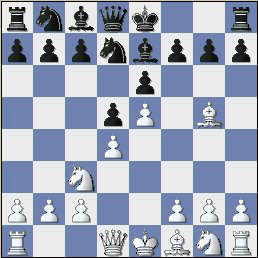
[ The normal 'book line' of that era was: 3.Nc3 Nf6; 4.Bg5 Be7; 5.e5 Nfd7;
(See the diagram directly below.)
|
(Etc.) This is the Main Line of the Classical French. White keeps his normal slight advantage. ("+/=");
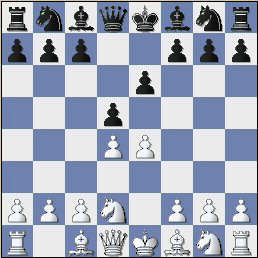
Tarrasch himself was to later pioneer the move: 3. Nd2!?, ("+/=")
(See the diagram directly below.)
|
( The TARRASCH Variation. ),
but it was not to gain widespread acceptance
until it was adopted and used repeatedly by World Champion Anatoly Karpov in
the 1970's and early 80's. ].
3...Nf6!?; A loss of time, but not fatally so.
Compare this to the book line of 1 .e4, e6; 2. d4, d5; 3. Nd2, Nf6!?; 4. e5, etc.
[
Best was:
3...dxe4!; 4.Bxe4
Nf6; ("=") ] .
4. e5
Nfd7; 5.
Nf3
c5; Black counter-attacks the center
in typical French fashion.
6. c3
Nc6; We have transposed to a
normal book line. (!)
7. 0-0
f6!?; (Maybe - '?!')
This might be risky.
Time-honored wisdom says that you should not open the center when you are
behind in development and your King is still in the middle of the board.
[ Black should probably play: 7...Be7; 8.Nbd2 Qb6; Etc. ].
8. Re1!?, "+/=" (Maybe - '!')
A good, solid move ... in keeping with the
principles I teach.
I like this move, bringing more pressure to bear on Black's position.
[
White could have also played: 8.exf6!?
].
8...f5!?; (Maybe - '?!')
This looks like a clear loss of time.
(Black took two moves to make
this move, when he could have
done it in
just one move!)
[Maybe Black could have played: 8...cxd4!? ].
9. Be3 c4?; Clearly bad, taking the pressure OFF White's center.
Chernev writes:
"With his last two moves, Black thinks he has barricaded himself against (the)
attack. In reality he has relinquished his pressure on White's center pawns."
[Any of the following moves were
much more acceptable for Black: 9...Qb6!?;
or 9...Be7; or 9...cxd4.
].
10. Bc2
Be7; 11.
b3!, The most thematic, White begins to break down
the Black Pawn Chain ... before Black has time to reinforce it!
[11.Ng5!?,
("+/=") ].
11...b5?!; (Maybe - '?')
This is clearly bad; Black continues
opening lines.
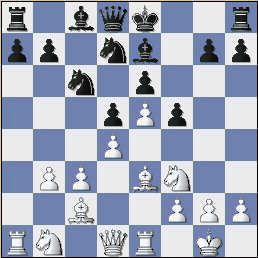
[ 11...cxb3; 12. axb3, ("+/=")
(See the diagram directly below.)
|
White has a very nice, clear and comfortable edge. But he is far from having a
forced win. ].
12. a4!
bxa4; 13.
bxc4!
dxc4; 14.
d5!, A nice move, and VERY energetic.
(The first move to receive
an exclam by Chernev.)
White INSISTS on some major line-opening!
[Much
less accurate is: 14.Bxa4!?].
14...Ncxe5?!; (Probably - '?')
Very bad.
Black continues on his course of destruction, opening even more lines.
[Forced was -
Junior 6.0: 14...exd5[];
15.Bxa4!, ("+/",
White is much better.)
(Maybe "+/-") White is virtually winning. 1.72/6
].
15. dxe6
Nxf3+[]; 16.
Qxf3
Nb6; 17.
Qxf5!, This is excellent, trapping
the
Black King in the center.
[
The computer, after only a few
seconds of analysis time, prefers
the grubby move:
17.Bxb6!?, trying to win material. ].
17...Bf6; 18.
Bc5!, Nice.
The second move to receive an exclamation point from Chernev.
(The first one was White's 14th move.).
Chernev writes:
<< "Obviously to prevent Castling," says Black to himself;
and proceeds
with developing his pieces. >>
[White could try:
18.Bxb6!?; Or also probably winning was:
18.Qh5+
].
18...Bb7; Does Black think he has defended?
19. Qg6+!, (Maybe - '!!')
This move also receives an exclam from Chernev.
It must have been quite a shock for poor Kurschner!
[White could have also won with:
19.Qh5+, with a probable
win for White.
But its boring and routine, and not
nearly as pretty! (Or as quick!) ].
19...hxg6; 20.
Bxg6#; 1-0 A cute mate.
A brilliant game by Tarrasch, but few positive things can be said about the way
that Black conducts his defense in this game.
(Basically it is not much more than a trap and a nice mating pattern.)
1 - 0
(A very cute game I first saw as a
teen-ager in a book/pamphlet of Tarrasch's games.
Of course, I saw it again when I copied all of Chernev's book by hand as a
teenager.
But I only recently became really aware of all the errors that Black made in
this game.)
This game is the full
length version of the game as it exists in my database.
(I have not shortened it for publication.)
If you would like a copy of that game to study, please contact
me.
Click HERE to return to my GeoCities "Home Page."
Click HERE to return to my (GeoCities) "Best Short Games Page."
Copyright A.J. Goldsby I. © A.J. Goldsby,
1998 - 2004.
Copyright (©) A.J. Goldsby, 2005. All rights reserved.