Steinkuhler - Blackburne
                      |
|
|
Chernev writes:
"As befits a Master who composed an occasional problem,
Blackburne sacrifices his Queen to evolve a 'PURE' mate"
[See the book,
{The} "1000 Best Short Games of Chess,"
by Irving Chernev.
Game # 605, page # 306.].
A nice game, and a very original mating pattern.
1. e4 e5; 2. Nf3 Nc6; 3. Bc4 Bc5; The Giuoco Piano. (Italian Game.)
4. c3 Nf6; 5. d4 exd4; 6. cxd4 Bb4+;
Now
White has a choice of two different lines.
7. Bd2, The "safe and sane" variation.
(White avoids the chaotic complications following 7. Nc3!?)
[The
book line:
7.Nc3!?, (Maybe - '!')
7...Nxe4!?; 8.0-0!
Bxc3!;
9.d5!
Bf6!;
10.Re1
Ne7;
11.Rxe4
d6; 12.Bg5
Bxg5;
13.Nxg5
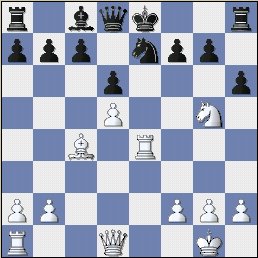
h6!; {Unclear?}
(See the diagram directly below.)
|
would not be worked out in its entirety until more than a 100 years later! ].
***
7...Bxd2+; 8.
Nfxd2?, This is a very bad loss of time.
(Violating the old rule,
"Never move the same piece twice
during the opening.")
[
The book line is: 8.Nbxd2
d5!; 9.exd5
Nxd5; 10.Qb3
Nce7;
11.0-0
0-0; 12.Rfe1
c6; ("=") etc. ].
8...Nxd4!?; This is interesting, but perhaps not the most precise.
[Maybe best is:
8...d5!; ("=") or Black could try:
8...Nxe4!?; ].
9. 0-0!?, Somewhat less than punishing.
[
9.e5!?
d5!; ].
9...d6; ("=/+")
Black already has a slight advantage.
10. Nb3
Nxb3; 11.
Qxb3
0-0; 12.
Re1
Nh5!?;
Very sharp and in keeping
with the way chess was played at that time. Black immediately starts an attack
on White's King. (But it probably does not represent best play.)
[
12...Ng4!; ("Black is
slightly better, " or "=/+".) ].
13. e5
Qg5; 14.
exd6
Nf4; Who is better?
What is the correct move?
15. Bxf7+!?, (Maybe - '?!'/?') Interesting. But this may actually be a mistake.
[
The computer finds:
15.Qg3!, ("White
is slightly better.") ("+/=")
].
15...Kh8[]; Taking the Bishop of course allows mate.
[15...Rxf7??; 16.Re8#. ].
16. g3, Chernev notes that this is forced, remarking that Qg3 is met by Ne2+.
[16.Qg3?
Ne2+; 17.Rxe2,
(17.Kf1
Nxg3+; wins for Black.)
17...Qc1+;
18.Re1
Qxe1#.
].
16...cxd6; 17. Nc3 Nh3+; 18. Kg2 Qf6; 19. Bd5?!, Probably not the best.
Chernev writes:
"Save his Bishop but at a fearful cost. Black now delivers mate in four moves."
[
White's best seems to be: 19.f4[]
Rxf7; 20.Ne4
Qe6; ("/+") Maybe -
("-/+".) ].
19...Qxf2+; 20.
Kh1
Qg1+!!; An original mate
- especially at that time.
I am not sure if this pattern had ever been seen before.
(Chernev only gives this move a single exclam.)
21. Rxg1 Nf2+; 22. Kg2 Bh3#! 0-1 A very cute and piquant mate.
But not a game that would merit inclusion in my list of,
"The Ten Best Miniature Games of Chess."
White plays very inaccurately and allows Black an almost free hand.
But Black finishes with a flourish.
- LM A.J. Goldsby I.
0 - 1
This game is the full
length version of the game as it exists in my database.
(I have not shortened it for publication.)
If you would like a copy of that game to study, please contact
me.
Click HERE to return to my GeoCities "Home Page."
Click HERE to return to my (GeoCities) "Best Short Games Page."
Copyright (c) A.J. Goldsby I. © A.J. Goldsby,
1999 - 2004.
Copyright (©) A.J. Goldsby, 2005. All rights reserved.