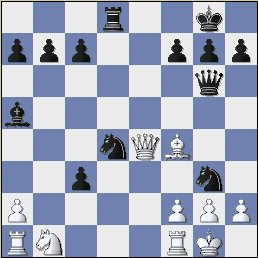
N. Marache - P. Morphy
New York, NY. 1857
                      |
|
|
|
Chernev
writes: I will only say that the game is beautiful beyond my ability to describe it. I can also (maybe) understand why (some) people tried to discredit Morphy and his contemporaries. After his games, no one else had anything to brag about!!! Lawson writes:
<< A chess teacher searching for a classic example of a 'positional sacrifice' will find it here on
Black's eleventh move. The game itself has a happy ending for everybody: Morphy wins and Marache gets
"Knighted." >> |
1. e4
e5; 2.
Nf3
Nc6; 3.
Bc4
Bc5;
One of the oldest
lines in all of chess.
White's next move initiates the,
"Evans Gambit."
(A variant of - and in - the Italian Game. The Italian Game is ANY line after
- - - 1. e4, e5; 2, Nf3, Nc6; 3. Bc4,
Bc5;)
This opening (The Evan's) was once described, "As a gift from the gods to a languishing chess world." (!!!)
I will also say the Evans was considered UNSOUND for virtually my entire career, until Kasparov crushed Anand with it! (Late 90's.)
4. b4!?
Bxb4;
The gambit accepted. Black should not be afraid to take.
[ { 4...Bb6!?; 5.a4
a6;
6.Nc3
Nf6; 7.Nd5
Nxd5;
8.exd5
Nd4; 9.a5
Ba7;
10.d6!
cxd6;
11.0-0
0-0;
12.Nxd4
Bxd4;
The end of column # 6. 13.c3
Ba7; 14.Qf3,
"White has compensation for the material invested." - GM P. Leko.
[ See MCO-14;
pages 27-28,
columns 1-6, (mainly col. #6);
and note # (z.).] } ]
5. c3
Ba5; 6.d4!,
The most energetic. (White attacks the center in a way that was not all that common in those days.)
[ {
White can also play the very logical 6.0-0!?,
"White has compensation for his pawn."
6...d6!;
This is the "Lasker's Defense." This line virtually killed the
Evan's for many years.
7.d4
Bb6; 8.dxe5
dxe5;
9.Qb3, ('!') The best line
for White.
( Less than best is: 9.Qxd8+!?
Nxd8; 10.Nxe5
Be6;
11.Be2
Ne7;
12.Nc4
Ndc6; 13.Bf4,
"=" Anageliev - V. Ivanov;
Ashkhabad, 1995.
[ See MCO-14;
pages 27-28,
columns 1-6, (mainly col. 1);
and note # (c.).] )
9...Qf6; 10.Bg5
Qg6;
11.Bd5
Nge7; 12.Bxe7
Kxe7; The end of column # 1.
13.Bxc6
Qxc6; 14.Nxe5
Qe6; 15.Nc4,
Probably the best.
(15.Qa3+
Qd6; "And Black is
OK." - Levenfish.);
15...Rd8;
16.Qb4+
Ke8; 17.Nxb6,
("=") "The position is equal." - Y. Estrin.
[See MCO-14;
pages 27-28,
columns 1-6, (mainly col. # 1);
and note # (d.).] } ]
6...exd4;
Acceptance is virtually forced. (Black cannot retain the strong-point on e5 without making his position the worse for it.)
[ { The computer gives:
6...d6!?; ('?!')
7.Qb3
Qd7; 8.dxe5,
Is this forced?
( MCO gives the line:
8.Nbd2
Bb6; 9.a4
Nf6;
10.a5
Nxa5; 11.Rxa5
Bxa5;
12.dxe5
Ng4; "=/+"
The end of column # 4.
"After: 13.exd6
Bb6; 14.h3
Nxf2;
15.Rf1
0-0; 16.Ba3
cxd6;
17.Rxf2
Bxf2+; 18.Kxf2,
a weird material balance arises
that is slightly in White's favor."
- GM Nick DeFirmian. ---> Note that the computer
greatly favors Black. {"/+"}
But here I prefer the GM's
evaluation!
{A.J.G.}
[ See MCO-14;
pages 27-28,
columns 1-6, (mainly col. 4);
and note # (o.).] )
8...Bb6; 9.Nbd2
Na5;
10.Qc2
Nxc4; 11.Nxc4
Bc5;
12.exd6
cxd6;
13.Be3
Bxe3;
14.Nxe3
Ne7; 15.0-0
0-0;
16.Rad1
Qc7; 17.Rd2,
("+/=") but I
think this line is terrible for Black, he is slightly inferior and has no real chances
for generating meaningful counterplay.} ]
7. e5!?, (Maybe - '?!/?')
Maybe not the best, although this was (seems to be) "accepted theory" at the time.
(I have found many examples of this line that pre-date this
game!)
Mednis gives this move a question mark. (I think this is far too harsh.) GM Mednis then goes on to write:
"White must look for rapid development as compensation for the sacrificed
material. The text does not further development and meets a clear refutation. The developing move, 7. 0-0, is in
order when 7...Nge7; is considered by theory to be the only correct response; eventual equality is the most likely outcome."
[See the book, "Practical {Chess} Opening Tips," by GM Edmar Mednis. Pg.'s 22-23.]
---> Of course by modern standards, we (now) know that this move is a waste of time.
[ Correct was:
7.0-0!, ("White has
compensation for the material invested.")
but this move is the result of nearly 200 years of development in opening
theory!!
Sometimes, it is easy - far too easy! - to forget this.
7...Nge7; The best according to theory.
( 7...dxc3?!;
"The Compromised Defence."
- It is considered
very risky by modern-day theory.
8.Qb3
Qf6;
9.e5!
Qg6; 10.Nxc3
Nge7;
11.Ba3
0-0; 12.Rad1,
"With good compensation for the material AND a strong
initiative."
[ See MCO-14;
pages 27-28,
columns 1-6, (mainly col. # 3.);
and note # (k.).] )
8.cxd4
d5; 9.exd5
Nxd5;
10.Ba3
Be6; 11.Bb5
f6;
12.Qa4
Bb6; The end of the column.
13.Bxc6+
bxc6; 14.Qxc6+
Kf7; ("=") (Analysis by Botterill.)
"Black is slightly better."
- GM Nick DeFirmian.
(According to the computers, the position is nearly dead-equal.
It also looks very equal to me. - LM A.J. Goldsby I.)
[ See MCO-14;
pages 27-28,
columns 1-6, (mainly col. 2);
and note # (h.).] ]
7...d5!;
Chernev also awards this move an exclam.
Black immediately gains some space for his pieces by countering in the
center.
(Controlling the center is the single most important thing you do in the
opening!)
8. exd6
Qxd6; 9.0-0!,
White correctly castles, despite many attractive alternatives.
[ Interesting is:
9.Qb3!? "~" The position is unclear, or maybe slightly better for Black. ]
9...Nge7!;
I believe this is the correct course for
Black. (He must develop as quickly as possible. Or perish!)
[ Most strong
computer
programs prefer:
9...dxc3!?; ("/+") giving Black
(now) as much better.
But White can play:
10.Qb3!, with a very
strong attack.
(And some good compensation for the material invested.) ]
10. Ng5!?, (Maybe -'?!/'?')
Sergeant gives this move a question mark, and recommends instead B-R3 followed by R-K1.
[See the book,"
"Morphy's Games of Chess,"
by Phillip W. Sergeant. Game # CLXI, pg. # 223.]
This may be an improvement over the actual game, but does NOT give White the better game. (Nothing gives White the better game at this point.)
The move Ng5 is certainly a time waster, and the kind of move Morphy showed his brilliance against. (I must also add I have taught this game dozens and dozens and dozens of times over the years. And a lot of people will pick Ng5 as the move White ought to play here!)
GM Edmar Mednis writes: (After giving 10. Ng5 a
question mark.)
"White is insufficiently developed to expect anything from such a Knight sally. 10. Ba3, Qf6; 11. cxd4, is logical; with some compensation for the pawn."
[See the book, "Practical {Chess} Opening Tips," by GM Edmar Mednis. Pg.'s 22-23.]
[ Better is 10.Ba3! Qf4; ("=/+") ]
10...0-0; 11.
Bd3, (!?)
Maybe not the best. But it is also hard to come up with viable alternative for
White.
GM Mednis's comments are very illuminating here. He writes:
" Notice how White is attempting to attack by moving the same pieces repeatedly ... rather than bringing new
soldiers into play. Morphy, therefore, decides that he can both complete his development
and gain a safe material advantage by an exchange sacrifice. In return, he will get 2-3 pawns and a clear initiative."
[See the book, "Practical {Chess} Opening Tips," by GM Edmar Mednis. Pg.'s 22-23.]
I will only add that White threatens Qh5 with a nearly winning attack. Morphy is as brilliant in defense as he is in attack. - LM A.J. Goldsby I
[ 11.cxd4 Qxd4; ("=/+") ]
11...Bf5!;
This move is given an exclam
by no less than GM Mednis.
[ My computer likes: 11...h6!?;
"(-/+") ]
12. Bxf5
Nxf5;
To me, Black's position is
not all that impressive. (At least, not right at this moment!) With his next move, White wins the exchange.
13. Ba3, ('!?')
White takes the bait.
(He may as well, he will get little else from Morphy!)
[ </= 13.cxd4?
Qxd4; "/+" (Maybe - "-/+".) ]
13...Qg6;
The Queen gets
out of the way.
Chernev writes: "Black is glad to give up the exchange. For his Rook, Morphy gets a Knight ... and
three tempo's! And NOBODY knew the value of time better than Morphy."
(The emphasis is mine.)
14.Bxf8
Qxg5!;
Perhaps a shock ... especially if you were expecting a simple recapture on f8!
(This is a good example of an "In-Between move," or a "Zwischenzug.")
Now White must lose yet ANOTHER tempo and retreat his Bishop.
15. Ba3,
White must retreat or lose another piece.
The loss of tempi here is very subtle and easy to miss. (Most of my students have failed to correctly identify where White's big tempo loss was.)
This piece has already moved 3 times (!!) {Ba3, BxR/f8, then Bishop back to a3}; and will wind up moving two more times!
[ 15.Bb4!?
]
15...dxc3;
Amazingly, Black has THREE Pawns for the lost exchange. The pawn on c3 prevents White from moving anything on the Queenside. And he is about to get his Rook on d8 into the game with YET ANOTHER gain of time. (The computers already give the
assessment of "-/+" or
"Black is winning.")
GM Mednis writes:
"White has no chance of coping with Black's initiative." (To say the least!)
16. Bc1,
A natural looking move.
White wants the Black Queen to move from its very imposing square.
GM Mednis writes: "The attempt to bring over the Bishop to help out on the Kingside will be insufficient, but there is nothing satisfactory."
Note White has already moved this Bishop four (4!) times, (B-R3, BxR/f8, Bishop back to R3, then B-B1); and will move it once more. (It maybe the losses of time with this one piece that could be the decisive factor of this game.)
[ White could have also played:
16.Qd3!?
Ne5!; ("/+") Or
maybe ("-/+"). ]
16...Qg6;
The Queen
'ducks'.
Very subtle. White probably thinks he is gaining time by attacking the Black Queen. But since the Queen only loses one tempo, (And gets to a much better square where she is well protected!); and the Bishop moves for the FOURTH (4th)
time, Black actually GAINS THREE TEMPI!! (With
this one move!)
17. Bf4!?,
Making
a brave attempt.
White is trying hard; given enough time (!) he may eventually unravel all his pieces.
(Now the plan is probably Na3-c2, followed by the mobilization of all his other
pieces.)
---> This is also WHITE's FIFTH (5th) MOVE WITH THIS BISHOP!!!!!
[
Maybe White should try:
17.h3!?
]
17...Rd8;
Another gain of time. And the White Queen now has few ... if any!!! ... viable squares. (For his lady.)
18. Qc2,
Its easy to label this a mistake.
It is hard (impossible!) to come up with a move or a plan to extricate White.
[
18.Qc1!?
]
18...Ncd4;
And yet
another gain of time. One begins to wonder if Chernev could count!! (This is like the 5th one. I thought he said Black only won three tempo!)
GM Mednis writes:
"Black just walks in on the fifth-rank central squares, which have been left unattended because of (the) lack of development on White's part."
19. Qe4,
Losing. But so did everything else.
"White's game is lost anyhow." - Sergeant.
[ Sergeant provides the following variations:
19.Qd3
Ng3; ("-/+")
Or 19.Rd1
Ng3!; 20.Qxg6
Nde2#; Or 19.Qa4
b5!; 20.Qxa5
Ne2+; 21.Kh1
Nxf4;
22.Rg1, (Or 22.g3
Qc6+; 23.f3
Qxf3+;
24.Rxf3
Rd1+; 25.Rf1
Rxf1#)
22...Rd1!!; 23.g3
Qc6+!, etc.
("-/+" ... & mate shortly!) ]
19...Ng3!!;
White Resigns. 0 - 1.
Chernev writes: "If 20. QxQ/g6, then N/d4-e7 is mate! White's Queen is attacked, and if he tries 20. Qe1, then 20...N/d4-e2+; wins the Queen and Bishop for the two Knights. White - of course! - RESIGNED. Everybody was crying!"
I can only say if someone else had written this, it would not be believable. But Chernev's credentials are impeccable and unimpeachable. I must also note that Chernev gave out VERY FEW double-exclamation points to moves, but Black's 19th move is one of the few to be showered with praise and receive the "!!"
This game is one of ultra-brilliance and of the very first magnitude. Easily one of the prettiest games ever played in a U.S. Championship. (Several have called this an "off-hand game," but this conflicts with both what was written about his game in the newspapers, and the game score given by several sources, including the CB database.) One should also remember that many events were "impromptu," and chess organization hardly existed in any form in those days. (Many players felt they had been unfairly excluded from the Congress. They wanted a chance to play the new champ. Morphy, on the other hand, seemed eager to prove himself against all comers!) One writer, in a N.Y. newspaper, wrote: "This is one of the finest game specimens recorded ever played on American Soil." ]
Sergeant compares this ending to the game, Levitsky- Marshall; Breslau, 1912.
Macon Shibut mentions this as one of the best combinations that Morphy ever played.
[See the book,
"Paul Morphy,"
And The Evolution of Chess Theory." By Macon Shibut. Game # 108, pg. # 214.]
I have seen this game in literally DOZENS of books over the years. (I have quoted several
here in the analysis of this game.) I have also seen this game in many
magazines over the last 25 years, and I cannot possibly remember all the times I have seen this game mentioned. I also wanted to thank two friends, who asked not to be named. These selfless individuals, (one from New York, one from Cleveland); poured over old newspaper accounts
(Micro-film) and copied them and sent them to me. "The White Collection," in Cleveland is a treasure-house of such information. (I have been there a few times, and hope to return again someday.)
(I have
also taught this game literally hundreds of times over the last 25 years!)
Copyright A.J. Goldsby I. (c) A.J. Goldsby, 1983-2003. Copyright (c) A.J. Goldsby, 2004. All rights reserved.
[ Still need to see more proof that White is lost? Then 19...Ng3!!;
{See the diagram just below for this picturesque final position.}
|
20.Qxd4
,
The computer says this move is forced.
(Or 20.Qxg6??
Nde2#; Or 20.Qe1?
Nde2+;
21.Qxe2[]
Nxe2+; 22.Kh1
Nxf4; ("-/+");
Or 20.hxg3?, White loses his Queen
this way on any recapture of the Black
Knight on g3! and now Black plays - 20...Qxe4;
("-/+"), with an easy win.)
20...Ne2+; 21.Kh1
Rxd4; ("-/+") Black
has an easy win on material. ]
This game is a much shortened version of the game as it exists in my database. (I have shortened it greatly for publication.) That version also contains virtually all the lines and notes in MCO (a repertoire) of the Evan's Gambit. (Plus a few quotes from other sources.) If you would like a copy of that game to study, please contact me.
Page last updated: December 07, 2002. Last edit/save on: Friday, August 06, 2010 02:33 AM .
Click HERE to return to my GeoCities "Home Page."
Click HERE to return to my (GeoCities) "Best Short Games Page."
Click here to go to my first domain. Click here to go to my second domain.
Copyright A.J. Goldsby I. © A.J. Goldsby, 1983-2009.
Copyright (©) A.J. Goldsby, 2010. All rights reserved.
|
|