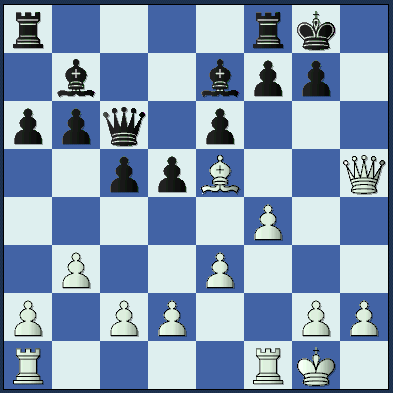
Em. Lasker - J. Bauer
                      |
|
|
One of the truly great contests and also a very original game. (The FIRST example that we know of ... of this type of sacrifice.)
"This game contains one of the beautiful combinations of the young Lasker, which created a blueprint ... " - GM Garry Kasparov.
"THE classic game of the genre." - Irving Chernev.
"Der Internationale Schachkongress zu Amsterdam." (1889) (- Schweizerische Schachzeitung.)
Click HERE to see a detailed explanation of the symbols that I use.
1.f4!?, {Diagram?}
The Bird's Opening.
This is a little
unusual for Lasker.
(In fact, this is the
only recorded usage of this move
by Dr. E. Lasker in serious match or
tournament play!)
He usually would open 1.e4, during the early part of his career.
[ A more normal an opening would
be: 1.e4, {Diagram?}
with a Ruy Lopez to follow.
(See: Em. Lasker -
J.R. Capablanca; St. Petersburg, RUS; 1914.)
Or even the move 1.d4,
{Diagram?} with a fairly routine QP game.
(See: E. Lasker - H.N. Pillsbury; Paris, FRA; 1900.) ].
1...d5;
This is the Classical response to
this opening. It controls the center,
gains space, and releases several
pieces.
Yet I have a concern that a reversed Dutch - with an extra tempo - would be good for White.
[ Black could play: 1...g6!?, {Diagram?} with a good game.
Or he could try: 1...Nf6;
{Diagram?}
and keep his options open.
(GM A. Soltis once played this way
against me one year in Bermuda.).
Or even 1...e5;
('!?') {Diagram?}
which is the "From's Gambit."
Now the sharpest line is:
2.fxe5
d6; 3.exd6
Bxd6; 4.Nf3
g5; 5.d4!
g4!?;
6.Ng5!, {"initiative"} {Diagram?}
with very wild play. (6.Ne5!?,
"=")
With the moves: 1...c5!?;
and now 2.e4!?, {Diagram?}
we have a transposition
into the
Sicilian Defense. ("Grand Prix Attack.")
One book I have recommends that
Black play: 1...b6;
"~" {Diagram?}
in this position. ].
2.e3!?, (Maybe - '!')
Lasker chooses the most flexible
move.
I prefer Nf3 here, but Lasker probably prefers to wait on this move, mainly to avoid the possible pin. (...Bg4)
***
[ A
modern 'book' line would be:
2.Nf3
g6; {Diagram?} Maybe the
best approach, according
to contemporary opening manuals.
***
( One book gives
the continuation: 2...Nf6; 3.e3
c5; 4.b3
Nc6; 5.Bb5!
Bd7; 6.Bb2
e6; 7.0-0
Be7;
This position could have arisen
from 1.b3, as well as 1.f4. 8.d3
0-0; {Diagram?}
The end
of the column. 9.Bxc6
Bxc6; 10.Ne5
Rc8; 11.Nd2
Nd7!?; 12.Qg4!
Nxe5; 13.Bxe5
Bf6;
14.Rf3
Bxe5!?; Apparently theory considers this
to be best for Black.
( Inferior for Black is: 14...Qe7!?; 15.Raf1
a5; 16.Rg3
Bxe5?!; 17.fxe5
f5?!; 18.exf6
Rxf6;
19.Qxg7+!, ("+/")
R. Fischer - H. Hecking; Palma de Mallorca Interzonal,
ESP/1970.
Note: According to the book:
"The Games of Robert J. Fischer,"
(edited) by R. Wade
& K. O'Connell, (page # 409); this game actually
began with the move, 1.b3.
[This
is common for this opening. Many
of the SAME positions (by
transposition), can
be reached
with the move order 1.b3, OR
1.Nf3 as well!] ).
15.fxe5
Qc7; 16.Qh5
h6!?;
17.Raf1
g6!?; 18.Qxh6
Qxe5;
19.Rf6!, "+/" (Maybe
only "+/=")
{Diagram?} White is clearly better.
- GM Nick de Firmian.
GM
Aaron Nimzovich - GM Rudolf Spielmann; New York, 1927.
[ See
MCO-14; page # 719,
column # 1, and also note # (c.). ]
)
***
(Returning to our stem {main analysis} line.)
3.g3
Bg7; {Diagram?} I like this best.
(MCO gives the move: 3...c5!?;
"~" in this position.)
4.Bg2
Nf6; 5.0-0
0-0; {Diagram?}
Play seems to resemble a
sort of reversed Leningrad
Dutch variation.
6.d3
c5; 7.c3!?
Nc6; 8.Na3!?
Rb8; "~" {Diagram?}
with a strange position.
(Approximately equal? "=").
V. Palermo - GM M. Najdorf;
Buenos Aries/CA/USA/1973.
(0-1, 40) ].
***
2...Nf6;
This development is both simple
and quite good.
3.b3!?,
An extremely hyper-modern move,
anticipating the revolution ... ... ... led by
Nimzovich by more than 30 years!
This is a very subtle move. This is not only just a fianchetto, White continues to avoid Nf3 because of the pin on g4.
"Not the most precise continuation," says the great writer, Fred Reinfeld. (But this is not clear.)
[ White could try: 3.c4!?, {Diagram?} with an interesting game.
Also 3.Nf3!? Bg4; ("=") {Diagram?} is probably equal. ].
3...e6!?;
According to principle, there is
nothing wrong with this. Yet now
Black's QB has been shut in, and
he will find it difficult to get into play.
[ The best line for Black seems to
be: >= 3...Bg4!;
4.Be2
Bxe2; 5.Qxe2!
e6!;
6.Nf3, {Diagram?}
This is the simplest, and probably
the best here.
(Or White could try the continuation: 6.Qb5+!?
Nc6; 7.Qxb7
Nb4; when Black has
"comp.")
6...c5!; 7.0-0
Nc6; "="
{Diagram?} and the position is very level. - LM A.J. Goldsby I
Fred Reinfeld and Ruben Fine
states that Black should play
the move: 3...d4!?;
"~" {Diagram?}
but the consequences of this
move are not really all that clear. ].
4.Bb2
Be7;
Simple and plain development. (Black guards f6 and prepares 0-0.)
[ Maybe much better was:
>= 4...Nbd7!;
5.Nf3
c6; 6.Nc3
Bd6; 7.Be2
0-0;
8.0-0
Re8 ].
5.Bd3!?,
This is OK, but I would have
expected Nf3. (No big deal,
as White plays this on the
very next move.)
"Clearly revealing his intention of obtaining a King-side attack," says Reinfeld and Fine.
[ White
could also try: 5.Nf3
0-0; "="
or 5.Be2!?
0-0; "=" {Diagram?}
with a fairly equal game. ].
5...b6!?;
Black prepares to place his Bishop
on the long diagonal, but I think
maybe 0-0 was a little better here.
[ Black
could have played: 5...0-0!?;
"=" {Diagram?}
or even 5...Nbd7!?;
"~" {Diagram?} with a fair game. ].
6.Nf3
Bb7!?;
This is normally a great place to
put this piece, but here the fianchetto
behind the pawn lacks punch.
***
( But I would be negligent if I did
not point out this was an extremely
common approach
at that time.
See for example, the following games:
H.N. Pillsbury -
S. Tarrasch; Hastings International Chess Tourn.
Hastings, ENG; 1895.
Or J. Zukertort -
J. Blackburne; London International Chess Tourn.
London, ENG; 1883.
Both of
these games can be found - deeply annotated - on my "Best
Games" Page.
)
***
[ I would be tempted to try the
move: 6...Ba6!; {Diagram?}
in this position.
(I
am quite sure Nimzovich would have greatly approved of this move.)
Black can also play: 6...c5; {Diagram?} with a fair game here.
And even 6...0-0; {Diagram?} is good here. ].
7.Nc3
Nbd7; 8.0-0
0-0; 9.Ne2, ('!')
Lasker begins deftly transferring
his pieces to the King-side.
(For the attack.)
This move also clears the diagonal of White's QB on the b2-square.
[ White
could try: ].
9...c5!?;
Putting pressure on the center, and
grabbing some much-needed space
on the Queenside.
But it might have been more prudent to play ...Nc5; first.
"Routine, mechanical, unimaginative." - Irving Chernev.
[ Best was: >=
9...Nc5!; "=" {Diagram?}
snaring one of the first player's
very dangerous
Bishops. ('Deutsche Schachzeitung.') ].
10.Ng3
Qc7; 11.Ne5
Nxe5!?;
Black begins an immediate
liquidation.
[ I prefer: >= 11...Ne4!; "~" {Diagram?} with a close game. {A.J.G.}
2 well-known writers advise that Black play: 11...g6!?; - Reinfeld & Fine. ].
12.Bxe5
Qc6;
Black forms a very dangerous
battery against the White King.
This move is nearly forced.
Most analysis engines still call this position pretty much equal.
[ Much worse for Black is: 12...Bd6?; 13.Bxf6, ("+/") White is clearly better. ].
13.Qe2,
"An all-round move."
- Irving Chernev.
He goes on to point out all that
this one move accomplishes:
It develops, unites the Rooks,
guards g2, threatens Bb5 - trapping
Black's Queen, (if he should try
to play ...Rac8?); and
also it
discourages Black from playing
the pawn advance, ...c4.
He (Chernev) goes on to comment:
"It is remarkable how much great
players can get out
of their pieces
with just one little move!" - Irving Chernev.
[ 13.a4!?, "=" ].
13...a6!?;
Black wished to prevent White from
playing the move, Bb5. Black also
probably intended to
follow up with
...b5; with a Q-side initiative.
(And maybe threaten ...c4; trapping
White's
Bishop on d3.).
While this was labeled a mistake by
some, (Mason, Reinfeld, etc.);
it looks to be a fairly
reasonable
move.
.
Black has played very routinely, and
yes ... maybe even passively.
Yet
hindsight is always 20-20!!
'?' - F. Reinfeld
& GM R. Fine.
(But I think this is overly harsh,
Black already has difficulties. And he
could not have possibly
guessed what was in
store for him here!)
Kasparov remarks that after a tame opening by Black, White is ready to unleash the final storm.
[ Probably best is: 13...Rfd8;
{Diagram?}
with a good game for Black.
(This prepares ...Nd7; and Nf8.) Now 14.Bb5
Qc8; 15.Nh5,
("+/=") {Diagram?}
White might
be a little better, but
there is no forced win here for
the first player. {A.J.G.}
(White does have a nice initiative, however.)
Supposedly better is:
13...Nd7!?;
"~" - Reinfeld & Fine.
(But
White may have a winning sack
on the h7-square.).
Definitely not:
13...Rac8??; 14.Bb5,
"+/-" {Diagram?}
and White is winning the
Black Queen.
- Irving Chernev. ].
White to move in this position.
What move would you play here?
14.Nh5!, {Diagram?}
An accurate move and the
beginning of a really very
exceptional combination!
"After this, there is no saving move." - Irving Chernev.
[ 14.Qf3!? Rfd8; "=" {Diagram?} and the position is about level. ].
14...Nxh5[];
{Box.}
This seems forced.
(It is totally and completely forced, despite what a few famous
authors MISTAKENLY have
written about this game.)
The alternatives are clearly
worse!!
(See just below.)
[ Variation # 1.)
14...Ne8!?;
15.Bxg7!
Nxg7; {Diagram?} This seems forced.
(Worse is: 15...c4; 16.Bd4
f5; 17.bxc4,
{"+/" maybe "+/-"} and Black's position is
riddled with holes.) 16.Qg4,
"+/-" {Diagram?}
and White's attack is decisive.
- Fred Reinfeld and
Ruben Fine.
Variation # 2.)
14...h6?!;
15.Bxf6
Bxf6; 16.Nxf6+
gxf6; 17.Qg4+
Kh8;
18.Qh4
Kg7; 19.Rf3
Rfd8; 20.Rg3+
Kf8; 21.Qxf6,
"+/-" {Diagram?}
and once again, White is winning.
- Fred Reinfeld and Ruben Fine.
Variation # 3.)
14...d4!?; 15.Bxf6
Bxf6; 16.Nxf6+!, {Diagram?}
This seems to be an improvement
over previous analysis.
( The older line was: 16.Qg4!?
Kh8; {Diagram?}
This looks forced.
(16...e5!?; 17.Be4!,
"+/-") 17.Rf3
Rg8; {Diagram?} This looks forced as well.
(17...dxe3; 18.Nxf6
gxf6; 19.Qh4,
"+/-" and White should win.)
18.Rh3!, ('!!') {Diagram?}
This is yet another improvement - over older, published analysis.
(The older published win was: 18.Bxh7!?
Rgd8; 19.Qh3
Be7;
20.Be4!, "+/-" {Diagram?}
- Fred Reinfeld & GM Ruben Fine. )
(We return to the analysis of the older analysis line.)
18...Be7; ('!?') 19.Nf6!
h6; 20.Be4!
Qc7; 21.Bxb7
Qxb7; 22.Qg5
Bxf6; 23.Rxh6+,
23...gxh6; 24.Qxh6#. {Diagram?}
A very pretty mate.
- LM A.J. Goldsby I ).
(Now we return to the main analysis line of variation # 3. The next few
moves are all forced.
Unfortunately
the rest of this variation is NOT java-script re-playable!!
Technical glitch.)
16...gxf6; (Obviously, Black must recapture)
17.exd4!, {Diagram?} This looks like it is forced.
(White can also play 17.Rf3!? or even 17.Bxh7+!?;
both of which are better for White.)
17...Kh8; {Diagram?} This also seems
forced.
(Worse for Black is: 17...cxd4?!; 18.Rf3!, and
White is nearly winning.)
18.dxc5 Qxc5+; 19.Rf2 Rad8; 20.Re1,
("+/") {Diagram?}
and
White is clearly much better here. - LM A.J. Goldsby I
Variation # 4.)
14...Kh8; 15.Nxf6!, {Diagram?}
Probably the most accurate.
(And a big improvement over Chernev's
analysis from this position.)
(15.Nxg7
Kxg7; 16.Qg4+
Kh8; 17.Qg5
Rg8; 18.Bxf6+
Bxf6; 19.Qxf6+
Rg7;
20.Rf3, "+/" - Irving Chernev.)
15...d4, {Diagram?}
Ugh, this seems forced.
(Simply horrible is: 15...gxf6??; 16.Qh5!,
"+/-" {Diagram?}
& White quickly mates.)
16.Nxh7
Rfd8; 17.Ng5,
"+/-" {Diagram?}
Black is toast.
Variation # 5.)
14...c4!?; 15.Nxf6+!
gxf6; 16.Bxh7+!
Kh8; {Diagram?}
This might be forced.
(16...Kxh7?!; 17.Qh5+
Kg8; 18.Qg4+
Kh7; 19.Rf3,
"+/-"
{Diagram?} ... "and mates." -
Chernev. Or Black can also play ...Kg7; then the following
moves are all forced - according to the
computer. 16...Kg7; 17.Qg4+!
Kh8; {Diagram?}
Or if ...Kxh7; then White plays
Rf3, finis. 18.Rf3
d4; 19.Bf5!
Qxf3; 20.Qh4+
Qh5;
21.Qxh5+
Kg7; 22.Qh7#
). 17.Qh5,
"+/-" {Diagram?}
White is winning easily,
the computer says it is mate in 6 or 7 moves.
- LM A.J. Goldsby I ].
***
15.Bxh7+!
White finds a very vigorous -
and even shocking - reply.
"A brilliant zwischenzug." - Irving Chernev.
[ Black probably expected:
15.Qxh5
f5; 16.Rf3,
"+/=" {Diagram?}
and perhaps the second player
will be able to mount a successful
defense. ].
15...Kxh7[];
This is absolutely forced here.
[ Even worse was: 15...Kh8??;
16.Qxh5, "+/-" {Diagram?}
with
a won game for White. ].
16.Qxh5+
Kg8; {Diagram,
just below.}
Black has defended the best he can, especially for the last few
moves.
|
|
(White to play, what move would you play here - in this position?)
17.Bxg7!!,
(Maybe - '!!!')
When I saw this game as a very
young lad: this move could be
adequately described as a
thunder-
bolt from the blue!!! (I was literally
shocked by this shot.)
White logically removes all of the
pawns in front of Black's King.
But this is a super-brilliancy.
(And the first time - that we know
of - that any player had sacrificed
two Bishops in this manner.)
NOTE:
Every other player ... who has
ever sacrificed two Bishops in this
manner is only - no
matter how
brilliant the game might be - is really
just using 'technique.' ONLY this
game can
claim to be original!!!
[ 17.Rf3!? f6!; "/+" {Diagram?} and Black is clearly better. ].
17...Kxg7[];
Once again, Black has no choice.
[
Worse for Black is:
17...f5!?; (Maybe
- '?!') 18.Be5!, {Diagram?}
This is probably the best.
( Also good is: 18.Bb2!?,
"+/" Or 18.Rf3!?,
"+/=" - Chernev. )
18...Rf6[]; (forced)
( 18...Rfd8??; 19.Qg6+
Kf8; 20.Bg7+
Kg8; 21.Bh6+
Kh8; 22.Qg7#.
Or 18...Rf7??; 19.Qh8#
)
And
now 19.Rf3!,
"+/-" {Diagram?} and White has a winning attack.
Very bad for the 2nd player is: 17...Rfd8??; 18.Qh8# Or even 17...d4??; 18.Qh8#. ].
18.Qg4+
Kh7[];
Once again poor Black plays
the only move he can.
[ Simply terrible was: 18...Kf6??; 19.Qg5# Ouch! ].
19.Rf3
e5[];
And ... this too ... is forced.
(Black has to be able to block the Rook check with his Queen ... or be mated.)
[ MUCH
worse for Black were the continuations:
19...d4??;
20.Rh3+
Bh4; 21.Rxh4#.
Or 19...Rg8??;
20.Rh3+
Bh4; 21.Rxh4#.
Also bad was: 19...Bg5??;
20.Qxg5
e5; 21.Rh3+
Qh6; 22.Rxh6#. ('!')
].
The next few moves are all forced.
20.Rh3+
Qh6;
This 'split attack' (fork) of Black's
two Bishops wins more material
for Lasker.
(And he still retains a
fairly strong attack.)
'!' - Irving Chernev.
[ 22.fxe5!?, "+/=" ].
22...Bf6!?;
This is probably Black's best
chance, in this position.
[ 22...Rab8!? ].
23.Qxb7
Kg7;
Another defensive move for
Black - that is probably forced.
[ 23...exf4?!;
24.Qxb6
Kg7; 25.Rf1,
"+/-" {Diagram?}
- Fred Reinfeld and
GM R. Fine. ].
24.Rf1
Rab8; 25.Qd7!,
"Rightly disdaining the Q-side
Pawns, in favor of the attack."
- Reinfeld and Fine.
(Chernev says pretty much
the same thing here. And
several annotators gave
this
move an exclam as well.)
[ Also winning were: 25.Qxd5!?, "+/-" {Diagram?} with a won position for White.
Or 25.Qxa6!?, "+/-" {Diagram?} again - winning for White. ].
25...Rfd8;
This creates a much-needed
flight square on f8 for the Black
Monarch. (And it is virtually forced.)
[ Much inferior was: 25...exf4?;
26.Qg4+
Kh8; 27.Rxf4
Bg7; 28.Qg5
Rb7;
29.Qxd5,
"+/-" {Diagram?} - Chernev. ].
26.Qg4+
Kf8;
(Looks to be forced.)
[ Not 27...Bxe5?; 28.Qh5, "+/-" {Diagram?} (White wins the Bishop.) ].
28.e6, (Nearly - '!')
"This settles matters."
- Reinfeld and Fine.
[ 28.h4!? ].
28...Rb7;
This is forced says Chernev.
[ Worse was: 28...f6?; 29.e7+, {Diagram?} ("+/-") and White wins. ].
29.Qg6
f6; 30.Rxf6+!,
An alert sacrifice that will target
the unprotected Black Rook on
the b7-square.
"The final coup," says I. Chernev.
[ 30.g4!?
].
30...Bxf6;
This is forced as well.
[ Inferior is: 31...Kg8?!; 32.Qxd8+, ("+/-") ].
32.Qh8+
Ke7; 33.Qg7+,
"Ain't no lie ... BYE! BYE! BYE!"
- 'N-Sync.'
Chernev gives ... "And Black Resigns."
(Several sources - incorrectly! -
give the game as ending here.
MANY books I have on Lasker
verify that this game did NOT
end here!! Probably what has
happened is that many writers
and
columnists for newspapers -
seeing that White has an easily
won game - arbitrarily cut off
the
game at this point. To some
people, the game is less beautiful
{somehow} because Black did not
resign this position. {In the old days,
some newspapers and magazines
felt free to stop a game at
a certain
place, and comment: ... and "Party 'A'
won." Usually space was a concern.
This practice
has led to disputes over
the length of a particular contest or
to MANY games being artificially
shortened.}
To me, when the game
did or did not end is meaningless.
The simple, historical fact
is that
this contest went 38 moves.
This in no manner detracts from Lasker's accomplishment at all.)
[ By playing 33.Qh7+!?, instead - White also wins. ("+/-") ].
33...Kxe6; 34.Qxb7, "+/-" 34...Rd6; 35.Qxa6 d4; 36.exd4 cxd4; 37.h4 d3!?;
38.Qxd3!, {Diagram?}
Black Resigns.
(If Black takes White's Queen, the
win in the K+P endgame is boringly
simple -
"plus five" in pawns.).
A game that was unmatched in its
depth or method of conception -
at least up to that
period of time.
<< A leading critic said at the time,
"From his conduct of this game, one
sees something of the
extraordinary
talent of the rising generation of
chess players." >>
(Source = Chernev.)
"One of the most brilliant games of that whole era." - Irving Chernev.
***
Easily one of the best games of the whole of the 19th Century!!! - LM A.J. Goldsby I
***
---> The code for this page was originally generated with ChessBase 8.0. (Although I have made MANY changes!!)
*********************************************************************************
Bibliography:
(I have close to 2 dozen books about
Lasker or that were written by him.
The following that are listed are the
most important sources that I used
for annotating this game.)
"The
Collected Games of ...
Emmanuel Lasker," by Ken Whyld.
(Copyright, 1998.) {With many credits to Hannak's work.)
"Dr.
Lasker's Chess Career" (Games from 1880's to 1914.)
By Fred Reinfeld &
GM Ruben Fine.
(Copyright © 1935.)
"The
Golden Dozen." (The twelve greatest chess players
of all time.) By Irving Chernev.
(Copyright © 1976, Irving Chernev - and also ©
Oxford University
Press.)
ChessBase annotations of this game. (- GM Garry Kasparov, ... and other GM's as well.)
Copyright (c) A.J. Goldsby I.
Copyright (©) A.J. Goldsby, 2002, 2003, 2004.
All rights reserved.
1 - 0
To
see a MODERN example of the TWO-BISHOP sacrifice ... see the
game:
Garry
Kasparov - Lajos Portisch; Niksic, (YUG); 1983.
If you have not already noticed, this page is VERY different than most of my other creations.
This
is because this game is a milestone for me ... it marks the completion of a
project I had
in mind when I first created my web page(s). If you want to see what I mean by
this, then
please click HERE. This
game marks a major completion of a goal. Therefore, I felt this
web page - because it IS a great
game .... AND represents something special to me - that it
should definitely look and feel a
little different than many of my other web pages. ENJOY!!!
Game
first posted on my web-site: Tuesday / September 10th, 2002.
(Page last updated on: Monday - September 01st, 2003.)
***
I
have quite a history with this game. I remember a gentleman at the Pensacola
Chess Club
virtually forcing me to analyze games with him every week back in the 1960's.
(In those days,
I would much rather play - than look at a pretty game. He had many books
of chess. He had a
book by GM Ruben Fine, and also the "Golden
Treasury Of Chess," by I.A.
Horowitz.
And! ... many others!!!) But today I know I
owe this person, (I don't even remember his name!);
a
tremendous debt - he instilled in me a deep appreciation for the history of the
game. He also
helped me understand very early there were many great games out there and that
by subjecting
these games to a deep analysis, I would definitely be able to improve.
***
This
is the original document I developed in ChessBase.
I have NOT
shortened
it for publication here! If you would like a copy of this game, (the actual ChessBase file);
to study on your
own computer, please contact me.
Click HERE to go to, (or to return!) to my big chess web site. ("Best Games" page.)
Click HERE to go to (or return to) my Yahoo/GeoCities chess web site. (Home Page.)
***
Click
HERE
to go (or return to) my web page on Lasker.
*** Click
HERE
to go to (or return) to my (Geo-Cities) "Annotated Games" Page.
(#2.)
Click HERE
to go to
(or return to) my 'Downloads' page about "Recent GM Games."
Click HERE
to go to my (Angel-Fire) "Downloads" Home Page. Click
HERE to go to (or
return) to my Downloads "Annotated Games" page. Click
HERE
to go to (or return to) my (GeoCities) "Best Short
Games" page.
(Or click the "back" button on your browser.)
Copyright
(©) A.J. Goldsby, 1985 - 2012.
Copyright (©) A.J. Goldsby, 2013. All rights reserved.