|
|
Click HERE to see an explanation of the symbols I use.
This
is a fantastic game of chess, and a true masterpiece by the (future)
GM L. Kavalek. It is also a very unusual and intricate tactical sequence.
It is also a fantastic game to illustrate the power of the foot soldiers.
GM
A. Soltis ranks this game as the SEVENTH BEST (#7) game ... ... ... ... ...
of the whole of the 20th Century!
***
While
I will not argue that this is not a great game, I contend with the high ranking
given it by GM Andy Soltis. The following are my reasons:
Black
wins this game, and does so rather quickly.
(I was taught as a youngster this is NOT good chess!!)
Black
actually plays a line that most books consider dangerous ...
and White
fails to meet it properly.
White's
handling of the opening, - especially by modern opening
standards - is
very risky and poor.
Black
gives up material in this game, and it is not entirely clear if
this
sacrifice
is 100% sound.
It is not entirely clear that Black even played the very best line.
White's
makes many errors. The most noticeable is 12.Kd1?,
which
GM Huebner has referred to as a simple blunder.
***
But
my objections are ONLY with the idea that this game
belongs in the list of,
"The Top Ten" overall, or in the ten best games of the 20th century.
This
IS a wonderful game of chess and certainly perhaps one of the best games
Kavalek ever played. It is also a game that deserves to be much better known
than it is!!
GM
E. Gufeld is both a colorful player and writer known for his attacking chess and
his aggressive style. (Gufeld was also a successful coach in the former
USSR.)
GM
L. Kavalek was one of the best players in Czechoslovakia ... before emigrating
to the U.S. (He later won {clear} first place in the U.S. Championship in 1978.)
THE
GAME "In an extremely original encounter ... " - GM John
Emms.
(The fine GM and excellent writer goes on to give an outstanding verbal description
of
this game. But I don't to give away too much at the beginning ... and perhaps
spoil the
joy of discovery for you!!) {A.J.G.}
(This
is also the finest annotation job you will see anywhere on this game. I give
just
about every significant variation given by GM Andy Soltis. I do NOT
give every line
given by the "Mammoth" book, {See item #2 of the Bibliography
at the end of this
game.}; but their analysis strikes me as a tad artificial, and in
many cases, just
plain bad! You will also find dozens of lines that originate with me and
no one else!!!)
There
are almost no diagrams, so you will definitely need a chess board for this one!
---> My goal was to create a very thorough analysis of this game,
maybe the best
that had ever been done on this game. Hopefully, even a Master would enjoy
these
annotations. (And find food for thought.) But my primary emphasis was to
create a
web page that even the most basic beginning-chess-player should be able to
follow...
and perhaps even learn something! Please drop
me a line if you enjoyed this game!
The game starts off as a Ruy Lopez.
(My annotations here are primarily based on those of GM A. Soltis's.)
1.e4
e5; 2.Nf3 Nc6; 3.Bb5 Bc5!?; {Diagram?}
MCO calls this line ... "The Classical (Cordel) Defense."
While
some sources consider this a little adventurous, it is certainly a sound move
by the opening principles I teach my students.
# 1.) Control the center.
# 2.) Rapidly develop your pieces.
# 3.) Protect your King and castle early.
(This also means developing your pieces - with the idea of getting out the
pieces that
will enable you to castle first - before the rest of your forces
are brought out.)
# 4.) Maintain the material balance. (This is the same as the
Nimzovichian concept
of "square control." I.e., if my opponent controls a key central
square, I should reciprocate.)
After
many years of being considered almost dubious by theory, this classical defense
to the Ruy Lopez is making a comeback. (But many GM's prefer to play ...a6;
before
bringing out the Black dark-squared Bishop.)
[ The main line of the Ruy is: 3...a6!; 4.Ba4 Nf6; 5.0-0 Be7;
(5...Nxe4!?)
6.Re1 b5; 7.Bb3 d6;
8.c3 0-0; 9.h3, "+/=" {Diagram?} and White keeps
a small edge. [ See MCO-14;
pages # 40 through page # 93. ] ].
4.c3,
('!') {Diagram?}
The main line. White prepares an immediate d2-d4, which will also gain
a tempo off the prelate on the c5-square.
[ 4.0-0!? ]
4...f5!?;
{Diagram?}
This is Black's most energetic option here.
(Most books consider this move the main line here.)
This
is actually a line known as: "The Cordel Gambit."
(Some books refer to it as: "The Classical Defence's Gambit.")
To
me this line is simply speculative, and should end in a solid advantage for
White ... with correct play.
*****
[ White gains an advantage after: 4...Nf6; 5.0-0
0-0; 6.d4 Bb6;
7.Re1,
"+/=" {Diagram?} and White is a little better.
(But this
line is MUCH more reliable, in terms of modern opening theory, than
what happened
in the game.)
This position has occurred at the Master level literally dozens of times.
(Over 200 different times, according to ChessBase's
on-line database.)
One of the most famous examples is the encounter:
GM W. Unzicker - GM R.J. Fischer;
FIDE Olympiad, (Men's Finals,
"A"); Leipzig; Germany, 1962.
An encounter between 2 GM's:
GM Alex Shabalov - GM Ben
Finegold;
Foxwoods Open, Connecticut, USA, 2002.
The most recent example I could find was:
P. Folk - P. Van Hoolandt;
XXVI Valdostano Open.
***
Black can also play: 4...Qf6!?; 5.0-0 Nge7;
6.b4, "+/="
{Diagram?}
when White has a very small, yet clear,
advantage here.
By searching the database, I found over a dozen examples of thus position at
the Master or GM level.
A few examples:
M. Yudovich - A. Tolush;
U.S.S.R. Championships, Leningrad, RUS; 1939.
A. Karpov - S. Mariotti;
Portoroz/Ljublana, 1975.
J. Hjartarsson - Karlsson;
Icelandanic Championship, Reykjavik, ICE; 1979.
White won the overwhelming majority of these games, yet the computer says the
position is almost equal. I prefer an
evaluation of: "White is slightly better," based
on an edge in space and a slightly more
organized-looking position. {A.J.G.} ].
*****
5.d4!,
{Diagram?} (big Pawn-center)
The most consistent and energetic option for White. And most opening books
consider this to be the main line here.
"For
years this move had been widely regarded as a virtual refutation
of Black's speculative opening." - GM Andy Soltis.
Soltis
does not give this move an exclam, but several of my reference books on
the Ruy Lopez do.
[ White could play the slower: 5.d3!? with a good game.
White could also play: 5.Bxc6!?
dxc6; 6.Nxe5, "+/=" {Diagram?}
and White has a slight edge.
].
5...fxe4;
{Box?} {Diagram?}
This is virtually forced for Black.
[ Much worse for the 2nd player is: 5...Bb6?!; 6.Bg5! Nge7; 7.Bxc6
dxc6;
8.Nxe5, "+/" {Diagram?}
and White is clearly better.
Interesting was: 5...exd4!?; 6.cxd4!, {Diagram?}
(6.e5!? dxc3; 7.Nxc3, "~")
6...Bb4+; 7.Nc3 fxe4;
8.Bg5! Be7; 9.Nxe4, "~" {Diagram?}
Maybe White is a little better in
this position. ("+/=")
(Line by - GM Andy Soltis.) ].
6.Ng5!?,
{Diagram?}
This move is bold ... even a little foolhardy ... according to most modern
opening books.
"White tries for a quick knock-out." - GM Andy Soltis.
*****
[ Much better is: 6.dxc5 exf3; 7.Qxf3, "+/=" {Diagram?} with a small, but
solid
advantage for White. - GM Andy Soltis.
Or the main line, according to MCO, is the following continuation:
>/= 6.Bxc6,
('!') {Diagram?}
This is also
a much better line than what was actually
played in this game. 6...dxc6;
7.Nfd2 Bd6!?; 8.dxe5 e3!?; 9.fxe3 Bc5; 10.0-0,
10...Bxe3+; {Diagram?} The end of
the column. 11.Kh1 Qe7; 12.Qf3 Bg5;
13.b3,
13...Nh6;
14.Ba3 Qe6; 15.Ne4,
"+/=" {Diagram?}
White is clearly (a little) better here.
Mikhailov - Sapundzhiev;
Correspondence, 1992.
[ See MCO-14; page # 43, column # 1, & also note
(f.). ].
A bland alternative is: 6.Nxe5!? Nxe5; 7.Qh5+!? Ng6!; 8.dxc5 Nf6;
9.Qg5,
9...c6!; {Diagram?} According to 2 different books on the Ruy Lopez I have,
White
gets zero advantage from this particular sub-variation.
10.Be2 d5; 11.cxd6 Qxd6;
12.Be3 Be6; 13.Na3 Qc7; 14.Nc2 0-0;
15.Nd4, "=" {Diagram?}
The players
agreed to a draw. (GM N. de Firmian thinks White might have
a {very} small edge
in the final position here.)
S. Tatai - Rantanen;
Thessaloniki (FIDE) Olympiad, Thessaloniki, GRE; 1984.
[ See MCO-14; page # 43, column # 1, and
note # (b.). ] ].
*****
6...Bb6!; {Diagram?}
Black has several different moves
he might play in this position, but this is the only
really effective line for
Black here.
'!' - GM Andrew Soltis.
[ Not as good for Black is: 6...Be7!?;
7.dxe5 Bxg5; 8.Qh5+ g6; 9.Qxg5,
9...Qxg5; 10.Bxg5 Nxe5; 11.Bf4 Nf7;
12.Bxc7, "+/=" {Diagram?}
and White is just a little bit better here.
].
7.d5!?,
{Diagram?}
White tries to gain a tempo off of Black's Knight on c6.
But
this move is a time waster, and definitely (at least) a little bit
risky.
(According to modern opening theory.)
Nonetheless, had White followed this move up
correctly, he might still have
obtained a small, yet clear advantage, out of the
opening.
[ An improvement was: 7.0-0! d5; 8.dxe5 e3!; 9.Nf3 exf2+;
10.Kh1 Nge7;
11.Bg5 0-0; "~" {Diagram?} with good play for both parties at this
point. (Equal?)
A. Mirchichi - S. Mariotti;
Venice, 1971. ].
7...e3!;
(blocks the diagonal) {Diagram?}
Black prepares to sacrifice a great amount of material.
'!' - GM Andrew Soltis.
This was probably prepared by Kavalek - and the
Prague Chess Club -
well in advance of this game.
[ "White was hypnotized by the
memory of a Soviet miniature that ended
7...Nce7??; 8.Ne6!, and Black
resigned." - GM Andrew Soltis. ].
8.Ne4!?, {Diagram?}
This might
now be forced.
(At least according to several different writers, including
Soltis.)
NONE!
of the writers ... {GM J. Nunn, GM R. Byrne, (who once did this
game for
his newspaper column), GM A. Soltis, and many (!!) others} ... make any
comment
here at all.
But did EVERYONE (!!!) overlook something here?
(I was
riding the bus one day, and looking at this game on a magnetic set. I had a
flash of inspiration. "Why not 8.f4?," I thought.)
*****
[ GM A. Soltis
gives the line: 8.dxc6!? bxc6?!; {Diagram?}
This is not really any good.
(Much
better was: >= 8...exf2+!; 9.Kf1 bxc6; 10.Qh5+ g6; 11.Qe2,
"~" {D?}
and the position is unclear. {A.J.G.})
9.Bxe3?!, {Diagram?} Another bad choice of moves by GM A. Soltis.
(A VERY big improvement
is: >= 9.f4! Qf6; 10.Bf1!, {D?}
This keeps the path to f3 open for the White
Queen.
(Or 10.Bd3!? exf4; 11.Nf3
Ne7; "~")
10...Qxf4; 11.Nh3!, "+/=" {Diagram?} I don't think Black has enough
compensation for the material in this
position. {A.J.G.} (If Black loses
his e-pawn ... he will be in serious trouble.) )
9...Bxe3;
10.Ne4?, {Diagram?} This is very bad, Bxc6 was
virtually forced for White. (Ne6!? is probably also much better than this move.)
(Better was: >= 10.Bxc6[] Rb8!; "=/+" {Diagram?} Black only has a
small
advantage from this position. {A.J.G.} Also interesting is: 10.Ne6!?, "~")
10...Qh4!,
"=/+" {Diagram?} and states that: "Black has ample
compensation for the Knight." - GM Andy
Soltis.
I spent many analysis
sessions ... (about 10-15 total hours); with the aid
of several strong and
different analysis engines ... verifying the above
variations. - LM A.J. Goldsby
I
***
A GIANT improvement seems to be the line:
>/=
8.f4! Nb8; {Diagram?} This seems to be forced.
( A blunder is: 8...Nce7??; 9.Ne6!, "+/-" Black's Queen is smothered.
(And is lost to the White N.);
Also bad
for Black is: 8...Na5?; 9.b4, "+/" {Diagram?}
and the Knight is lost.
Maybe another playable idea here is: 8...Qf6!?; {Diagram?}
with
vast complications. ("+/=")
Maybe 8...exf4!?; ('?!') with wild play. )
9.Bxe3!!,
{Diagram?}
A nice tactic, and probably
the thing that everyone may have
overlooked here.
(Playable is: 9.Qh5+ g6; "~" with an unbalanced position.)
9...c6;
{Diagram?}
According
to several strong analysis engines, this move is ...
more-or-less best.
(Bad
for Black is: 9...Bxe3?!; ('?') 10.Ne6! Qf6; 11.Nxc7+ Kd8;
12.Nxa8, "+/" {Diagram?} when - according to several strong analysis
engines - White just about has a won game, from this position. {A.J.G.})
10.Bxb6! Qxb6;
11.Qh5+! g6; 12.Qe2, "+/=" {Diagram?}
No matter how you slice it,
ALL the computer programs agree that White
has a very large advantage in this
position!! (Maybe - "+/") ].
*****
8...Qh4!?;
{Diagram?}
This
looks good, several books even give it an exclam. Yet Soltis points out
that
Black has at least one very playable alternative.
[ According to GM Andy Soltis,
a very "promising alternative," is the following
continuation:
8...Nf6!?; 9.dxc6 dxc6; 10.Bd3 Nxe4; 11.Qh5+ Kf8; 12.Bxe4,
12...exf2+; 13.Ke2 Qf6!,
{"comp"} with a good game for Black.
(Variation by GM Andrew Soltis.) ].
9.Qf3
Nf6!?; (Is this best?) {Diagram?}
This is both a good and solid move choice for
Black. But GM Gufeld criticized this
move, and suggested instead that Black play
...Nge7; here.
[ Maybe actually better was: >= 9...Nge7!; 10.dxc6 bxc6;
11.g3 Qh6; 12.Be2,
12...exf2+; 13.Kf1 Qg6;
"comp" {Diagram?} ... "with great
compensation."
- GM Andrew Soltis. (Maybe "=/+")
(I believe this line
originated with GM E. Gufeld himself.
He gives this line in his book, "My
Life In Chess.") ].
10.Nxf6+ gxf6;
11.dxc6!?, {Diagram?}
White wins a piece ... but enters great complications.
(But I personally feel
this is both unnecessary and overly risky.)
[ Maybe better than the game was the
continuation: >= 11.Bxe3!, "~" {Diagram?}
(Maybe - "+/=") White is a tiny bit
better. ].
11...exf2+; {Diagram?}
White displaces his opponent's King -
a serious liability for White from this position.
12.Kd1?!,
(Probably
- '?') {Diagram?}
White runs away from all the open lines on the King-side.
(Actually a natural response.)
But!
.... ... ... ...
this is simply a TERRIBLE move ...
GM R.
Huebner referred to this as "a simple blunder."
GM A. Soltis (himself) even awards this move an entire question mark!!
'?' - GM Andy Soltis. '?' - GM John Nunn. '?!' - GM Robert Byrne.
"Faced with a difficult position, White makes the
wrong choice."
- GM John Emms.
[ GM Andy Soltis offers the following line -
which is definitely better than what
was played in the game: 12.Kf1[]
dxc6; ('!')
{Diagram?} This is best, Soltis
gives this move an exclamation point here.
(Not
12...bxc6?; 13.Be2 d5;
14.Be3, "+/" & White
is
better.) 13.Be2 Rg8; 14.Qh5+ Qxh5;
15.Bxh5+,
15...Ke7; 16.Nd2 Bf5;
"comp" and Black has excellent play and great
compensation for the material here. Several
programs even consider Black
to be at least a little better here.
("=/+") ].
12...dxc6!, (releasing the QB)
{Diagram?}
This is best, and
Soltis gives it an exclam here.
(Black threatens ...Bg4; just to get White's attention!)
'!' - GM Andy Soltis.
[ Maybe Gufeld expected:
12...bxc6; 13.g3, "+/" {Diagram?}
and the worm has turned. (White may even be
winning.) ].
13.Be2, {Diagram?}
This is pretty much forced.
[ Simply
awful for White is: 13.Bxc6+? bxc6; 14.Qxc6+ Kf7; 15.Qxa8??,
15...Bg4+; {Diagram?} and the first player loses his Queen - and has
a hopeless position.
("-/+") ].
13...Be6;
{Diagram?}
A marvelous conception ...
and one that is very rare for real chess ...
(as compared to an artificially
composed chess problem).
"Who would have thought a few moves ago that
Black would be willing to
exchange Queens?" - GM Andy Soltis.
(I am sure Gufeld saw all of this. He simply must have under-estimated the
amount
of play Black's Pawns will give the second player here.)
14.Qh5+
Qxh5; 15.Bxh5+ Ke7; 16.b3, (A very creative defense.)
{Diagram?}
"This creates a King haven at b2 and a good square for his Bishop at a3,
while
also preventing ...Bc4." - GM Andrew Soltis.
[ 16.Nd2!? ].
16...Bd5;
17.Ba3+ Ke6; 18.Bg4+!?, {Diagram?}
White decides to place
his Bishop on h3, but this strikes me as a tad artificial.
[ 18.Bf3!? ].
18...f5;
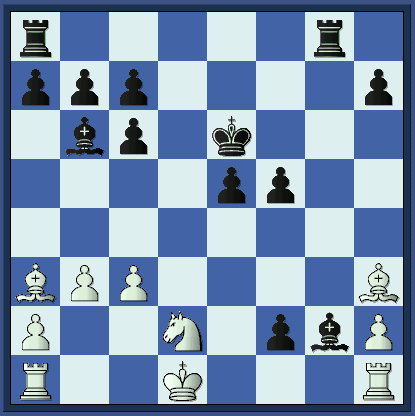
19.Bh3 Rhg8; 20.Nd2 Bxg2; {See the diagram, just
below.}
"Black has a
fourth pawn for his sacked piece ... but his initiative is winding down."
-
GM Andy Soltis.
(Position check: r5r1; ppp4p; 1bp1k3; 4pp2; 8; BPP4B; P2N1pbP; R2K3R)
*************************************************************************************************
While the first part of this game was
not played
perfectly, the final part of this contest
solidly places it in Caissa's ... "Hall Of Fame."
|
|
21.Bxg2 Rxg2;
22.Rf1!, {Diagram?}
Soltis
gives this an exclam. (White avoids a lot of nastiness.)
'!' - GM Andy Soltis.
[ Not 22.Ke2? f1Q+!; {Diagram?} and Black is winning.
(He regains the piece and keeps all
the extra Pawns.) ].
22...Rd8;
('!') {Diagram?}
Black's final piece is thrust into the fight.
23.Ke2,
(Take a look.)
{Diagram just below.}
Thus far White seems to be defending very well.
|
|
A few of my
(lower-rated) students, after just a quick and casual glance at
the position,
have assumed that White must be winning.
(They probably mainly just count pieces, White is a piece up.)
[ 23.Rb1?! Rd3; "-/+" ].
23...Rxd2+!!;
(What is up - with this move???) {Diagram?}
This fantastic move ... "elevates the game towards
immortality."
- GM A. Soltis.
'!' - GM Andy Soltis. '!!' - GM John Emms. '!!' - FM Graham Burgess.
Soltis only gives this move one exclam, but I am convinced it deserves two.
"My opponent had a moment of inspiration!" - GM E. Gufeld.
Black sacrifices MORE material simply to
dominate the dark squares ... and
to keep his pawns from being blockaded!!
[ Black could also win with the somewhat routine line of: 23...e4!?;
24.Rac1, {D?}
White does not have many good move choices here.
(24.Nc4 f4; 25.Nxb6
f3+;
26.Ke3 Kf5!!; "-/+"
{Diagram?} Black is winning. - GM Soltis.)
24...Rxh2;
"/+" (Maybe "-/+") {Diagram?}
and Black is easily much better
here - & probably winning. ].
24.Kxd2 e4;
{Diagram?}
"Black's
many threats are beginning to loom... " - GM John Emms.
25.Bf8!,
{Diagram?}
An active and creative move by Gufeld.
Soltis notes that White was
faced with a multitude of good plans for Black,
(...f5 - f4 - f3; and also e4-
e3+ - e2); and finds a way to activate a Bishop
that was shut almost completely
out of the game.
[ In the line of: 25.c4!? Bd4; 26.Rad1 Rxh2; This might be
best.
(Or 26...f4!?; 27.Kc2 Ke5; 28.Bc1
c5!; "=/+" - FM G. Burgess.)
27.Ke2 c5; 28.Bc1 Ke5; 29.Be3!? f4;
"/+" {Diagram?}
White is slowly getting smothered.
(Black is clearly much better here.) - LM
A.J. Goldsby I. ]
25...f4;
26.b4! Rg5!?; {Diagram?} '!' - GM
John Emms.
Black fights
to maintain his death-grip on the dark squares.
(Maybe an exclam?)
GM Emms
gives this move an exclam, but many hours of analysis leads
me to believe
Black's other moves may have been just as good.
(But it might be purely a matter of taste.)
[ Also good was: 26...Rxh2; "=/+" when Black is better. ("/+") ]
27.Bc5,
('?!') (Hmmm.) {Diagram?}
White wants to win the pawn on f2.
"This makes it easier for Black than 27.c4!" - GM Andy Soltis.
'?' - GM John Emms. '?' - FM Graham Burgess.
Personally I think it is a little late in the day to be criticizing White's
moves ...
no matter what the first players does, Black is probably much better!!
{A.J.G.}
(Also note that Soltis - who as
far as I am concerned, is in a class by himself -
gives this move no mark at
all!)
[ The best line is: >= 27.c4! e3+!; {Diagram?}
Definitely the best
move here.
( GM Andy Soltis offers the following line, but it contains
many flaws:
27...Be3+!?; 28.Kc2?! Rg2!?; 29.Bc5?! Bxc5; 30.bxc5
Kf5!?; "=/+"
and Black is better. (GM John Emms was the first to give this line,
so perhaps we should condemn him, and not Andy!) )
28.Ke2[] Rf5!;
29.c5 Rxf8; 30.cxb6 axb6!?; 31.Rfd1 Rg8!;
32.a3 Rg2;
33.h3 Ke5;
"/+" (Black is clearly much better, if not winning.)
{Diagram?}
Black's 3 connected-passed Pawns will carry the day. (Maybe
"-/+")
- LM A.J.
Goldsby I ].
27...Rxc5!;
(Maybe - '!!')
{Diagram?}
Black continues his
incredible sacrificial assault ... all to keep his passed pawns
alive and
mobile.
'!' - GM Andy Soltis. '!' - GM John Emms.
[ Black also holds the advantage after the
linear continuation:
27...Bxc5;
28.bxc5 e3+; 29.Ke2 Rxc5; 30.Rac1 Rb5!;
31.Rc2 Rg5!;
"/+" {Diagram?} and Black is clearly better.
(31...Rh5!?) ].
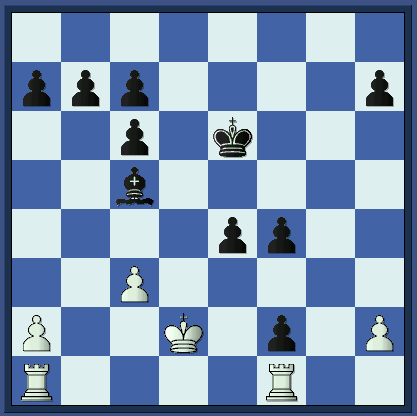
28.bxc5
Bxc5; "/+" (look at the material) {Diagram just
below.}
GM Soltis notes that Black has the MOST
unusual material alignment of a Bishop
and five (!) pawns for TWO Rooks ... ...
... but Black still has a deadly initiative.
|
|
29.Rab1! f3!;
30.Rb4,
('!') {Diagram?}
"Resourceful to the end." - GM John Emms.
[ GM John Emms
provides the following line, which is most instructive:
30.Rh1!? Ke5; 31.Rxb7
e3+; 32.Kd3 e2; 33.Rbb1 Be7!;
34.h3 Bh4; "-/+" {D?}
(Believe it or not, Black is winning here.)
and White is helpless
to stop the Black Pawns. ]
30...Kf5!;
{Diagram?}
Black uses his ...
King!! This piece, normally best hidden in a corner during
extreme tactical
operations, is utilized to administer the knock-out blow.
........ Incredible.
'!' - GM Andy Soltis.
This move is also much more simple ... and much more elegant ...
than the
immediate advance of the e-pawn by Black.
[ Black is better after:
30...e3+!?; 31.Kd3 e2; 32.Re4+ Kf5; 33.Rxe2 fxe2;
34.Kxe2 Kg4; "/+" {Diagram?} and White has a
(very) poor game.
(But this continuation is
inferior to what was actually played in the game!) ]
31.Rd4!,
{Diagram?}
White
tries to cut off the dangerous Black Bishop from protecting the far
advanced
ground troops.
[ Soltis point out the amusing idea: 31.Rxe4!?
Kxe4; "-/+" {Diagram?} and
... "White is helpless against a king-raid to g2."
- GM
A. Soltis. ].
31...Bxd4;
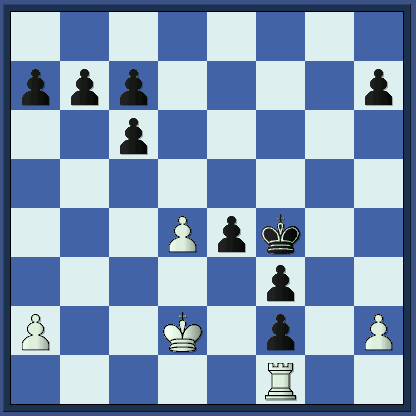
32.cxd4 Kf4!; {Diagram just below} '!' - GM
Andy Soltis.
White Resigns. (0-1)
|
|
[ Andy is kind enough to point out that it
is a simple win after:
32...Kf4;
33.Rxf2, {Diagram?} (Hmmm.)
This walks into a fork, but White had no
decent alternatives.
(Or 33.Rb1, e3+; 34.Kd3, e2; "+/-" & Black
makes a couple of Q's.)
33...e3+;
("-/+") {Diagram?} and Black wins easily. ]
An
amazing game. The final position is worthy of a picture. White has an extra
Rook,
all Black has is his King - yet the first player is helpless against the
onset of the
advancing Black infantry. A truly immortal finish.
(Notice Black still has EIGHT Pawns on the board!!!)
"Since this game I always maintain
that the dark-squared Bishop
has a magic all its own." - GM Eduard Gufeld.
Bibliography: I consulted over a dozen books, many magazines, and almost
countless references from the Internet to annotate this game. But the following
sources were easily the most helpful in my completing this task.
# 1.) "The
100 Best." by GM Andrew Soltis.
("The 100 Best Games of The 20th Century, {annotated} and
Ranked.")
# 2.) [The Mammoth Book Of]
"The
World's Greatest Chess Games,"
by
GM John Nunn, GM John Emms, and FM Graham
Burgess.
(I think Emms mostly did
the analysis of this game.)
# 3.) "Chess
HighLights of The 20th Century,"
by FM Graham Burgess.
# 4.) "My
Life In Chess,"
by the (late) GM Eduard Gufeld.
(I
consider only Gufeld's analysis of this game to be reasonably accurate.)
0 - 1
(Code initially) Generated with ChessBase 8.0
***
Click
HERE
to see another (fantastic) example of Pawns ...
(and pawn-rollers) in action.
Copyright (c) A.J. Goldsby I.
Copyright (©) A.J. Goldsby, 2002, 2003, 2004 & 2005.
Copyright (©) A.J. Goldsby, 2005. All rights reserved.
This
is the full version of this game, (as it exists in my ChessBase files);
I have NOT shortened it for publication.
(Other than to omit the numerous diagrams!)
Page
first published in August, 2002.
(Final version published: October 15th, 2002.
Last update: October 28th, 2004.)
Click HERE to return to my "Annotated Games (# 2)" page.
Click HERE to go to, (or return to); my (DownLoads) Home Page.
Click HERE
to go to, (or return to); my Geo-Cities
(re-play) web-page
on this great game.
(Or click the "BACK" button on the web browser.)
Copyright (c) LM A.J. Goldsby, 2002 - 2005.
Copyright (©) A.J. Goldsby, 2006. All rights reserved.
|
|