|
|
lifemasteraj
(2215) - Champbuster (2785)
[C03]
Xdosher2003 Internet Chess Club (2), 16.03.2003
The
Dos Hermanos 2003 Blitz Qualifiers. Time: Eight (8) Minutes, with
a two-second (02) delay. Sunday Evening, March 16, 2003.
Round No. Two. (#2.)
My
best game of the tournament.
(And a 500+ point upset.)
My opponent was an IM with a real ELO of 2400+.
This is a plain, old, text-score page. You will need a chess set here.
1.e4
e6; 2.d4 d5; 3.Nd2 Be7; {Diagram?}
A very slow developing move, but this move is too passive to be any good.
The book line is PxP or N-KB3.
[ Best was: >/= 3...Nf6;
"<=>" {Counterplay}
The main line then runs: 4.e5,
Nd7; 5.f4, c5; 6.c3, Nc6;
7.Ndf3, Qb6;
"<=>" {Diagram?} with
good play for both sides.
Also good is: 3...c5!?;
{Diagram?}
a favorite of Korchnoi's. ]
Both
sides continue to develop here.
4.Ngf3 Nf6; 5.e5 Nfd7; 6.c3 c5; 7.Bd3 Nc6; 8.Qe2 a5!?;
{Diagram?}
I
am not sure what Black accomplishes with this move.
(Maybe prevents a later PxP and then P-QN4?)
It seems to be a little slow.
[ I could only hope for: 8...0-0;
9.h4!? a6?!; 10.Bxh7+!! Kxh7;
11.Ng5+ Kg6;
12.h5+! Kxg5; 13.Ne4+ Kf5; 14.g4#. ]
9.0-0 g5!?; {Diagram?}
What
in the world???
(I guess he thinks he can blow me right off the chess board.)
I expected castling here.
[ An interesting line is: 9...cxd4;
10.cxd4 Qb6; 11.Qe3 Nb4;
12.Bb1 Qc7;
13.Qc3; "~" {Diagram?}
with a fair game and approximate
equality.
***
Was 9...0-0!?; "=" {Diagram?}
really so terrible?
(The computer says this position is
very close to equal.) ]
Now
Black wins a pawn, but the price is very high. White gets a very
strong attack with all the open lines.
10.dxc5
g4; 11.Nd4 Ncxe5; 12.Bb1! Bxc5; 13.Kh1! Bd6; 14.f4 gxf3;
15.N2xf3 Nxf3; 16.Qxf3 Qe7; 17.Qh5 Nf6; 18.Qh4 Ne4;
19.Qh5 Bd7?!;
This could be much too ambitious for Black.
[ It may already be time for Black to
be thinking about forcing a draw
with a repetition of moves:
19...Nf6;
20.Qh4 Ne4; 21.Qh5 Nf6; 22.Qh4,
"=" etc. ]
|
|
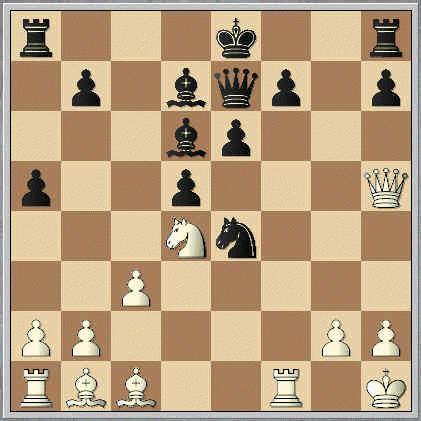
(The position just after Black plays 19...Bd7.)
***
20.Bxe4 dxe4; 21.Bg5 Qf8; 22.Bf6!?, {Diagram?}
This is good, but ...
[ Maybe better is: >/= 22.Rae1!,
"+=" (Maybe "+/")
{Diag?}
with a powerful game for White. ]
22...Rg8; 23.Nb5 Rc8!?; (Maybe - '?!') {Diagram?}
The
retreat of the Bishop to b8 may not have been attractive,
but was probably the safest course of action for Black.
[ The best defense had to be: >/=
23...Bb8[]; {Diagram?}
]
maintaining some dark-square
control.
24.Nxd6+ Qxd6; 25.Rad1 Rc5?!; (Maybe - '?') {Diagram?}
This
is probably a mistake.
(But Black was trying to complicate.)
[ Maybe better was: >/= 25...Qc5!? ]
26.Qxh7 Qf8; 27.Qxe4!, {Diagram?}
I
thought a long time, and felt this was the best move.
Be7!? was also an alternative.
(I felt it important to try and remove the e-pawn.)
[ An interesting alternative was:
27.Be7!? Rh5; {Diagram?}
Believe it or not, this is
probably forced for Black.
(White wins after either: 27...Kxe7?;
28.Rxf7+! Qxf7; 29.Rxd7+!,
29...Kxd7; 30.Qxf7+ Kd6; 31.Qxg8, "+/-" {Diagram?}
and an easily won game. Or 27...Qxe7??; 28.Qxg8+,
"+/-")
28.Qxh5 Qxe7; 29.Qxa5, "+/-"
{Diagram?}
and White has a won game.
]
27...Qh6!?; {Diagram?}
Black
continues to go for bizarre complications.
(It no longer matters, Black is completely lost.)
[ Definitely not: 27...Bc6??; 28.Rd8#.
Maybe the sturdiest line for Black here was: 27...Rc7;
{D?}
with a tough nut to crack. ]
|
|
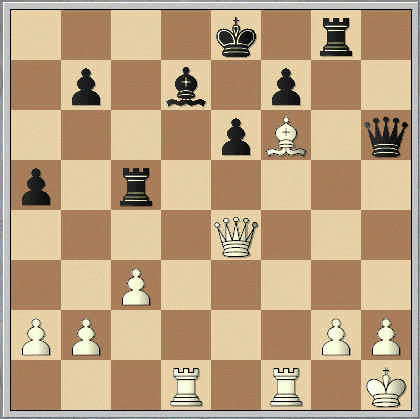
(The position following Black's move, 27...Qh6!?)
28.Rxd7! Kxd7!?; {Diagram?}
This actually could be a mistake.
I sent this game and analysis to
an Internet student in California. He and a few friends spent the
entire morning analyzing this game; and they used several programs,
(like CM 9000) to assist them.
In the end, they determined Black's
only chance of survival is to play
...Qxf6 here. Then after RxQ/f6, KxB/d7. White then takes the Black
QNP with check. My personal opinion is that White should not lose this
game, but maybe Black MIGHT draw by playing this idea.
[ The best defense might be: >/= 28...Qxf6. ('!?') ]
29.Qxb7+ Kd6; {Diagram?}
This is forced.
[ Terrible would have been: 29...Ke8??; 30.Qe7# mate.
Equally bad is:
29...Rc7??;
30.Rd1+, Qd2[]; 31.Rxd2+, Ke8; 32.Rd8#
mate. ]
30.Qb6+!?, {Diagram?}
I think I missed the quickest win here.
[ The most accurate was: >/=
30.Be7+! Ke5; 31.Re1+!, {Diag?}
Looking for the knock-out blow, this was the move I missed.
(31.Bxc5!? "+/-")
31...Kf5; 32.Qe4# ]
Now
White throws in a couple of extra moves, before hitting
upon the correct idea.
30...Kd5;
31.Rd1+ Ke4; 32.Qxc5 Qxf6; 33.Qc6+!? Ke3;
34.Qc5+ Ke4; {Diagram?}
This is forced.
[ Even worse for Black was: </=
34...Ke2?; 35.Qh5+! Ke3;
36.Re1+ Kf4;
37.g3+, ("+/-") {Diagram?}
with an easy win for White. ]
Now I finally find the win.
35.Rd4+! Ke3!?; 36.Rd8+! Ke2; 37.Rxg8 e5; {Diagram?}
There is no mate for Black, the White Queen covers g1.
[ 37...Qf1+; 38.Qg1, "+/-" ]
Now
Black could resign, but plays on - perhaps hoping for an error.
(And pelting me with repeated draw offers, probably in the hope
of distracting me.)
38.Qg1
e4; 39.Rg3 Qf4; 40.Rh3 f5; 41.Rh8 Qd6; 42.g3!? Qe7;
43.Rh4 e3;
44.Rd4! Qe4+; 45.Qg2+!? Ke1!?; 46.Rxe4 fxe4; 47.Qxe4 e2;
48.h4!? Kd1;
49.Qd3+ Ke1; 50.Kg2 a4; 51.Kf3, {Diagram?}
Black ... finally ... RESIGNS.
Copyright (c) A.J.G; 2003.
(Code initially) Generated with ChessBase 8.0