This is a pure text-score
page, you will definitely
need a chess board to study this great game.
Click here
if you would like to view this game on your computer ...
where you can re-play the moves, and do not need a chess board.
(This is NOT one of my sites. If you have
disabled java-script, you may not be able to use it.)
Click here to see an explanation of the symbols that I use.
Easily one of the greatest games ever
played.
(Certainly one of Bobby's best games.)
All the players who were present -
many Top GM's were watching
this game - failed to predict that Fischer would win. (Or how.)
From one of the most dominating
tournament performances of
all time. (Fischer scored just four draws, a monstrous 13 wins,
and no losses. He buried a field that included about 10 of the
best players in the world ... of that particular time in chess history.)
Panno was a strong player, and was
having a very good tournament.
(He finished third here, just a half point behind second-place Tukmakov. {10.5})
***
My annotations are my own. But I based
them on GM S. Gligoric's
work, and the work of the book:
"The Games of Robert J. Fischer,"
edited by Robert G. Wade and also Kevin J. O'Connell.
(Game # 523, page # 274.)
1.e4 c5; 2.Nf3 e6;
3.d3!?, {Diagram?}
The King's Indian Attack, a favorite of Fischer's since his youth.
Panno is a great expert in the open
systems of this line.
Fischer decides to side-step Panno's best lines.
Wade and O'Connell call this move an
effective 'second-string'
answer to Black's opening system.
[ One of
the main lines is: 3.d4 cxd4; 4.Nxd4 Nc6; 5.Nc3
Qc7; {Diag?}
with a good game for both sides.
See the encounter: A. O'Kelly - O. Panno;
Capablanca Memorial, 1969.
(Black won a crisp game in just 32 sharp moves.)
Fischer was undoubtedly familiar with this game and, perhaps
having found no weaknesses in Panno's game,
decides to
avoid the entire line.
(He also watched Panno's blitz games
intently. Did he discover
a weakness in his play?) ]
3...Nc6; 4.g3 g6!?;
{Diagram?}
"Black avoids the French type of position a la
Fischer - Miagmasuren; Sousse Interzonal, 1967."
- Wade and O'Connell.
(Fischer scored a crushing win.)
To me, this fianchetto is both too
slow and too weakening.
(But it is obviously playable, as dozens of titled players have
used this system.)
[
The main line is: 4...d5; 5.Nbd2 Nf6; 6.Bg2
Be7; 7.0-0 0-0;
8.Re1, "+/=" {Diagram?} White has
just a very, very small edge
in this position.
Checking ChessBase's on-line database, (as well as my own); we find
this position has occurred at the Master level over
1000 times! The first
example was a game of Aaron Nimzovich
vs. L. Forgacs from
Ostende, (B) 1907.
A very good game is: V. Borjanovic - V. Cabarkapa;
JUG Championship (T2), 1994. (29) (Black won an
interesting game.) ]
5.Bg2 Bg7; 6.0-0 Nge7;
7.Re1 d6; 8.c3!, {Diagram?}
Fischer plays both simply and elegantly ... and in the pure
classical style.
(He goes for the simple and slow expansion in the center.)
[
After the continuation: 8.Nc3 0-0; 9.Be3 Nd4;
"=" {Diagram?}
White has little or no edge.
K. Warhid - B. Wexler; FIDE Men's Olympiad, (Prelim.)
Leipzig/W. Germany/1960. (Drawn in 41 moves.) ]
8...0-0; 9.d4 cxd4!?;
{Diagram?}
Black decides to open the game. As Wade and O'Connell
note this is a monumental decision which determines the
nature of the game for a very long time.
In hindsight, it may have been wiser
for Black to keep the
game closed.
[ Was 9...b6!?; "~" {Diagram?} playable? ]
10.cxd4 d5!?; 11.e5,
('!') {Diagram?}
The correct response, fixing the dark squares on the King-side.
(Fischer loves these types of position.)
[
The continuation of: 11.exd5!? Qxd5!?; 12.Nc3
Qd7; 13.Bg5, "=" {Diag?}
holds almost no promise of an edge for White. ]
11...Bd7; {Diagram?}
Black decides to keep the center closed, and play on the wings.
[
According to Wade and O'Connell, Black could not have liked the looks
of a line like: 11...f6!?;
12.exf6 Bxf6!?; 13.Bh6 Bg7!?; 14.Bxg7 Kxg7;
15.Nc3, "+/="
{Diagram?} White has a small, but clear edge.
(Black has many weaknesses for Fischer to play
against.) ]
12.Nc3 Rc8; 13.Bf4
Na5!?; {Diagram?}
Last chance for ...f6? (So says Wade and O'Connell.)
Black gets almost nothing from this Knight sally here.
[
In my mind, too risky is: 13...f6!?; 14.exf6
Bxf6; 15.Bh3, "+/=" {Diagram?}
with a comfortable game for White here.
I like the continuation of: >= 13...Nf5; 14.Rc1
h5!; "~" {Diagram?}
with a playable game for Black here. ]
White now plays slowly and logically
to increase his edge.
14.Rc1 b5; 15.b3 b4; 16.Ne2 Bb5; 17.Qd2
Nac6!; {Diagram?}
Black avoids exchanges, as he probably feels he is not ready for to
contest the c-file yet.
[
Interesting was: 17...Rxc1!?; 18.Rxc1 Nec6; 19.Bh6!?,
"~" {Diagram?}
with a difficult game. ]
18.g4!, (Excellent.)
{Diagram?}
Since White has an edge on the King-side, and has ambitions there;
it is natural - and good - for White to seek to increase his edge in
that sector.
(Several other authors also praise this move.)
[ 18.Bg5!? ]
18...a5!?; {Diagram?}
Black continues to play on the Queen-side.
Wade and O'Connoll advise Black should
play BxN/e2 here, but
Panno said later he did not want to give Bobby the two Bishops!
(Fischer fear?)
[
Maybe dangerous is: 18...Bxe2; 19.Rxe2 Qb6; 20.Qd3!
a5;
21.Rec2,
"+/=" {Diagram?} with a growing advantage.
(But maybe Black can defend.) ]
19.Ng3 Qb6; 20.h4!,
{Diagram?}
White continues his King-side demonstration, but later Panno
said he was unconcerned. (Against Fischer?!?)
[ Maybe 20.Be3 Rfd8; "~" {Diagram?} with unclear results. ]
20...Nb8; 21.Bh6 Nd7;
{Diagram?}
Black maneuvers to try and defend his King-side. The square, (f6);
is very vulnerable. Additionally, White will soon be able to consider
sacrificial ideas based on Nh5!?
[
An inferior line is: 21...Bd7?!; 22.Bxg7
Kxg7; 23.Rxc8 Rxc8;
24.Qf4, "+/=" {Diagram?}
and White is much better. ]
22.Qg5!, {Diagram?}
Best say Wade and O'Connoll, who also award an exclam.
White continues to step up the pressure on the dark squares.
[
Also interesting is: 22.Bxg7!?
"+/=" {Diagram?}
with a slight edge for White. ]
22...Rxc1; 23.Rxc1
Bxh6!?; {Diagram?}
Black finally decides to exchange.
This is maybe an inferior move,
although six different Fischer
books give no comment here.
[
Maybe a better defense was: 23...f6; 24.Qe3 Rf7;
25.Bxg7 Kxg7;
26.h5,
"+/=" {Diagram?} but White still holds a sizeable
advantage in this position. ]
24.Qxh6 Rc8; 25.Rxc8+
Nxc8; 26.h5!, {Diagram?}
The best say Wade and O'Connell, who also award this move
an exclamation point.
White continues to probe the pawn
structure around Black's King.
He also softens Black up a bit and prepares a later tactical shot.
[ White could also play: 26.Qf4!? Qc7;
27.Ng5 Ndb6; 28.h5, "+/=" {Diag?}
with a clear, (small, but solid); advantage. {A.J.G.}
Wade and O'Connell give the variations of: 26.Qg5!?,
"+/=" {Diagram?}
with a slight advantage.
They also provide the line of: 26.Ng5!? Nf8;
27.N3e4?, {Diagram?}
This is a mistake here.
(Necessary was: 27.Nf3, "=") 27...dxe4;
28.Nxe4 Qd8; "-/+" {Diagram?}
Black has a sizeable edge. ]
26...Qd8!?;
(Probably - '?!') {Diagram?}
Black probably makes a slight error ... in an extremely difficult
position.
Wade and O'Connell state that Black
has to play
...Nf8; in this position.
'?' - Wade and O'Connell.
[
Another line is: 26...Qc7!?; 27.Ng5 Nf8;
28.Nxh7!!, {Diagram?}
and White has a virulent attack. ]
Blacks's faulty play now ...
"enables Fischer to set in motion a most
elegant storming of the Black King's citadel."
- Wade and O'Connoll.
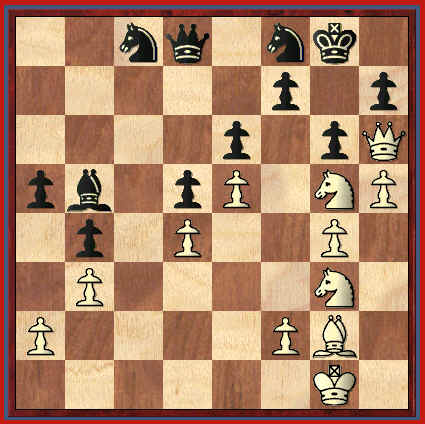
27.Ng5! Nf8; {See
the diagram just below.}
Black appears to be defending and have all of his bases covered.
|
|
28.Be4!!,
(Maybe - '!!!/!!!!')
{Diagram?}
An incredible move, surely one of the most brilliant and shocking
moves ever executed on a chess board. In a GREATLY simplified
position, Bobby is attacking! (Offering to sack a piece!!) And now
he has found a way to involve all of his pieces in the assault.
[
Nearly all the computers find the win for White with: 28.hxg6!
hxg6[]; {Diag?}
This is forced.
(Even worse is: 28...fxg6?!; 29.Nxh7 Nxh7; 30.Qxg6+ Kh8;
31.Qxe6 Ne7; 32.f4, "+/-" {Diagram?} with a probably winning
pawn-roller
for
White.) 29.Qh8+ Kxh8;
30.Nxf7+ Kg7; 31.Nxd8 Na7;
32.f4, "+/-"
{Diagram?} and White is probably winning.
This works, but Fischer's win is much more accurate and
vastly more impressive. ]
28...Qe7; {Diagram?}
This is both best and forced.
(Black dies horribly if he captures the Bishop.)
[ A
terrible blunder is: 28...dxe4?; (Maybe - '??')
{Diagram?}
This is a mistake, f6 is now indefensible. 29.N3xe4
Bc6; {Diagram?}
There is little Black can do.
(29...Nd7; 30.Qxh7+ Kf8; 31.Qxf7#.
Or 29...f5; 30.Nf6+, ("+/-"))
30.Nf6+ Qxf6; {Diagram?}
What else can Black do? (Except resign!)
(30...Kh8; 31.Nxf7#)
31.exf6, ("+/-")
{Diagram?} and it is mate next move. ]
29.Nxh7!!,
(NO FEAR!)
{Diagram?}
Fischer continues his brilliant lesson in world-class tactics.
[ White could also play: 29.Bb1!,
"+/=" {Diagram?}
with some advantage. ]
29...Nxh7; 30.hxg6 fxg6;
{Diagram?}
This is forced.
[
Not 30...Nf8??; 31.g7, "+/-"
{Diagram?}
and White is winning easily.]
31.Bxg6 Ng5?!; ('?')
{Diagram?}
According to Wade and O'Connoll, this is Black's only real try.
But actually the move is a mistake, and allows White to win quickly.
To be fair, I should also point out
Panno was running very low on
thinking time on the clock. The move looks logical, and Panno
thought he was winning here. But he is in for a very rude surprise.
[
Black had to play: >/= 31...Qg7!?; 32.Bxh7+
Kh8; {Diagram?}
This is forced.
( Bad
is: 32...Qxh7?; 33.Qxe6+ Qf7; 34.Qxc8+, ("+/-") {A.J.G.} )
33.Qxg7+ Kxg7; 34.Bb1!
Ne7; 35.f4 Nc6; 36.Kf2, "+/" {Diag?}
White has a comfortable extra pawn, and basically a won
game.
( - Wade and O'Connoll) ]
32.Nh5 Nf3+; 33.Kg2 Nh4+;
34.Kg3 Nxg6; {Diagram?}
Now if White takes the Knight, Black is clearly better.
35.Nf6+!,
(Maybe - '!!') {Diagram?}
Fischer pulls one more surprise from his bag of tricks.
[
Panno expected something like: 35.Qxg6+ Kf8;
{Diagram?}
This is forced.
(35...Qg7??; 36.Qxg7#) 36.Nf4 Bd7;
{Diagram?}
and Black < appears > to be
defending his position.
(Actually, Panno is probably losing this
position as well.
He said after the game, he thought he was
holding. But a deep
computer analysis reveals he will
eventually lose.) ]
35...Kf7; 36.Qh7+,
{Diagram?}
Black Resigns. (36...Kf8; 37.Qg8 is mate.)
One of the most brilliant games on record.
Surely one of the great Bobby Fischer
wins.
(And one of my favorite games.)
*****
Copyright (©) A.J. Goldsby I. Copyright (c) A.J.G, 2002.
1 - 0
(Code Initially) Generated with ChessBase 8.0
Click HERE to return to my Home Page.
Click
HERE
to go to, (or return to); my "Best Games" Page.
(On my Geo-Cities web
site.)
Click
HERE
to go to (or return) to my
"Annotated Games" (2) Page.
(Or press the "BACK" button on your
web browser.)
***
This game is almost an exact copy of the ChessBase document, as it exists in my database. (I have not shortened it for publication.) If you want to obtain a copy of this to study on your own computer, you may contact me by clicking here.
***
Game first posted (rough version) in October, 2002. Final Up-Date: Monday; November 25th, 2002. Last checked: December 15th, 2003.
Copyright (©) A.J. Goldsby, 1995-2005.
Copyright (©) A.J. Goldsby, 2006. All rights reserved.