*********************************************************************
Capablanca - Mattison
                      |
*********************************************************************
|
|
Chernev writes:
"This lovely game shows Capablanca at his best. Without seeming to make a
single aggressive move he causes the disintegration of his opponent's position.
Underneath the placid surface there may be all sorts of subtle little combinations,
but somehow they all seem to be in Capablanca's favor!" - Irving Chernev.
[ See the book,
{The} "1000 Best Short Games of Chess,"
by (the Great, late) Irving Chernev. Game # 679. Pg.'s 347-349. ].
A very beautiful game of chess,
and it is hard to pin down exactly
where
Black went wrong.
1. d4 Nf6; 2. c4 e6; 3. Nc3 Bb4; 4. Qc2, The "Classical Variation."
Although this may not have originated with him, this could be referred to as Capa's patent. He played this line pretty much consistently against 'The Nimzo-Indian.'
MCO calls this,
"The Classical Variation." This move (line) could [also] be called,
"The Capablanca Variation."
(Few players played it as well as he did.)
[
Another good move is:
4.e3, which is,
"The Rubinstein Variation." ].
4...c5; (Maybe - '!?')
Hitting the center. This is a perfectly legitimate move.
(Attacks/controls a key central square. It also nicely complements Black's
dark-square strategy in the Nimzo-Indian.)
According to the nearly 30 (or more!) books I have on this opening, this move
may not be the most accurate. Several texts, including MCO & NCO question
this, as White MIGHT get the better ending.
(But this is not 100% certain.)
[ 4...0-0;
is the modern main line,
and 4...d5; is also considered
completely playable. ]
One should also bear in mind that this is also the result of close to 100 years of development in opening theory ... greatly accelerated by the advent of computers and large game databases. You should also remember these players NEVER had access to this information - and we cannot judge them too harshly.
. . .
.
. (What follows is a very brief (!) peek
at modern theory.) . . . . .
{MCO has like close to 20 columns
and pages of notes. It would be
silly
to even try to reproduce most
of that here.}
***
[
Also good was:
4...d5!?; ("=" or
"+/=") 5.a3
Bxc3+; (5...Be7!?~)
6.Qxc3
Ne4;
(6...0-0!?)
7.Qc2, ("=")
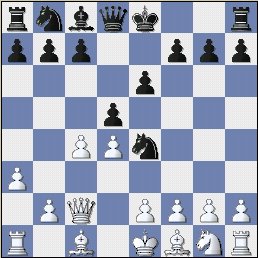
(See the diagram directly below.)
|
(Possibly - "+/=") White has MAYBE a tiny edge, according to modern theory.
(The paths branch quite a bit from this position.);
The [modern]
main line is: 4...0-0; 5.a3
Bxc3+; 6.Qxc3
b6; (6...Ne4!?)
7. Nf3, ("=")
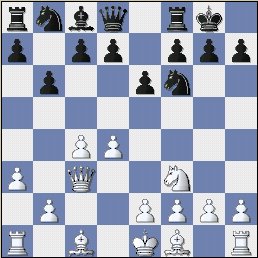
(See the diagram directly below.)
|
(Possibly - "+/=")
The most flexible and logical move.
(The move recommended by theory here, 7. Bg5; does not impress me.)
Again, White has MAYBE a tiny
edge, according to modern theory.
Interesting is: 7.f3!?~; {Unclear.}
MCO-14 gives:
7.Bg5!?
Bb7; 8.f3
h6;
9.Bh4
d5; 10.e3
Nbd7;
11.cxd5!?
Nxd5!;
12.Bxd8
Nxc3;
13.Bh4
Nd5;
The end of column # 1, page # 532.
14.Bf2
f5; 15.Bb5
c6;
16.Bd3
e5; 17.Ne2
Rae8, & White is
slightly better. ("+/=")
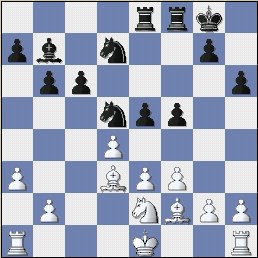
(See the diagram below.)
|
White has a tiny ("minute") edge,
according to MCO.
( The computers sees no advantage
at all for White, "=". )
GM J. Piket - GM A. Karpov;
Match Game, 1999.
[See MCO-14;
pg.'s # 532-534, columns # 1 - 6;
(Mainly column # 1 here.)
and notes b-g. (Mainly g here.).].
Returning to the analysis of 7. Nf3 (!)
7...Bb7; 8.e3
d6; 9.b4
Nbd7; 10.Bb2
Ne4; (10...c5!?)
11.Qc2
f5;
12.Bd3
Qe7;
13.0-0,
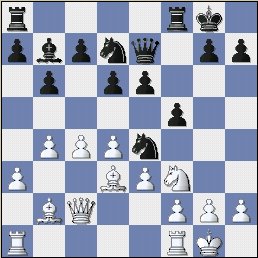
("=") (See the diagram directly below.)
|
With a position that is close to being equal. (Dynamic balance.) ].
***
(We now return to the actual game, after our brief excursion into opening theory.)
5. dxc5 Nc6; 6. Nf3 Bxc5; 7. Bf4 d5!?; This might be a bit too aggressive.
8. e3 Qa5!?; Again, maybe a mite too aggressive.
[
8...0-0; ].
9. Be2
Bb4; ("=")
Black may be planning on
giving up this Bishop for a
Knight.
I am not sure if this
is wise.
[Junior 6.0:
9...Nb4; 10.Qb3
dxc4;
11.Bxc4
0-0; 12.a3
Rd8; ("=") 0.04/12
].
10. 0-0
Bxc3!?; 11.
bxc3
0-0; 12.
Rab1!, Very nice.
Chernev writes:
"Prevents the development of the
adverse Bishop, and exerts pressure
on the Q-side."
[12.Rfd1!?].
12...Qa3!?; (Maybe - '?!')
This might be too aggressive,
and even the losing move.
[ Much safer was: 12...dxc4; 13.Bxc4 Rd8. ].
13. Rfd1, ("+/=")
13...b6!?; Very logical looking, (dulling the
action of the Rook);
but maybe
very risky.
[
Black could have tried: 13...h6!?
].
14. cxd5, ('!') This is probably the best.
[
14.Nd4!?, ("+/=") ]
.
14...Nxd5; This looks (more-or-less) forced.
Chernev writes:
"The combinations begin: if 14...PxP;
15. P-B4, when he cannot take on
account of 16. B-Q6, and he must not
protect by 15....B-K3; 16. PxP, BxP;
17. RxB, wins material." (See below for this variation.)
[14...exd5; 15.c4
dxc4?; This looks like a
slight error.
(Or 15...Be6?!;
16.cxd5
Bxd5; 17.Rxd5
Nxd5; 18.Qxc6,
"+/-")
16.Bd6, ("+/-") ].
15.Ng5!, ("+/=")
15...f5?!; (Maybe - '?')
In all likelihood, this is the losing move.
(Although Chernev does not mention it.)
Although this move LOOKS forced, Black should probably play instead ....g6.
[ If 15...Nf6; then 16.Bd6, ("+/-") With a relatively easy win for White.
Black's only chance is:
15...g6!; 16.Bf3
Bb7; 17.Bxd5
exd5; 18.e4,
("+/=" Maybe - "+/") and White is clearly {a little} better.
(NOT 18.Rxd5??
Nb4; 19.Rxb4
Bxd5, ("/+",
maybe "-/+".) ]
16.Bf3!
Qc5[]; This looks like it is completely forced.
Chernev writes:
"White's threat was 17. RxN, PxR;
18. BxPch, removing a good part
of the [Black] army. The text move is an attempt to protect the Knight (and the vital center) as the other defenses fail."
He then goes on to give a few of the variations given below.
[ The following variations should give an idea of the complexity of this position:
Var. # 1.)
16...h6!?; 17.Rxd5
exd5; 18.Bxd5+
Kh8;
19.Nf7+
Rxf7; 20.Bxf7,
("+/-") - A.J.G.
Var. # 2.)
16...Rb8?; 17.Rxd5
exd5; 18.Bxd5+
Kh8;
19.Bxc6, ("+/-") - Chernev.
Var. # 3.) 16...Nce7;
17.c4!, (17.Rb3,
"+/-") 17...Nb4;
18.Rxb4, ("+/-") - Chernev.
Var. # 4.) 16...Nxf4; 17.Bxc6 Rb8; 18.exf4, ("+/-") - Chernev.
Var. # 5.) 16...Nde7; 17.Bd6 Qa5; 18.Bxe7 Nxe7; 19.Bxa8, ("+/-") - Chernev.
Var. # 6.) 16...Rf6;
17.c4
Ndb4; 18.Rxb4!
Nxb4; 19.Rd8+
Rf8;
20.Rxf8+
Kxf8; 21.Qd2,
("+/-") - A.J.G.
].
17. c4!
Ndb4; This looks good, but ...
[Chernev gives:
17...Nf6; 18.Bd6,
("+/-") (18.Rb5,
"+/-");
Chernev also gives:
17...Nxf4; 18.Rb5
Qe7;
19.Bxc6
Qxg5; 20.exf4,
("+/-") ].
18. Qb3 e5; This looks forced.
Chernev writes:
"Not only to prevent 19. B-Q6, but
with the hope of some counterplay."
19. a3!
Na6; The computer gives Bb7 instead,
but this obviously loses a piece.
[Chernev gives the variation:
"If 19...exf4; 20.axb4,
("+/-") and White wins a piece." ].
20. Bxc6, (!) ("+/-")
Black Resigns. 1-0 (1 - 0, in 20 moves.)
[
The finish could be: 20.Bxc6
Qxc6
; 21.c5+
Kh8
; 22.Nf7+
Kg8
;
(22...Rxf7!?;
23.Rd8+
Qe8; 24.Rxe8+
Rf8; 25.Rxf8#
)
23.Nh6+
Kh8
; 24.Qg8+!
Rxg8
;
25.Nf7#.
]
White wins easily.
(A fantastic game of chess by Capa,
but it perhaps lacks
the spark of
some of the other games of chess
in the "Top Ten" list.
{And his opponent's defense is not
very good, to be honest.}
- Although it may merit inclusion
in the 'Top 100.')
1 - 0
(I
first annotated this game for a student of mine in the mid-eighties. --->
He
thought the game very brilliant.
That analysis was originally done on paper, but I clearly remember most of what
I did there. I also submitted that
game for publication, but it was never printed. Most editors - at that time - wanted current GM
games.)
This game is the full
length version of the game as it exists in my database.
(I have not shortened it for publication.)
If you would like a copy of that game to study, please contact
me.
Click HERE to return to my GeoCities "Home Page."
Click HERE to return to my (GeoCities) "Best Short Games Page."
Copyright A.J. Goldsby I. © A.J. Goldsby, 1986
- 2006.
Copyright © A.J. Goldsby, 2007. All rights reserved.