Boden - Bird
                      |
|
|
[A.J. Goldsby I]
(The ratings are extrapolations of what the players would be minimally rated if they were alive today.)
Chernev wrote:
"Henry Bird, who played them all - from Morphy in 1858 to Lasker in 1899 - dared to be original. He believed that any line of an opening that was considered theoretically unsound, was good enough to venture on in tournament play. And though against the greats he lost more often than he won, he gave the spectators their money's worth in exciting action over the chessboard."
[ See {The} "1000 Best Short Games of Chess" Game # 686, page # 352. ]
***
I have seen this game in dozens of books, and many books call this encounter a game of exceptional brilliance. And at first blush, it appears this is what it is.
For my part, I will simply say the game LOOKS very pretty, but is really nothing more than a swindle. The entire game is unsound. (Unfortunately.) As is the case with better than 99% of the older games, they simply do not stand up well to modern analysis.
(I will also say I was not pleased with having destroyed the myth of a supposedly beautiful game. But science and truth are higher values than the search for tawdry brilliance.)
***
1. e4
e5; 2.
Nf3
Nc6; 3.Bb5
Nd4!?; Bird's
patent.
(The variation which is named after Bird.)
[The normal book line is:
3...a6;
4.Ba4, "+/=" and White is a little better. ]
4. Nxd4
exd4; 5.
0-0, ("+/=") 5...Bc5;
6. c3!?,
A nice move - attacking the center.
[Sharper was:
6.Qh5!; "+/="
]
6...Ne7; 7.
d3,
White is playing routinely and somewhat passively here. He is also missing many chances for a much better game.
[
7.Qh5!,
"+/"
]
7...c6; 8.
Bc4,
Pointing at the Black King.
(Certainly not a bad idea.)
[
8.Ba4!?
]
8...0-0; 9.
Bg5!?
Kh8!?; This move was
praised by some, but may be unnecessary.
(This move is probably not the best, and maybe is even very risky.)
[
The most accurate variation:
9...h6!;
may have lead to equality. ]
10. Qh5
f6!?; (Maybe a mistake.)
A gambit, and probably not even the best.
[ The best move
has to be: 10...d5!; with
good play for Black. ]
11. Bxf6!?
d5!; This is almost forced, as taking the Bishop clearly leads to a White advantage.
[
11...Rxf6; ('?') 12.Qxc5,
"+/".
]
12. Bxe7!?, ('?!')
Probably not the best.
(White is exchanging off all his developed pieces.)
[ The best move for White must be: 12.Bh4!, "+/="
(See the diagram just below for the
position.)
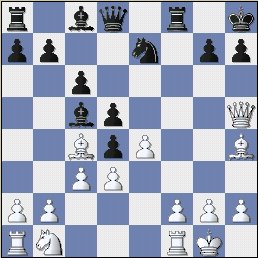
This position was much better for White.
(Maybe even "+/".)]
12...Qxe7; 13.
exd5!
Rxf2!!; ('?')
Given one exclam by Chernev.
Coles calls this, "An entirely unexpected stroke." (That's for sure!)
I give it two exclams for the sake of the swindle.
(But, ... in actuality, the move is an error!)
14. Nd2!?, ('?')
Looks VERY reasonable.
(And for nearly 130 years it has been assumed that this move is correct.)
{One writer gave a faulty variation where if White captures the Black Rook
on f2,
Black wins by getting a 2nd Queen in the corner.}
Yet the truth is that the move 14. Nd2 is actually a mistake and loses by force!
[Of course not
14.Kxf2??
Qe3#;
But White wins with:
14.Rxf2!!
Qe1+; 15.Rf1
dxc3+; and Chernev says,
"... and mate in two." But this is NOT the case!
(One of the few times I have
discovered a gross error or oversight
in any of Chernev's work!)
Now White should play: 16.d4!,
This protects White's Rook on f1. (16.Kh1??
Qxf1#); 16...Qe3+;
(16...Bxd4+?
; 17.Kh1,
"+/-") 17.Kh1
cxb2; 18.dxc5
Bg4!;
19.Qf7!,
(19.Qxg4?,
('??') 19...bxa1Q;
"-/+") 19...bxa1Q; 20.Qf8+
Rxf8;
21.Rxf8#,
(See the diagram directly below for this position.)
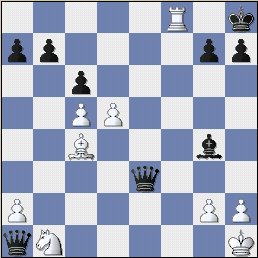
A position so pretty, it deserves a diagram. This variation of course
refutes the entire way that Black played the game! ]
14...dxc3; 15.
Nb3,
Now White may be worse off,
no matter what he plays.
(White may already be lost.)
15...cxb2; 16.
Rae1
Rxf1+!;
The most accurate.
17. Kxf1 Qf6+; 18.Qf3, Now this is forced.
[Not 18.Ke2??
Qf2+; 19.Kd1
b1Q+;
20.Nc1
Qbc2#
]
18...Qxf3+; 19.
gxf3
Bh3+; 20.
Ke2
Re8+;
"and Black wins." - Chernev. 0-1
A writer in the English newspaper, 'The Field,' wrote this was,
"One of the most brilliant parties on record."
Of course this is not true. Unfortunately many of the older games do not hold up under modern scrutiny, especially that done with the aid of accurate chess-playing programs. (But I am sure to the players of that day, who had access to neither modern theory OR chess-playing programs, this must have appeared to be an exceptionally pretty game!)
[ 20...Re8+; 21. Kd2 Rxe1; 22. Kxe1 b1Q+; ("-/+") ]
0 - 1
Samuel Standidge Boden - (1826-1882) - Boden
was an English player
active primarily in the 1850's. In 1851, he wrote the
book,
"A Popular Introduction to The Study
and Practice of Chess."
This was an excellent
book for its time and was immensely popular.
It also introduced several
opening variations, including, ...
"The BODEN-Kieseritszky Gambit."
(1. e4, e5; 2. Nf3, Nf6; 3. Bc4!?, NxP/e4; 4. Nc3, NxN/c3;
5. dxc3!, and
White has some compensation for his gambited pawn.)
This almost immediately became one of the most popular variations of its
day.
(He also introduced the "Boden-Lange" variation of the Evans Gambit,
and worked on several lines of the King's Gambit. He also analyzed several of
the closed lines similar to, "The Wyville Variation.")
(Boden's work and line was severely criticized by Staunton, and perhaps unjustly
so.)
Boden played in few tournaments, but when he did so, he usually acquitted
himself very well. (He won the 'provincial tournament' of London 1851. This was
a smaller side event run at the same of the first large International Tournament
of London, 1851.) At Manchester, 1857; (A knock-out event.), he came in second
to only the very strong player, J. Lowenthal. (Lowenthal was easily one of
the strongest players of the 1800's.) Boden defeated many players in matches,
including Wyville and Rev Owen. (twice)
[In 1858, Boden defeated Owen, one of the strongest of all English players and
one of the few to score well against Morphy. Boden defeated Owen +7, =2,
-3.]
Many historians have considered him to be in the
top three of all English
chess
players for over 15 years. He was easily superior to most of the
players of his day.
Morphy, after playing many games with S. Boden, declared him to be the strongest player in all of Great Britain! (At that time - both Staunton and Buckle had retired.) I feel Morphy, perhaps one of the greatest players who ever lived, is more than qualified to judge chess strength. Morphy was also brutally honest and would have never said this if it were not true.
Boden ran one of the oldest and most respected chess columns in the world for many years. (In the newspaper, "The Field." From the 1850's to 1872. This column has continued without interruption since then, and is the oldest contiguous chess column in the world.)
Boden died of typhoid fever on January 13th, 1882. He is buried in the cemetery at Woking, Surrey. (England.) His contributions to chess should not be underestimated.
Henry Edward Bird - (1830-1908) - was one of the stronger amateur players England has ever produced. He was an accountant by trade, but obviously was great devotee to the game of chess. He added much to the lore and literature of our great game.
Bird was born on July 14th, 1830 in Portsea, Hampshire. (England.) The son of a shopkeeper, Bird learned to play chess at the age of 10 by watching the players of 'Raymond's Coffee House' in London. By the time he was 16, he was a regular to the Divan in the Strand, and would accept any odds and play anyone for a cash stake.
By 1851, his reputation was strong enough for him to be invited to the First International Chess Tournament of London, 1851. But he was eliminated by Horwitz (one of the strongest players in Europe at that time) in the first round. He arranged a Match with Horwitz, but lost by the score of: +3, -7, =4. (A creditable result.)
He played in around 15 major tournaments with varying results.
Some of his best achievements were: At Vienna, 1873; he tied with Paulsen for
4-5th places. At Paris, 1878; he shared 4th place with Mackenzie. At Manchester,
1890; he shared third prize with MacKenzie, (behind Tarrasch and Blackburne). He
also competed in numerous minor tournaments, most notably tying with Isidor Gunsberg
for FIRST (1st) Place at London, 1889.
He played dozens of matches with many, many players. He was playing Steinitz in 1866, (The winner would be the first to win 11 games.); when he was called away to the USA on business. (The score was +5, =5, -7; in favor of Steinitz.) [The match was awarded to Steinitz.] Bird also drew Amos Burn (+9, -9, =4) when that player was at the height of his powers. (1866)
Bird played Morphy when he visited Europe but had no great success against
him.
(But FEW did! ha-ha)
Bird was an ingenious tactician and liked to attack. He preferred not to trod the same paths in the opening that everyone else used. Many of the lines that he chose at the time were considered bizarre, but now are commonplace in the opening. (Such as the DRAGON VARIATION.) He won several brilliancy prizes, including Bird - Mason; New York Chess Congress, 1876. (Perhaps Bird's greatest game.)
H.E. Bird - J. Mason; New York, 1876.
1st
Brilliancy Prize.
1. e4, e6; 2. d4, d5; 3. Nc3, Nf6; 4. exd5!? exd5; 5. Nf3, Bd6; 6. Bd3, 0-0; 7.
0-0, h6;
8. Re1, Nc6; 9. Nb5, Bb4; 10. c3, Ba5; 11. Na3, Bg4; 12. Nc2, Qd7; 13. b4, Bb6;
14. h3, Bh5; 15. Ne3, Rfe8; 16. b5!?, Ne7; 17. g4, Bg6; 18. Ne5, (Out-post!)
18...Qc8;
19. a4, c6; 20. bxc6, bxc6; 21. Ba3, Ne4; 22. Qc2, Ng5; 23. Bxe7, Rxe7;
24. Bxg6, fxg6; 25. Qxg6, Nxh3+; 26. Kh2, Nf4; 27. Qf5, Ne6!?; 28. Ng2, Qc7;
29. a5!, Bxa5; 30. Rxa5! Rf8; 31. Ra6!! Rxf5; 32. gxf5, Nd8; 33. Nf4, Qc8;
34. Nfg6, Re8; 35. Nxc6! Qc7+; 36. Nce5, Qxc3; 37. Re3, Qd2; 38. Kg2, Qxd4;
39. f6! gxf6; 40. Rxf6, Ne6; 41. Rg3, Ng5; 42. Ng4, Kg7; 43. Nf4, Qe4+;
44. Kh2, Nh7; 45. Nh5+ Kh8; 46. Rxh6, Qc2; 47. Nhf6, Re7; 48. Kg2, d4;
49. Ne5, Qc8; 50. Ng6+, Black RESIGNS. 1 - 0
(Click HERE to view this game in PGN format
...
or download
this game to your PC.)
[
Source for the game: "The Oxford Companion To
Chess."
By David Hooper & Kenneth Whyld, © 1992. ]
***
Bird liked to create and invent, and was one of chess's most original
thinkers. "The Bird's Opening," (1. f4) has never been refuted.
(Indeed, it could be just a Dutch Defense Reversed with an extra tempo.) The
"Bird Defence" to the Ruy Lopez,
(1. e4, e5; 2. Nf3, Nc6; 3. Bb5, Nd4!?) has never been refuted. And while
it has never gained widespread acceptance, dozens of GM's have used it. (GM's
Tarrasch, Spassky, & Malaniuk; just to name a few.) There is also a Bird
Attack in the Italian Opening, and half a dozen different variations that could
bear his name today. (Including a "Bird" sub-variant in the Pelikan Variation of the Sicilian.
This shows just how far ahead of his time Bird actually was.)
Bird wrote extensively on Railway Finance. (His book, "An Analysis of Railways In The United Kingdom," published in 1866 is considered a landmark in its field.) He was also {maybe} the most prolific chess writer of the 1800's. He wrote six (6!) different books on chess. His book, {books?} "Modern Chess, and Chess Masterpieces," {1887} is one of the first great game collections in the history of chess and contains more than 200 games. (Many of these are annotated.) His book on "Chess Openings" was probably the first modern attempt to really examine openings in a scientific manner. He also wrote an interesting book on chess novelties, and even attempted to trace the history of chess in Great Britain. (One of his books contained the advice: "It is bad form for spectators to remove the pieces from the board without the consent of the players ...") He also authored "Chess Novelties," as well as several other books.
Anne Sunnucks wrote: "In international tournaments,
Bird was rarely
among the prizewinners. His temperament made him disdain draws, and he
handicapped himself by his insistence on playing openings which had been
analysed and were considered to be theoretically unsound. However, the fertility
of his imagination made him an opponent whom his contemporaries always treated
with the greatest respect. He was a true amateur, who regarded chess merely as
an agreeable pastime."
(Pg # 28 of her book, "The Encyclopedia
Of Chess.")
Gaige wrote he was one of the more active and creative of the chess players of that period. Hundreds of examples of his games remain to this day.
Bird was one of the more original thinkers in chess and one of the greater players England has ever produced. His contributions to chess are documented and enormous.
Henry Bird died in London on the 11th of April, 1908. (The exact cause of death is not given by historians. They also do not reflect on where his body may have been interred.)
Click HERE to go to/return to my big {formerly} a Yahoo/GeoCities chess web site. (Home Page.)
Click HERE to return to my "Best All-Time Games Page."
Click HERE to go to my "Best Short Games Page."
Copyright,
(©) A.J. Goldsby I. © A.J.
Goldsby, 1985-2013.
Copyright © A.J. Goldsby, 2014. All rights reserved.
|
|
