Click
HERE
to see some of the more common symbols that I employ while annotating a game.
(This is mostly a text-based game with only one diagram.
Therefore you will probably need a chess board.)
************************************************************************************************************
Game One, < Discredited Opening. >
"White's second move has long been discredited because it leads to a loss of time when White's Queen is attacked. Add this error of commission to one or two of omission, and the result is a dazzling brilliancy." - Fred Reinfeld.
While what Reinfeld has said is still true today, many GM's - most notably a young Morozevich - have successfully used this opening ... but mainly as a surprise weapon. And with correct play, an equal position should result. - LM A.J. Goldsby I
************************************************************************************************************
*** Center Game ***
************************************************************************************************************
Historical note. Some databases give this as:
Colburn - Blackburne;
Simultaneous game,
Hastings, Great Britain; 1892.
************************************************************************************************************
1.e4 e5; 2.d4!?,
{Diagram?}
The Center Game, which is not
played much anymore.
(It went mostly unused at the
Master-level for nearly 100 years.)
[ More normal would be: 2.Nf3 Nc6;
3.Bb5 a6; {Diagram?}
which is the venerable Ruy
Lopez. ]
2...exd4; 3.Qxd4 Nc6;
4.Qe3 g6; {Diagram?}
Black's play strikes me as terribly
modern ...
for a game played in
the eighteen-hundreds!
[ The modern main line is:
>/= 4...Nf6; 5.Nc3 Bb4;
6.Bd2 0-0;
7.0-0-0, "=" {Diagram?}
yielding a position with mutual
chances.
[ See MCO-14; or any opening book on this line for more information.] ]
5.Bd2!?,
{Diagram?}
"Not a bad move, if White follows
up with 6.Bc3 to neutralize Black's
Bishop on
the long diagonal, -
but he doesn't." - Fred Reinfeld.
Reinfeld's note seems to indicate
that he thinks White is already worse.
(In actuality, the position is close to equal.)
[ Possibly better were: 5.Nc3!?, or 5.Nf3. ]
5...Bg7; 6.Nc3 Nge7;
7.0-0-0 0-0; {Diagram?}
Despite White's 'discredited' opening,
the first player has achieved a fairly
reasonable position.
I once showed this position to a
highly-rated GM in New York.
(During the very strong N.Y. Open.)
I asked him what he would play here.
He thought for a few minutes and said:
"The move h4! should give White
a strong attack."
8.f4!?,
(Maybe - '?!') {Diagram?}
Reinfeld awards this move a whole
question mark, ('?'); and goes on
to say:
"Altogether inferior to 8.Nd5,
with a view to Bc3 and good chances
of equalizing."
While not wishing to quibble, the
move, while ho-hum, is hardly
worthy of such
condemnation.
*******
[ OR ... White could try:
Variation # 1.)
Probably best was: >/=
8.Bc4!, ("+/=") {Diagram?}
and White keeps a small edge.
Variation # 2.)
Better was: 8.Nd5 d6;
9.Bc3, "=" {Diagram?}
according to Fred Reinfeld.
Variation # 3.)
Another try would be: 8.Nf3!? d6;
9.Bc4 Na5!?; {Diagram?}
This is an attempt to get the
Bishop off the key diagonal.
***
(A modern example of this opening in action would be:
9...a6!?;
10.h4 b5; 11.Bb3 Na5; 12.h5 Nxb3+; 13.axb3 Bg4;
14.hxg6 fxg6;
15.Ne2 Bxf3; 16.gxf3 Nc6; 17.Bc3 Qe7; 18.f4,
"+/="
18...Rae8;
19.Ng3 a5; 20.f5 Ne5; 21.f4 Ng4; 22.Qe2 Bxc3;
23.bxc3,
{Diagram?} This is good, but ...
(Even better than the game was: >/= 23.Qxg4!, "±" {Diagram?}
and White wins a pawn on g6.)
23...Nf6; 24.fxg6 hxg6; 25.Qxb5 Ng4?!;
26.Rdf1 Qg7!?; 27.Qg5 Nf6;
28.Rh6,
{Diagram?} and Black Resigns. 1 - 0
IM Boris Kreiman (2455) -
GM Peter Lukacs (2475);
"First Saturday Tourn. (GM, # 10)
Budapest, HUN; 03.10.1998
Not bad for a completely discredited opening!)
***
10.Bd3 Nac6; 11.h4,
"+/=" {Diagram?}
White has a strong initiative.
(Analysis line.)
Variation # 4.)
Maybe 8.h4!?,
"--->" {Diagram?}
("+/=")
and White will be attacking down
the h-file. ]
*******
8...d5!,
{Diagram?}
Black correctly breaks in the center.
"Black (threatening ...d4) seizes the
initiative with this move."
- F. Reinfeld.
[ Less accurate would have been: 8...d6;
9.Nf3, "+/=" {Diagram?}
and White keeps an advantage. ]
9.exd5 Nb4!;
{Diagram?}
A very vigorous move.
[ The continuation of: 9...Nxd5;
10.Nxd5 Qxd5; 11.c4 Qd4, "=" {Diag?}
is only good for equality. ]
10.Bc4 Bf5!;
{Diagram?}
"Every move a threat," says
Reinfeld. (And he's right!)
11.Bb3 Nexd5;
12.Nxd5 Nxd5; 13.Qf3?!, (Maybe - '?')
{Diagram?}
Perhaps the first real mistake of
the whole game.
(Reinfeld does not comment.)
[ Much better would have been: >/= 13.Qc5 Qf6;
14.c3 c6; "~" {Diagram?}
when Black's advantage is kept
to an absolute minimum. ]
13...Qf6!;
{Diagram?}
"Another threat - this time ...Qxb2 mate." - F. Reinfeld.
Notice Black does not have to waste time guarding the Knight on d5.
[ 13...c6!?; 14.g4, "=" ]
14.c3 Nb4!;
{Diagram?}
Yet another very powerful move
from the great Blackburne.
"Now Black threatens ...Nd3+,
followed by ...Ne5+, or ...Ne1+;
(both are discovered
checks) -
winning White's Queen." - Fred Reinfeld.
(And pawn-takes-Knight is impossible due to ...Qxb2#.)
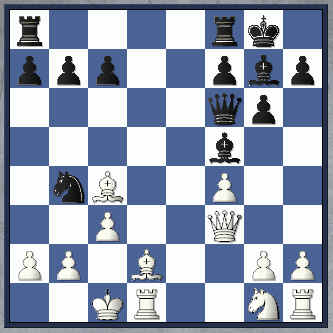
15.Bc4,
(tempo-loss) {See the diagram just below.}
(White had to guard d3 somehow.)
[ Maybe 15.Be1,
{Diagram?} was slightly better than the game,
although Black is probably still
winning after ...Rad8. ]
|
|
(The position just after White has played his 15th move.)
**********
Now Black finishes White with just a few well-placed blows.
15...Qa6!!;
{Diagram?}
"With this exquisite point: if White
captures the Queen, Black
replies 16...NxP/a2 mate." - F. Reinfeld.
16.g4,
{Diagram?}
"This feeble attempt to confuse the
issue leaves Black unruffled."
- Fred Reinfeld.
[ </= 16.Bxa6?? Nxa2#.
White's best try was: 16.cxb4 Qxc4+; 17.Bc3 Qxa2;
{Diagram?}
but Black keeps a killer attack. ]
16...Qxa2!!;
{Diagram?}
The same idea as before.
"Once more, if White replies
17.BxQ/a2, Black has 17...Nxa2#.
Meanwhile Black is threatening
...Qa1# or ...Qb1#, so White
makes
room for his King." - F. Reinfeld.
17.Be3,
{Diagram?}
While nothing here is good for White,
Be1 might have been a little better.
[ 17.Bxa2?? Nxa2# ]
17...Bxc3!!;
{Diagram?}
White Resigns.
"White is overwhelmed by the threats
of 18...Qa1# or 18...Qxb2# or (even)
18...Qb1#.
And of course the reply to
capturing the Bishop on c3, is 18...Qc2 mate."
"Black has played with heart-stirring brio." - Fred Reinfeld.
An extremely energetic and brilliant game by J.H. Blackburne.
{A.J.G.}
Copyright (c) A.J. Goldsby I. Copyright (c) A.J.G; 2003.
(HTML code initially) Generated with ChessBase 8.0
Joseph Henry Blackburne: (1841 - 1924) For many years, (probably well over 100!); he was up and away the strongest player that the British Isles had ever produced. Many books acknowledge the fact that for over 20 years, he was one of the best players in the world. (In the top three, {or four} for about 15 years, according to Sunnucks. And according to Hooper and Whyld he was in the top 6 players in the world for over 20 years. {Probably closer to 25.} To read more about ratings, and see old rating lists ... click here.)
He won MANY tournaments and matches. His greatest triumph was probably BERLIN, 1881. All the best players were there, yet Blackburne finished first ... THREE WHOLE POINTS AHEAD of Zukertort, who was in second place!!! He also came in second in Manchester, 1890 ... just behind Tarrasch, who won this very strong event. He won the British Championship in 1868 ... and tied for first in 1914 ... AT THE AGE OF 72!!
Blackburne had other skills as well, he was a creative and innovative chess player in the openings. (His play here clearly demonstrates that.) He was a good problem-solver, a problem composer, and he was also excellent at BLINDFOLD chess. He also gave HUNDREDS of simultaneous exhibitions, often winning every game he played! P.A. Graham wrote a book that was published in 1899 that contains 407 of his best games. (And a few of his best problems.) {I have the Dover reprint of that book, plus several others on Blackburne as well.}
Click HERE To go to Google and see how many matches you can find for chess and Blackburne.
Click HERE to go (or return) to my "Home Page." (For this site.)
Click
HERE to go to (or return to) to
my page, "Chess Books,
#2."
(Or use the "back" button on your web
browser.)
If you would like to see more annotated games, then click here.
If you would like to see some recent GM games, that are also annotated, then click here.
If you would like to see a couple of my annotated games, then click here.
***
Click
HERE
if you would like to visit my big Geo-Cities web site.
(I have an entire web page devoted to the best short games
of chess!!!)
This page was first posted: Friday; June 6th, 2003. This page was last updated on 09/19/06 .
Copyright (c) A.J. Goldsby, 1994 - 2005.
Copyright (©) A.J. Goldsby, 2006. All rights reserved.
|
|
(Note: This page was previewed approximately 5-7 times.)