GM Tigran V. Petrosian (2695) -
GM Wolfgang Unzicker (2594)
|
|
|

Petrosian won only one game (with the White pieces) from the German GM, and this was it. But it is a real masterpiece, and maybe even the finest game that Petrosian ever played ... in his entire career.
(I am not going to simply copy it here,
however, Irving Chernev's introduction
to this game has to be read to be
believed!
Wanna see it? Buy the book!)
*************************************
{The ratings here come from the
website of the respected chess
statistician, Jeff Sonas.}
(Actually, the ratings come from the "old"
site; in March of 2005, Sonas released a big re-do his entire
site.
For the "new" site, J. Sonas has actually
come out with monthly lists ... I spot-checked just a few of these,
and apparently they are completely accurate. {The
old site only had yearly lists ... in many instances.}
For the June, 1960 list,
Sonas gives a new {updated} rating for Tigran Petrosian of 2764,
and he
gives a rating for Wolfgang Unzicker of 2676.)
1.d4 Nf6;
Black chooses a hyper-modern
move, but as we will see, we can
quickly transpose to a Classical
set-up.
2.Nf3,
White chooses the most solid
second move available to him.
(It controls e5 and also hits d4,
it strongly develops a piece, and
it also prepares castling.)
[ 2.c4, is the choice of most masters here. ]
2...e6;
A good "wait-and-see" move.
Black hits d5, releases his KB
and paves the way for a quick
castling. Meanwhile, the second
player has not (yet) tipped his
hand as to what his definite pawn
structure might look like.
[ Also good is: 2...d5!?; looking to gain equality by copying the opponent's moves. {symmetry} ]
3.Bg5,
Today we call this the Torre Attack,
however Petrosian was the first
really strong GM to use this opening
on any real, consistent basis.
However, here Petrosian uses this
opening to simply steer his
opponent back into the main lines.
[
3.e3 d5; 4.Bd3,
{Diagram?}
is the "Colle Opening."
(See my
WCA February, 2005 lesson ...
for more details.)
**************************************************
3.c4, {Diagram?} is the standard approach here.
After the further moves:
3...d5; 4.Bg5
Nbd7; 5.Nc3 c6; 6.e3 Be7;
7.Rc1 0-0; 8.Bd3,
"+/=" we reach a standard ...
"Queen's Gambit Declined."
[ See MCO-14, page # 391;
all columns and applicable notes.
{Their coverage of the "Orthodox
Variation" is extensive, and
runs
for many, many pages.} ] ]
3...d5;
(high ground)
Black decides to grab his fair
share of the center. (The 'book'
move here is 3...c5; but apparently
Unzicker was more comfortable
playing the Black side of a QGD,
rather than the Black side of the
lines of the Torre Attack - I guess
you would call that a matter of taste.)
[ Black can also try:
3...c5!?; 4.e3 Be7;
{Diagram?}
Probably the best move, Black can
also play 4...Qb6; in this position.
** ** ** ** ** ** ** ** ** ** ** ** ** ** ** ** ** ** ** ** ** ** ** ** ** ** **
( A tough contest - played in
one of the most important of
all competitions - would have
been the following encounter:
4...Qb6;
('!?')
5.Qc1 Nc6; 6.c3 Ne4;
7.Bh4 d5; 8.Nbd2 f5; 9.Nxe4!?,
This exchange seems to give
a slight edge to Black.
( 9.Qc2 Bd6; "~" Unclear ... maybe equal. )
9...fxe4; 10.Nd2 cxd4;
11.exd4 Bd6; 12.Be2 0-0; 13.0-0 Bf4;
14.Bg3 e5;
Interesting, but maybe not
the most accurate.
( Probably an improvement (for
Black) would have been:
(>/=) 14...Bxg3; 15.hxg3 e5!; {Diagram?}
All the programs that I tested
this position on, clearly
indicate that Black is better here. ("/+") )
15.dxe5 Bxg3; 16.hxg3 Nxe5;
17.Nb3 Bg4; 18.Qd1 Bxe2; 19.Qxe2,
19...Qg6; 20.Nd4 Rae8;
{Diagram?}
This is OK, also the immediate
move of 20...Ng4; was worth
serious thought here.
21.Qb5!?,
{Diagram?}
An interesting attempt to
complicate the game by Petrosian.
( Or 21.Nc2 Nd3; "/+" looks excellent for Black. )
21...Ng4; 22.f3 Ne3;
23.g4 a6; 24.Qxb7 exf3;
{Diagram?}
Hmmm, maybe playing the
Rook to the b8-square was
a little better.
( Another possible line is:
>/= 24...Rb8!; 25.Qc6 Rf6; 26.Qc5 Rxb2; 27.Rf2 Rxf2;
28.Kxf2 Nxg4+;
This could be better than the
game, and seems to give Black
a winning attack. )
25.Rxf3 Rxf3; 26.gxf3 Qd6;
27.Ne2 Nc4!?; {Diagram?}
Playing the Knight to c2 looked
like a win for Black.
( >/= 27...Nc2; 28.Rd1 Rxe2; 29.Qxd5+ Qxd5; 30.Rxd5 Ne3; 31.Rd3 Kf7, "-/+" (Fritz 8.0) )
28.Re1 Qc5+?;
{Diagram?}
Black misses a knock-out blow.
(29...Ne5! looks to be a clear
win for Black.) The final phase
of this game is VERY uneven ...
it has all the earmarks of a wild
time scramble.
( >/= 28...Ne5!; 29.Rf1 Nd3; "-/+" )
29.Kg2 Ne3+; 30.Kh3 Nc2;
31.Rd1 Rxe2; 32.Rxd5 Qf8; 33.Rf5 Qd8??;
A true blunder ... missing a mate,
the move of 33...Qe7; looked fine
for Black.
( >/= 33...Qe7[]; 34.Qxa6 h6; "~" {D?} is unclear. )
34.Qf7+, Black Resigns, 1-0.
GM Tigran Petrosian (2621) -
GM Fredrik Olafsson (2506);
/ FIDE Interzonal (izt)
Tournament /
Stockholm, Sweden; /
(R#1), 1962.
(Not a pretty win, but it does show
Petrosian
using this line to defeat another
GM - less than 2 years
later, Tigran Petrosian
became
World Champion.)
This game
greatly affected the
fates of both players. Olafsson
had been playing
well in other
events ... and seemed to be on
a roll. He never really recovered from
this devastating and emotional loss.
Meanwhile, Petrosian seemed to
gain confidence with every game.
If Black had won this game ...
who's to say how chess history
would have been affected?
*******
Editior's
note: I think the ratings for the above game came
from the ChessBase website.
(You can download games in several different
formats. They usually have a rating assigned
for each of the players in any given contest.
However, I do not know the source for this.)
Sonas gives a rating
of 2788 (# 1.)
for Petrosian
as of this date. For Fredrik Olafsson,
Sonas gives a rating
of 2659 ... which makes him the # 23 player in the
world at that time. )
** ** ** ** ** ** ** ** ** ** ** ** ** ** ** ** ** ** ** ** ** ** ** ** ** ** ** ** ** ** **
Back to our opening analysis.
5.Nbd2,
{Diagram?}
Perhaps the most consistent
move, but c3 was good here.
*** *** *** *** *** *** *** *** *** *** *** *** *** *** *** *** *** ***
(
Another way to go would be:
5.c3 b6; 6.Bd3 cxd4; 7.exd4 Ba6;
8.Bxa6 Nxa6;
9.Nbd2, "+/=" 0-0; ("~")
{Diagram?}
MCO gives this as equal,
I prefer unclear or a slight edge
for White.
[ See MCO-14, page # 499, column No. #05 and all applicable notes. ]
This is based on the GM contest:
Gata Kamsky -
Robert Hubner;
/ Dortmund, GER; 1992.
(This game was quickly drawn,
I really don't think that either
player was interested
in a real
fight that day. GM J. Hodgson
has won several nice games
with this line ...
so maybe things
are not as simple as MCO would
have you believe.) )
*** *** *** *** *** *** *** *** *** *** *** *** *** *** *** *** *** ***
5...d5; 6.c3 Nbd7;
7.Bd3 b6; 8.0-0 Bb7;
("+/=") {Diagram?}
White has a small, but solid edge.
GM J. Piket - GM J. Timman;
/
Hoogovens (Merrillville);
1997.
(This game was drawn in under
30 moves.) ]
4.c4!?,
Playing the Pawn to e3 would
have been simpler, but Petrosian
was avoiding a well-known
method for Black to equalize.
(See the variation that begins
with 4.e3, given just below.)
[ After the simple continuation:
4.e3 h6!?; 5.Bh4!? c5!;
{D?}
Black has good play, and usually
can equalize ("=") quickly from here.
See the GM contest:
Alex Moiseenko - Pedrag Nikolic;
EuCup G5 / Pula, (1) / 1999.
(Black equalized ... and went on
to win a long game. {74 moves.}) ]
4...c6;
Now we have transposed back
to a regular ...
"Queen's Gambit Declined."
(With a Slav or Semi-Slav
pawn formation.)
[ 4...Be7; was also possible. {Which should transpose back to book.}
**********************************************************
**********************************************************
A rarely used line would be:
4...Bb4+!?; 5.Nc3 dxc4!?;
"~" {Diagram?}
which Irving Chernev (correctly)
calls: "The Vienna Variation."
[ See MCO-14, page # 422; columns # 73-75, and all applicable notes. ]
*** *** *** *** *** *** *** *** *** *** *** *** *** *** *** *** *** *** *** ***
( Irving Chernev provides the
following game but does not
give us the source:
5...dxc4; 6.e4 c5; 7.Bxc4 cxd4; 8.Nxd4
Qa5; 9.Bxf6!?, {Diagram?}
This is certainly playable,
although it LOOKS extremely
risky, especially at a quick,
first glance!
** ** ** ** ** ** ** ** ** ** ** ** ** ** ** ** ** ** ** ** ** ** ** ** ** ** ** ** ** **
( After the safer moves:
9.Bd2!? Qc5; 10.Bb5+ Bd7; 11.Nb3 Qe7;
12.Bd3 Nc6; 13.0-0, "+/=" 13...0-0;
"~" {D?}
White might be just a little bit
better in this position -
but Black certainly has no reason
to be really unhappy.
GM Vladimir Kramnik - GM Joel Lautier;
The Melody Amber Tournament /
(7th blindfold, round # 10)
Monaco, 1998. {1-0, 46 moves.} )
** ** ** ** ** ** ** ** ** ** ** ** ** ** ** ** ** ** ** ** ** ** ** ** ** ** ** ** ** **
9...Bxc3+; 10.bxc3 Qxc3+; 11.Kf1 Qxc4+;
12.Kg1, {Diagram?}
White almost looks to be playing
some form of "give-away" chess,
there
was no choice ... as the
move of 12.Ne2, "/+" clearly favors
Black.
12...0-0!?; {D?} Not much choice here.
( Definitely not: </= 12...gxf6?; 13.Rc1, '±' and Black has huge problems. )
13.Qg4! g6; 14.Qf4!! Nd7; 15.e5! Nxf6;
16.exf6 Kh8; {Diagram?}
This is forced, White was
threatening to play Qh6.
( </= 16...Qc3?; ('??') 17.Rc1! Qb2; 18.Qh6, ("+/-") and White wins. )
17.Rc1! Qd5?;
{Diagram?}
For reasons that will soon
become evident, Black had to
play his Queen to the
b4-square in this position.
( >/= 17...Qb4; ('!') 18.Qh6 Rg8; 19.Nf3 Qb2!; "~" /w good play. )
18.Qh6! Rg8; 19.Nf3! Qh5; 20.Ng5 Qxh6!?;
21.Nxf7#, {D?}
An amusing and most amazing
little trap.
A. Kotov - Judowitsch; / URS (U.S.S.R.) / 1939. ]
5.Qc2!?,
{See the diagram given, just below here.}
An early Queen move, White is
doing a bit of shadow-boxing
himself. (See the note after
Black's second move.)
This
move is not bad, it protects c4,
clears the way for the QR to
come to d1, and also avoids a
possible pin after 5.Nc3, Bb4.
(Unzicker was fond of that line.)
Meanwhile, Petrosian will develop,
but he will try to keep all of his
options open ... for as long as
he possibly can. (Most of the time,
the average player does not
realize how sophisticated a
simple-looking series of moves
can really be. Hopefully, if I have
done my job, you should have a
better understanding of some of
the nuances of a single move
order - and how a move order
can be used to avoid your
opponent's favorite lines.)
"Both players handle the opening subtly, ..." - GM Andrew Soltis. He goes on to talk about all the opening lines that were played or avoided. (Torre Attack, The Vienna Variation of the QGD, The Cambridge Springs Defense, The main lines of the Botvinnik Variation, etc.)
*********************************
|
|
*********************************
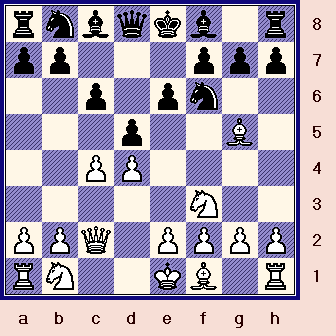
This would be a good place to stop and assess the position and also have a diagram to help us do exactly that.
[ The continuation of:
5.e3 Nbd7; 6.Nc3 Be7;
7.Rc1 0-0; 8.Bd3,
("+/=") {Diag?}
is a transposition is the main
hallways of the QGD. (See the note here after move 3.)
]
5...Be7;
Now both sides continue to
develop ... and in a fairly normal
manner for this particular opening.
[ Another possibility for Black
would be the continuation:
5...Nbd7; 6.e3 Qa5+!?;
{Diagram?}
One book strongly recommends
this move as the equalizing play.
( Maybe the simple continuation:
(>/=) 6...Be7; 7.Nbd2 0-0; 8.cxd5 exd5;
9.Bd3, ("+/=") 9...a5!?;
would have been a fairly
substantial improvement
for Black. )
7.Nbd2 Ne4!?; 8.Bf4 Be7;
9.cxd5 exd5; 10.Bd3 Ndf6; 11.0-0 Bf5;
12.Nb3 Qd8; 13.Ne5 Bg6;
14.f3!,
"+/=" {Diagram?}
White had a significant edge ...
and went on to win the game in
less than 35 moves.
GM J. Lautier - GM D. Barua;
/
(FIDE) World Championship
Tournament,
(knock-out
event); / Moscow, Russia, 2001. ]
6.e3 0-0;
7.Nc3 h6!?;
A crucial moment in the game.
Black immediately ... ... ...
"asks the question" of White's
Bishop on g5. The real question
is whether or not Black should have delayed this whole procedure
until a later time.
[ Black could also play:
(>/=) 7...Nbd7; 8.Rc1 a6;
9.a3 Re8; 10.Bd3,
("+/=")
White has a solid plus - and
went on to win the game in
51 moves.
GM Rafael Vaganian (2575) -
GM David Bronstein (2630);
ICT / Kirovakan
(Round #11), USSR / 1978.
(White won a good game, 1-0 in
51 total moves.) ]
8.Bf4!,
Bearing down on e5, making
a Pawn break on that square -
anytime soon - nearly impossible.
('!' - GM Andrew Soltis)
[ 8.Bh4, ('!?') was also possible. (White has a small advantage, "+/=".)
GM Igor Khenkin
(2585) -
GM Roman Slobodjan (2550);
ICT / 20th Arco Open
(Round # 04) / 1998.
(White won a nice game in
54 total moves.)
***********************************************************
A solid reference work provides
the following continuation for White:
8.Bxf6!? Bxf6; 9.Rd1 g6!?;
10.Bd3 dxc4; 11.Bxc4 Nd7!?;
12.h4!?,
("+/=") 12...Bg7!?;
"~" {Diagram?}
The end of the column.
White has a small edge, although
MCO evaluates this particular
position as being unclear.
This is based on the following
super-GM contest:
Vladimir Kramnik -
Nigel Short;
(Ratings = W-2730; B-2645)
ICT / Super-Master (Invitational) /
Dortmund, Germany; (R5) / 1995.
{White won an exceedingly
brilliant
game in 25 moves ... it is beyond
my ken to analyze that game here.}
[ See MCO-14, page # 401; column # 29, and esp. note # (x.). ] ]
8...Nbd7;
Black definitely should continue with
his development in this position.
[ Black should not play:
</= 8...Nh5!?; ('?!')
9.Be5 f6?;
('??') {Diagram?}
A bad move ... that was actually
recommended by a well-known
chess writer in his regular, weekly
newspaper column!
10.Bxb8! Rxb8; 11.g4,
("+/-") {Diagram?}
White is winning a piece. ]
9.cxd5!,
Petrosian had a very dry style,
but he was correct here - in order
to gain a long lasting advantage,
White must: A.) Fix the pawn structure;
B.) Avoid losing any tempi.
(White has also played Rd1 in
this position, but it is not clear that
it leads to a clear or solid edge
for White.)
[ White can also try:
9.Rd1 Qa5; 10.Nd2 Nh5;
11.Be5 Nxe5; 12.dxe5 g6; 13.h4,
("~") {Diagram?}
GM Anthony Miles (2580) -
GM Jesus Nogueiras (2555);
/ GMA-qual f Moscow (3), 05,1990.
(This was an "up-and-down"
game that was eventually
drawn in 58 moves.) ]
9...cxd5!?;
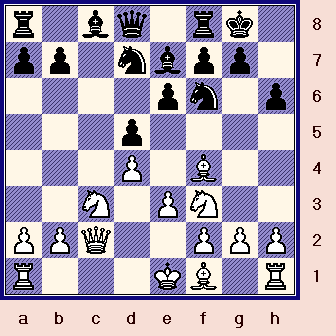
(Maybe dubious?) {See the diagram given below.}
Believe it or not, this is a (THE?)
'book' move for Black in this
particular position.
In most sources that I could find this game, this move is rarely questioned - one opening book gives this move without any comment at all. However, two other recaptures were playable here, and taking with the other Pawn was probably better than what transpired in the game.
*********************************
|
|
*********************************
White now has a solid advantage ... and begins to build on this in an impressive fashion.
[ Another way to go might be:
(>/=)
9...Nxd5!?;
{Diagram?}
Interesting, ('!?') and certainly
fully playable.
10.Bg3,
{Diagram?}
The alternative was to exchange
on the d5-square.
( Or White could play instead:
10.Nxd5 exd5; 11.a3 Nf6; 12.h3 Ne4; 13.Bd3 Qa5+;
14.Nd2 Nxd2; 15.Qxd2 Qxd2+; 16.Kxd2,
("+/=") {Diag?}
Black has nothing to fear
here, with a reasonable defense ...
I can't imagine
Black losing this position. )
10...Qa5;
11.Rc1,
"+/=" 11...Re8;
"~" {Diagram?}
Black can play his Bishop to f6,
and play the freeing advance,
...e7-e5; with a very good game.
************************************************************
Seemingly the most accurate would have been:
>/=
9...exd5!; 10.Be2 Nh5!;
("=") {Diagram?}
when Black has full equality. ]
10.Bd3 a6!?;
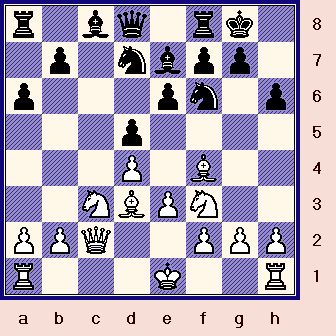
{See the diagram given below.}
Some authors have said that this
move was forced - to prevent Nb5.
*********************************
|
|
*********************************
Either here, or on his next move, Black should have seriously considered the move, 10...Nh5! (This does NOT mean that this move will completely bail Black out of all his difficulties, not by a long shot! But its a place to start any real search for improvements.)
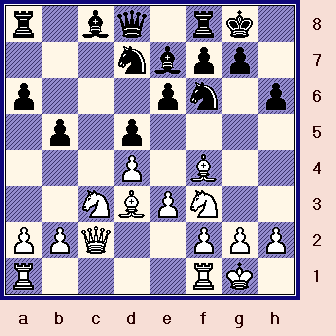
11.0-0 b5!?;
(Maybe dubious?) {See the diagram given below.}
Normally a Q-side advance like
this would give Black good play,
but here Petrosian exploits the
downside of this move with great
force and artistry.
*********************************
|
|
*********************************
Some of the authors and pundits have branded this move ... as "the losing move" in this 'partie.'
However, close analysis, {see the detailed variation given below}; has shown me that Black already has an extremely difficult game here. Therefore, if Black really wants to improve his play in this contest, you have to look back much earlier than move eleven! ('?' - GM Andrew Soltis. This is not an indictment of Soltis, often he is just repeating what has already been written about a move in various chess magazines and newspaper columns.)
*** *** *** *** *** ***
Let me share a theory I have about annotating chess games. Often times, when a player loses a game, it is a very normal reaction to go looking for ... "the smoking gun." The writers find the one move that they believe to be bad, slap a label on it ... and BINGO! All the problems have been resolved.
But chess is vastly more complicated than that. Often times, a player might play a second (or third) best move ... for a whole long series of moves. This often has a devastating and very severe, "CUMULATIVE EFFECT." In other words, one move - by itself - is really not all that bad. The computer program will not even indicate any type of variations in the evaluations of the position. But if you add all of these slightly "less-than-best" moves together, it can add up to one side getting the worst of things.
Another aspect of chess annotation that compounds this problem is that there is not a set yardstick for this part of chess. What one author, say an extremely critical writer like GM R. Huebner, (who is still one of the world's best analysts); might give a move a whole question mark, or even TWO question marks. Yet another author might give the same play only the dubious ('?!') appellation.
In the end, it will probably be the computer that resolves this issue. A move that causes a slight dip in the evaluation of the position could be considered dubious. A move that causes a drop in the 'scoring' of a position that is greater than say 0.75, could be considered worthy of a whole question mark. Exclams will still be a matter of taste, however. What I consider to be a very fine or a deeply hidden move, someone else, sitting at home and analyzing with the aid of a computer, might consider to be just a routine move.
In this game, Black played a whole
series of moves that could be justly
considered as: "less than best."
(From move seven to eleven.) If I
were to condemn any one move and
attach any kind of mark to it, it would
have to be Black's ninth move. This is
curious, as theory has been - at
least up until 2005 - very silent on
the real merits, (or the lack thereof); of this particular play.
[ Black could have tried:
11...Nh5!?; 12.Be5! f6!?;
{Diagram?}
One GM stopped here ... and
stated that Black has ... "complete equality."
(ha-ha-ha!)
13.Bc7!! Qxc7; Black may not refuse this gift.
( </= 13...Qe8??; 14.Bg6, "+/-" )
14.Nxd5! Qxc2;
{Diagram?}
Several programs indicate that
this move is probably forced.
( </= 14...Qd8?; 15.Nc7! Rb8!?; 16.Nxe6 Qb6;
17.Bc4! f5; 18.Nf4+ Kh8; 19.Nxh5,
("+/-") {D?}
White is two Pawns ahead, and
all the programs that
I tested this
position indicate that White is
simply
winning in this position. )
15.Nxe7+ Kf7; 16.Bxc2 Kxe7;
17.Bg6 b6; 18.Bxh5 Bb7; 19.Nd2,
'±'
White is a solid Pawn ahead ...
with no weaknesses that Black
can play for.
(This is basically a
won game for White, especially
with some good technique.)
***************************************************************************
Black could also try:
(</=)
11...Nb8!?;
(- Irving Chernev)
It is NOT entirely clear if this really
represents a valid improvement
over the actual game!
(In my own
opinion, Black is just trading one
bad game for another inferior,
and nearly
lifeless position.)
12.Qe2! Nc6; 13.Ne5 Bd7;
14.Rac1, "+/=" (Maybe "±")
{Diagram?}
and White has a VERY large
and significant advantage here. ]
12.a4!,
Several of my students found
this play rather surprising with
the White Queen still sitting on
the c-file. Nonetheless, this is
the correct procedure - the first
player must open lines and
exploit Black's lagging Q-side
development, before the second player has a chance to catch up.
[ The continuation of:
</=
12.h3 Bb7; 13.Rac1 Rc8;
{Diagram?}
is not as convincing as the
method that White chose in
the actual game. ]
12...b4;
This is virtually forced, otherwise
Black will lose a Pawn.
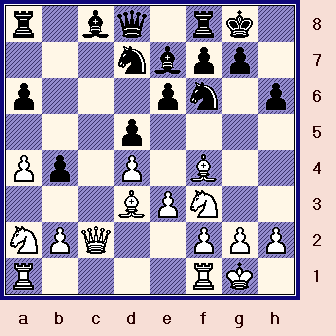
13.Na2!,
(Maybe - '!!') {See the diagram given below.}
('!' - GM Andrew Soltis)
The reason for playing this Knight to this particular square is NOT immediately apparent - even the computer prefers to play the Knight to e2 instead.
*********************************
|
|
*********************************
"Much superior to Ne2," says the revered and respected ... Irving Chernev.
[ 13.Ne2 Bb7; 14.Rac1, ("+/=") was also good for White. ]
13...Ne8;
14.Nc1 a5; 15.Nb3 Ba6;
As a result of the choice that
Unzicker made on his ninth move,
this Bishop is a rather sorry piece.
Rather than maintain a soldier
with limited movement, Black
decides to simply exchange it
for his opponent's good Bishop.
16.Bxa6 Rxa6;
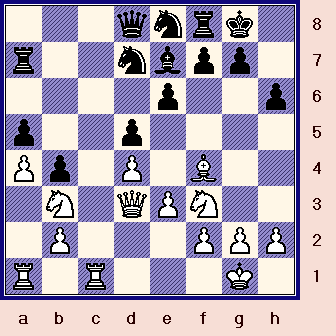
17.Qd3 Ra7; 18.Rfc1!, {See the diagram given below.}
Now the reasons for White's
13th move become more apparent.
The piece (N) on b3 will perpetually
harass the Black a-Pawn, continuously
threaten to grab the outpost on c5,
and aids White in his ability to
dominate the only open file.
*********************************
|
|
*********************************
Black's position is something of a mess, he must immediately begin untangling the knots ... or face the consequences.
[ Or 18.Ne5 Nxe5; 19.Bxe5; "~" Unclear. ]
18...Nd6;
Black's position looks rather
congested, but not at all without
play ...
perhaps Unzicker has
chances for some Q-side piece
activity.
[ </= 18...Bd6?!; 19.Ne5!, '±' ]
19.Bxd6!,
(Maybe - '!!')
This looks like a mistake, exchanging
off a Bishop with plenty of open lines
for a Knight with very limited range.
However, Petrosian's decision is
guided by a very deep understanding
of the position and also his knowledge
of the endgame. (In positions with fixed
Pawn structures, as in this game, it is
often best to have a Knight! Especially
in the endgame!!!)
(now) "Black does not get to occupy either c4 or e4." - GM A. Soltis
[ 19.Rc2!?, "+/=" was also possible here. ]
19...Bxd6;
20.Rc6! Nb8; {Box?}
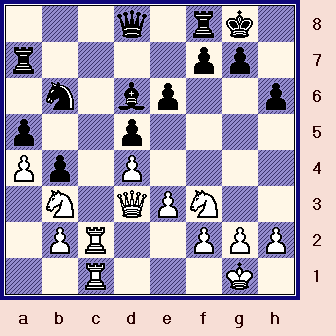
21.Rc2 Nd7; 22.Rac1 Nb6; {See the diagram given below.}
Black is permanently hobbled
by his weak a-Pawn, and will
never be able to challenge White's
dominance of the c-file, (see the
variation given after 22...Rc7).
Therefore Black is limited to fighting
a limited guerilla war and seeking
counterplay by attacking White's
foot-soldier on a4.
*********************************
|
|
*********************************
This is a good place for a diagram.
(Take a few minutes and ponder this
position. Try to weigh up all of the
reasons why White is better here.)
[ Black gets in trouble after:
</= 22...Rc7;
('?') {Diagram?}
This move is a mistake, or at
least highly inadvisable.
23.Qb5 Rxc2; 24.Rxc2 Bc7;
25.Qb7 Bb8; 26.Nxa5,
26...Qxa5; 27.Qxd7,
"+/=" (Really '±')
{Diagram?}
White has won a Pawn and should
win the game,
especially with best
play from this position. ]
Soltis gives Whites next move an
exclam ... his explanation of the
move is valid so I must concur.
23.Qb5! Nc4;
24.Nfd2, (Maybe - '!')
Petrosian naturally exchanges
off his opponent's one really
good piece.
[ Not
</= 24.Kf1, ('?!')
24...Qa8!;
{Diagram?}
and suddenly White is in trouble,
as Black threatens ...Rb8. ]
24...Nxd2;
25.Rxd2 Qa8; 26.Rdc2 Rd8;
Black's Bishop looks to be fine,
the truth is quite the opposite of
this.
(In an endgame, the weakness
on a5 will probably doom Black.
This is why Black does NOT try to
exchange Rooks in this game!)
Irving Chernev confirms my
observations by providing the
following comment:
"Passive resistance, but energetic
measures might be dangerous."
[ Or if 26...Rb8; then 27.Qd3, "+/="
****************************************
Bad for Black is the continuation:
</= 26...Qb7?!; ('?')
27.Qxb7 Rxb7;
28.Rc6 Rd8;
29.Ra6,
'±'
White has picked off a Pawn and
is probably winning here. ("+/-")
{Analysis by the author, Irving Chernev.}
]
27.Rc6 g6;
Black is forced to play a waiting
game ... it is up to Petrosian to
demonstrate how he will manage
to win from this position.
(Black's
last move gave his King some air,
and avoided a possible back-rank
mate in the future. Several sources
criticize Black's last move,
suggesting 27...h6; in its place. To
me, it does not really matter - Black
has no effective antidote to what Petrosian cooks up.)
28.g3 Kg7;
Very few people know that Unzicker
offered a draw around this move -
and that the normally mild Petrosian
turned him down.
29.Kf1!!,
{Truly spectacular!}
(It is time ... for a King march?)
{A diagram - just below.}
('!!' - GM Andrew Soltis)
This quiet King move is actually
a prelude to a monster attack.
(Petrosian has hatched a nearly
unbelievable idea ... he will march
his King all the way to the Q-side.
Once his King is safely tucked away
he will advance all of his Pawns in
that sector to fatally expose the
Black King. Meanwhile, Black will
be unable to try and pare down the
material, because the endgame is
virtually lost for him.)
The really cool part of Petrosian's plan is that he saw he had no weak spots or further points of entry into Black's position. But having fettered Unzicker through his complete and total domination of the Queenside, the crafty Petrosian uses this lull most impressively ... to shepherd his own King to safety and then open lines on the right-hand side of the board.
I can further comment (and compliment) on this game by saying that this contest is extraordinary and I cannot readily think of many parallels in chess. In fact, I can't think of any game that shows such a grandiose display of superior strategy, and where such a complete dominance on one wing is so quickly converted into a winning advantage in the opposite sector.
The authors of the magazine "64"
(in an article) praised this move as ... ... ...
"One of the most remarkable and
ingenious plans ever conceived."
*********************************
|
|
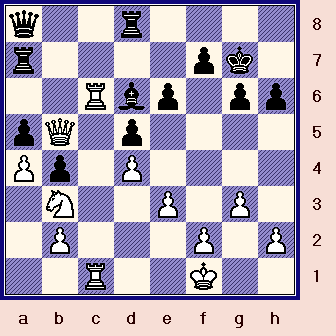
The position just after the move, 29.Kf1!!
*********************************
This is the current position in the game.
[ Also good was: 29.h4, ("+/=") with an advantage to White. ]
During the next series of moves here,
Petrosian continues to execute his
idea(s), while poor Unzicker has
been reduced to moving his King
back and forth.
29...Kg8;
30.h4 h5; 31.R1c2 Kh7; 32.Ke1 Kg8; 33.Kd1 Kh7; 34.Kc1 Kg8;
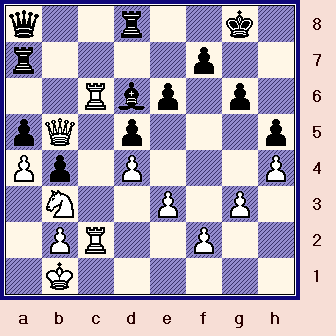
35.Kb1,
{See the diagram given below.}
The first phase of Petrosian's
plan is complete - his King is
safely tucked away.
*********************************
|
|
*********************************
Take a look at the position now, see how much things have changed since the last time that we looked at the position.
[ 35.f4, ("+/=") ]
35...Kh7;
36.Qe2 Qb7; 37.Rc1!,
Beginning a pleasing "switch-back"
theme, White's pieces must now be
available for service on the K-side
as well!
[ 37.g4!?, is also good for White. ]
Irving Chernev gives White's 38th
move an exclam ... he gives a very
good line of reasoning ... and an
excellent variation as well.
(I concur,
it gives Black a big opportunity to
go wrong.)
37...Kg7;
38.Qb5! Qa8[];
Black cannot exchange Queens,
as much as he would like to.
Few people have pointed out, that - on the whole - GM W. Unzicker played VERY good defense in this game! A lesser mortal would have fallen into one of the many snares that Petrosian was constantly setting in this super-human contest.
[ Black cannot play:
</= 38...Qxb5?;
39.axb5 a4; 40.b6 Rad7; 41.Na5, (!)
This wins ... and I think it is
easily the most accurate. But White did have one
alternative here.
( The computer likes:
(</=) 41.Nc5!? Bxc5; 42.dxc5, '±' {Diagram?}
and Shredder 9.0 evaluates this position as winning
("+/-") for White. However, it is hard to see how
White can get his pair of passed Pawns rolling. )
41...Ra8; 42.Rxd6!! Rxd6; 43.b7 Rb8!?;
{Diagram?}
This looks like a natural move (for
Black).
( The computers give
the almost insane-looking continuation of:
(</=) 43...Rh8; ('?!') 44.b3! Rd7; 44.bxa4,
Rb8;
45.Kb2, Kf6; 47.Kb3, ("+/-") {Diagram?}
and now the computer, (Fritz 8.0); evaluates this position
as completely winning for White. )
44.Rc8 Rd8; 45.Rxd8! Rxd8; 46.Nc6,
("+/-")
when White has an easy win. {Analysis by - Irving Chernev.}
(This variation was double-checked
and modified on April 15th, 2005.) ]
39.f4 Kh7;
40.Qe2! Qb7; (Handshake?)
Black plays to {hopefully} repeat the position, and get a draw.
[ One of my
{former} on-line students suggested ...f7-f5; in this position, so
as
to prevent White from playing the
g2-g4 idea that occurs in the game.
</= 40...f5?!;
41.Rb6! Kg7!?; 42.Qb5 Kg8; 43.Rcc6 Bc7;
44.Ra6 Rxa6; 45.Rxa6 Qc8;
46.Nc5, '±' (Maybe "+/-")
{Dg?}
Black's position is ready to
fall apart here, several programs
evaluate this position as simply
winning for White. ]
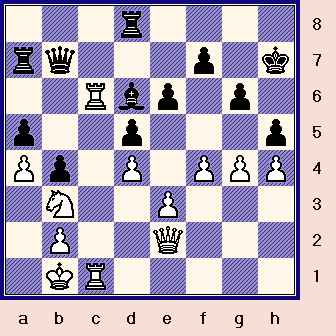
41.g4!,
{See the diagram given below.}
After a bit of jockeying for position -
perhaps in order to reach the time
control on move forty - White begins
phase two of his plan ... and begins
opening lines to the hapless Black
King. (Whom unlike his counterpart,
has no safe haven to flee to!)
*********************************
|
|
*********************************
Now it can be readily seen that White's own King is safe, and the first party can begin to tear open some lines in an effort to try and get at the opponent's King.
[ 41.Ka2, ("+/=") ]
41...hxg4;
42.Qxg4 Qe7; 43.h5 Qf6; 44.Ka2!, ('!' - GM Andrew Soltis)
Unzicker's one hope is that
Petrosian will miss the idea of
...Qf5+; forcing an exchange
of Queens. (No such luck!)
[ Or 44.Rb6 Qf5+; 45.Qxf5 gxf5; "~" (Unclear?) ]
44...Kg7;
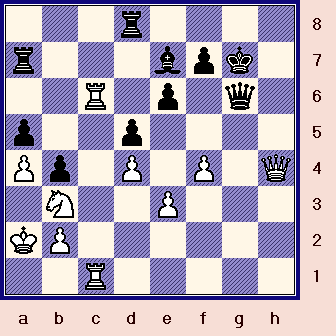
45.hxg6 Qxg6; 46.Qh4! Be7; {See the diagram given below.}
(Black's last move was probably
forced.) White's advantage is big ...
and thanks to superior strategy ...
it just keeps getting bigger.
Meanwhile, Black has no real source
of counterplay, he can only sit there
and await the killing blow.
*********************************
|
|
*********************************
With Black's King sitting in an open file, it is {now} obvious to even the most casual observer that Unzicker has some real problems in this position.
[ But not:
</= 46...Rh8; ('?')
as then 47.Qf2,
("+/-") {Diag?}
and Black cannot deal with two
decisive threats ... his Bishop on
d6 is hanging and White also
threatens Rg1, pinning (and
winning)
the Black Queen. ]
White's next move looks like a
retreat ... but actually threatens
to pin (and win) the Black Queen by playing "Rook-to-g1" here.
47.Qf2 Kf8[];
48.Nd2!,
After sitting on b3 ... seemingly
for the whole game ... the Knight
on b3, who was bored out of his
gourd, decides that he likes the
look of this little party ... and decides
to come on over and get in on the
action. (The e5-square is now
tailor-made for a Knight, anyway.)
The reason that this move gets an exclam is that I have shown this game many times over the years. Few, if any, of my students find this cunning Knight maneuver. (There are many interesting ways for Black to lose.)
"The Knight seems headed for K5,
but then Petrosian changes his mind ... - or is he toying with Unzicker?"
--- The one and only, Irving Chernev.
[ Also good for White was: 48.Qh2!?±, (Maybe "+/-") ]
48...Rb7;
49.Nb3 Ra7;
The Rook is forced back.
Now Black seems to be holding,
his position, so how does White
break through?
50.Qh2!,
(Maybe - '!!')
This seemingly innocent Queen
move is actually decisive, now
there is nothing to be done about
White's many threats.
[ Also good was: 50.R1c2, "+/" ]
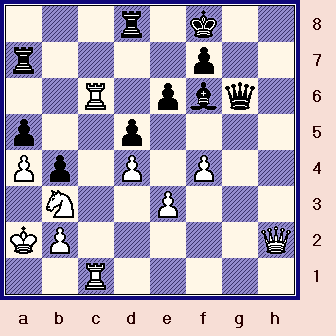
50...Bf6!?,
{See the diagram given below.}
Something like this is probably
forced - instead playing the Queen
to f6 will probably just transpose to
the note that begins with the move,
50...Raa8.
*********************************
|
|
*********************************
Now White is ready to begin some fireworks ... just in case Black has gotten bored with all this maneuvering.
[ After the following continuation:
(>/=)
50...Raa8; 51.f5, {Diagram?}
The long-awaited breakthrough.
( 51.Rg1±, ("+/") )
51...Qf6; {Diagram?} This is forced.
*******
( </= 51...Qxf5??; 52.Qh8#.
*** *** *** *** *** *** *** *** *** ***
</= 51...exf5??; 52.Rxg6, "+/-"
*** *** *** *** *** *** *** *** *** ***
51...Qg4!?; 52.fxe6 Qh4; 53.Qxh4 Bxh4;
54.Rc7 Be7; 55.Rf1, ("+/-") - Fritz 8.0 )
*******
52.fxe6 fxe6; 53.Qh3 Bd6;
54.Rf1, ("+/-") {Diagram?}
(and) Black has lost his Queen.
**********************************************************************
Of course it is bad for Black to
play the following variant:
</=
50...Bd6?; 51.Rxd6 Rxd6;
52.f5 exf5; 53.Qh8+ Ke7; 54.Rc8,
("+/-")
... and Black is lost. {Chernev}
**********************************************************************
Maybe the best defense was to
play the Queen to the f6-square.
However, this would NOT have
saved Black ... as the following
analysis will clearly demonstrate:
(>/=)
50...Qf6; ('!')
51.Rc8! Ra8; 52.Rxa8! Rxa8;
53.Rh1 Bd8;
54.Qc2! Be7; 55.Qc7 Kg7!?;
56.Qb7! Re8!?; {Diagram?}
There are not a lot of great
squares for Black's Rook to
go to here.
( </= 56...Rh8?!; 57.Rxh8 Kxh8; 58.Nxa5 Bd6; 59.Nc6, "+/-" )
57.Nxa5 Bf8; 58.Rg1+! Kh7;
59.Nc6 b3+!?; 60.Kxb3! Qf5;
61.Ka2 Bh6!?;
{Diagram?}
This is almost forced - Black
is running out of moves.
( After the moves: </= 61...Bd6?!; 62.Qd7 Ra8;
63.a5 Bf8;
64.Qb7 Re8; 65.a6, ("+/-") {Diagram?}
Black is clearly lost. )
62.Ne5 Qf6; 63.Ng4!! Qg6;
64.Rh1!, ("+/-")
{Diagram?}
White wins at least a piece. ]
*** *** *** *** *** *** *** *** *** *** *** *** *** *** *** *** *** *** *** *** *** *** *** ***
After all the {above} analysis,
we return to the actual game.
51.Rc8!,
('!' - GM Andrew Soltis)
The final assault begins.
Chernev points out that White
intends the following continuation:
52.RxR/d8+, BxR/d8; 53.Rc8 Ke7; 54.RxB/d8!, KxR/d8; 55.f5!, QxP/f5;
56.Qb8+, "+/-"
... "and White wins the Rook." (It is always ESSENTIAL to try and
figure out what your opponent's
PRIMARY (tactical) THREAT is!!)
[ White could also play:
51.Qh3!?±,
{Diagram?}
which gives White a very
large edge. ("+/") ]
51...Rad7;
('!?')
(Double-hmmm)
It no longer matters, Unzicker was
a good enough player to know when
he was beaten.
(Playing the Rook to
the a8-square was just slightly better,
but would not have averted the loss
from this position.)
[
(>/=) 51...Ra8; 52.R8c7 Bg7; 53.Nc5
Qh6; 54.Qg3 Re8;
55.Nd7+ Kg8;
56.Ne5 Rf8; 57.Rg1 Ra6; {Diagram?}
Black is completely tied up
in this position.
58.Rc2 Ra7; 59.Rh2 Qf6;
{Diagram?}
Black actually had to play his
Queen to the g6-square to avoid
the mate, however, I am sure that
Unzicker would have preferred
resignation to play that move!
60.Qh3,
("+/-") {Diagram?}
and Black cannot avoid a mate
in more than three more moves.
*************************************************************
Another gross line for Black is:
</= 51...Rxc8?; 52.Rxc8+ Ke7;
53.f5! Qxf5; 54.Qh6! Kd7;
55.Qf8 Rc7; 56.Rb8 Qc2;
57.Qe8+ Kd6; 58.Nxa5 Bh4!?;
59.Rb6+,
("+/-") {Diagram?}
and Black would surely resign.
(This time, improving on Chernev,
but thanks only to the modern
marvel of the PC and also a
strong chess program .................
like Fritz 8.0.)
*************************************************************
Also bad for Black would be:
</= 51...Rb7?;
52.f5! exf5!?;
{Diagram?}
This leads to the prettiest finish.
( >/= 52...Qxf5; 53.Qd6+ Ke8; 54.Rxd8+! Bxd8;
55.Rh1 Qf6;
56.Qc6+ Rd7; ('?') {Diagram?}
The box indicates that this move
is an error and that Kf8 was
forced. However, I doubt many human
players would continue
from a
position where they were a Rook
down!
(Play now continues in our analysis line.)
57.Nc5 Qe7!?; 58.Rh8+ Qf8; 59.Qxd7#. )
53.Qd6+! Ke8; 54.Qc6+ Rbd7;
55.Nc5, ("+/-")
{Diagram?}
White wins easily, as the move
of 55...Be7?; is met by 56.Qxd7+!
(Or if 55...Ke7; then
simply 56.NxR/d7.) ]
52.Nc5!,
('!' ... ... ... maybe - '!!')
The great Tigran Petrosian has
timed everything perfectly ...
Black cannot even grab the Rook
that seems to hang on the
c8-square.
[ 52.f5!?, {Diagram?} probably would also win the game for White. ]
52...b3+,
This is known in the business
as ... "a spite check."
[ Even worse for Black would have
been the following variation:
</= 52...Rxc8; ('?')
53.Nxd7+ Ke8; 54.Rxc8+ Kxd7;
55.f5 Qxf5; ('?')
{Diagram?} This is the same as resignation.
( Or if 55...Kxc8; then just
simply 56.fxg6, ("+/-")
and Black should quit here. )
56.Qc7#. (OUCH!!!) ]
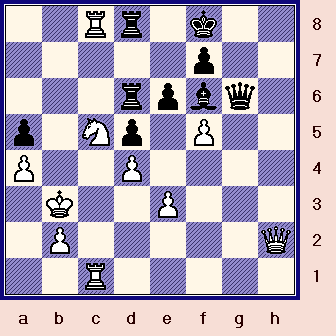
53.Kxb3 Rd6;
54.f5!!, (BOOM!!!)
{See the diagram given below.}
Petrosian plays this crushing move
only when the tension in the position
has reached an absolute crescendo.
"At last! This has been hanging over
Unzicker's head just as The Sword of
Dionysus hung over that of Damocles."
- The incomparable Irving Chernev
*********************************
|
|
*********************************
The problems that face Black are his Queen is hanging ... and, thanks to the pinning action of the White Rook on c8, Petrosian also threatens QxR/d6+.
[ After the continuation of:
54.Rc7, ('!?')
{Diagram?}
which should also carry the day, ("+/-"); for White ...
but it is not nearly as effective
as the move that Petrosian actually played in this game. ]
54...Rb6+;
55.Ka2, ("+/-") Black
Resigns, 1-0.
(Black's Queen is threatened - so
Black must capture the pawn on f5;
and thus is unable to defend all of
White's other threats in this position.)
[
After the further moves:
55.Ka2 exf5; 56.Nd7+ Kg7;
57.Nxb6, "+/-" {D?}
White wins a whole Rook. ]
*********************************
|
|
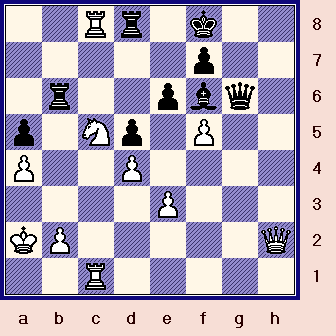
The final position in this superb contest.
*********************************
In terms of pure STRATEGY -
one of the most brilliant displays
ever played on a chess board;
the wily Tigran Petrosian had every
angle covered!!!
<< A MASTERLY performance by
(the great) Tigran Petrosian. >>
- Irving Chernev. (my emphasis)
***********************************************************************************
***********************************************************************************
BIBLIOGRAPHY:
I have seen this game in more books
than I care to count, I have nearly
every good book on Petrosian
that
has ever been printed in the English
language. I also have all the main,
modern reference books, like
MCO,
NCO, BCO, ECO, SCO, etc. I also
used all my books on the Queen's
Gambit Declined that I
own, (somewhere around 30); during my work
on this great GM contest.
However, one book stands out above
all others, at least as far as I am
concerned here.
That would be:
# 1.) << THE GOLDEN DOZEN >>
"The Twelve Greatest Chess Players
... Of All Time,"
by Irving Chernev. Copyright (c) 1976, by the author.
Published by: Oxford University
Press, (NY, USA) and also Oxford.
His notes are far better than mine.
(During the critical phases of the
game, there is a comment after
nearly every move!!!) I have given
you just a taste here, in the hopes
that you will buy this most excellent
book! (You may want to carefully
search the Internet, or any stores
that sell used books in your area.)
*** *** *** *** *** *** *** *** *** *** *** *** *** *** *** *** *** *** *** ***
# 2.) GM Andy Soltis wrote a wonderful
book by the name of:
< The 100 Best. >
("The 100 Best Chess Games of
The
20th Century, Ranked.")
It was published
in the year, 2000; by McFarland & Company
Inc. Jefferson, North Carolina / USA.
ISBN: # 0-7864-0926-6, Hard-cover.
In this book, he ranks this as game
number # 76, overall. He showers this
contest with praise and
exclamation
marks. Additionally, he gave this game
very high marks for originality. (18/20)
***********************************************************************************
***********************************************************************************
Copyright (c) A.J. Goldsby, 2005. All rights reserved.
1 - 0
[My bio of this player.] [Petrosian's games] [A good example of Petrosian's tactical skill.]

