|
|
|
|
We will examine a beautiful game below ... first, I wanted to give a little background information about the winner of this contest.
|
|
|
|
|
|
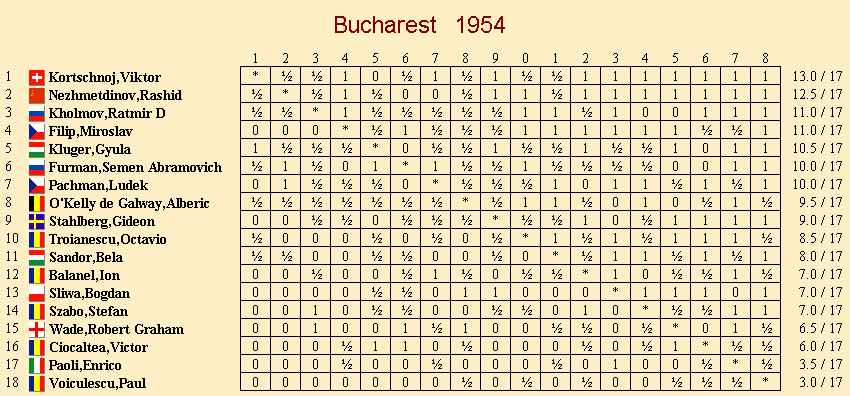
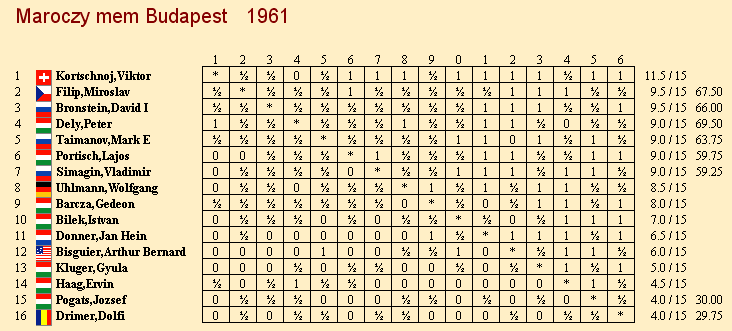
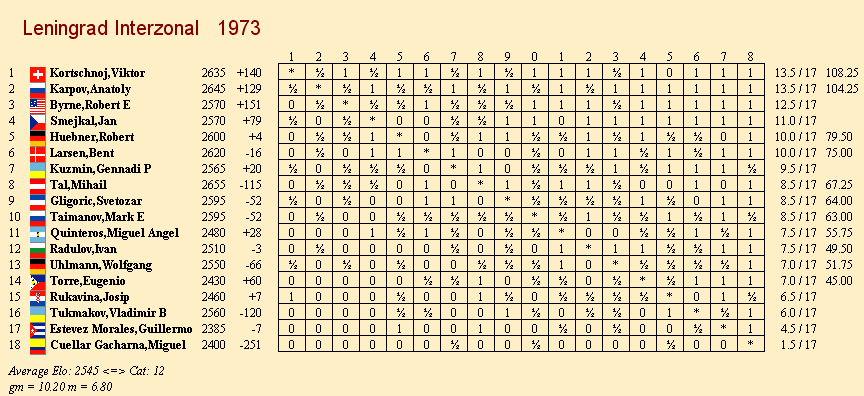
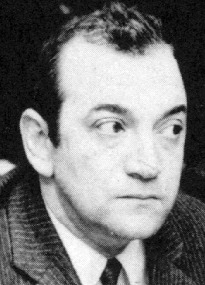
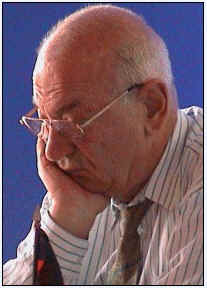
GM Victor Korchnoi, (spelled in the CB database as "Kortschnoj"); has long been one of my favorite players. When I first learned of this player (I was about seven years old when someone first told me about Korchnoi.); ... and his many exploits ... I was immediately enthralled. I was eighteen years old ... and playing in a tournament ... when I first heard the news that Korchnoi had defected. Naturally, the departure of one of the world's strongest GM's from the {former} Soviet Union sent out shock waves that were felt in every corner of the chess world. On his page of "peak ratings" (based on a three-year average); Jeff Sonas ranks Korchnoi as #12 of all time!!! *********************
********************* [His chess games.] [Some biographical data and trivia about this great player.] [His Wikipedia entry.] [CB, Korch going strong at 75.] [CB, Korchnoi wins International event at age 73.] [CB, K takes Berlin.] [CB, Dennis Monokroussos on this great player.] [Another page, with more Korchnoi info and links.] I continue to enjoy Korchnoi's games. My friend, (Stephen Davis); and I always try to go over his games together at chess club. I celebrate every time he wins, and I can only pray that he will continue to delight his fans for many years to come! |
|
|
Viktor Korchnoi wins World Senior Championship!! 23.09.2006
This man has been a
candidate for the world championship since the sixties, and although he
never actually won the title (in spite of three finals against Karpov)
he remained in the world elite for decades. At 75 he still plays in top
events, but now has taken part in a Senior Championship, which he
naturally won. |
An explanation of the symbols that I use when annotating a chess game. [replay - on another site]
GM Vicktor Kortschnoj (2670) -
GM Anatoly Karpov (2700)
|
|
|
Miniatures and brilliancies at the very highest levels are extremely rare, players are often so evenly matched ... that a quick knockout is not really probable. But here is one of the best examples of this type of chess (at such a rarified plane) ... that I know of.
1.d4 Nf6;
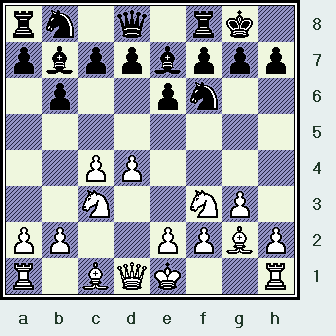
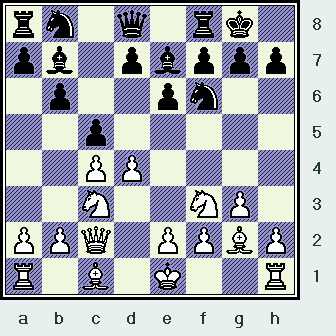
2.Nf3 e6; 3.g3 b6; 4.Bg2 Bb7; 5.c4 Be7; 6.Nc3 0-0; {Diagram.}
By a slightly unusual move order, we have arrived at a fairly normal "tabiya" of the Queen's Indian.
(>/= 6...Ne4 is the most popular move for Black in this position today.)
|
|
rn1q1rk1/pbppbppp/1p2pn2/8/2PP4/2N2NP1/PP2PPBP/R1BQK2R w
Today these lines are pretty thoroughly mapped out, however in the 1970's, things were not as clear. (It is also important to remember that this was played in "B.C." (BEFORE COMPUTERS. No Fritz, no PC's, no monster database of master-level games.)
[ See MCO-14, beginning on page # 555; for more information on this opening and analysis
of many of today's key, topical lines. ]
7.Qc2! c5!?;
(Hmmm.) {Diagram.}
Black must strike out at the center, but this leads to a position where White is clearly superior.
|
|
rn1q1rk1/pb1pbppp/1p2pn2/2p5/2PP4/2N2NP1/PPQ1PPBP/R1B1K2R w
8.d5! exd5;
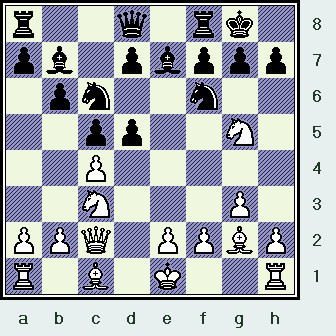
9.Ng5! Nc6!?; {Diagram.}
GM A. Matanovic, in Informant # 18, awards this a dubious appellation ...
and I would be inclined to agree. However his recommendation of 9...g6 hardly looks like the answer to all of Black's problems. {It is also too similar to the actual game continuation to be a really big improvement.}
|
|
r2q1rk1/pb1pbppp/1pn2n2/2pp2N1/2P5/2N3P1/PPQ1PPBP/R1B1K2R w
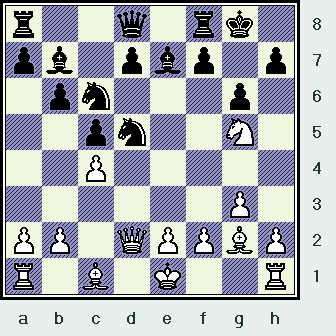
10.Nxd5!
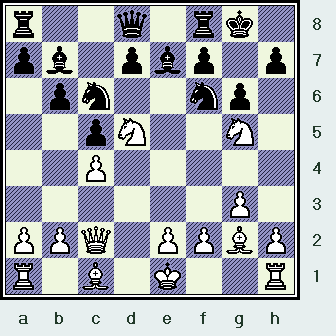
g6[]; (dark-squares) {Diagram.}
This is forced, of course if Black plays 10...NxN/d5??; then the simple 11.QxP/h7# is the answer.
(And Black must block the diagonal, </= 10...h6??; 11.NxN/f6+ is of no help.)
|
|
r2q1rk1/pb1pbp1p/1pn2np1/2pN2N1/2P5/6P1/PPQ1PPBP/R1B1K2R w
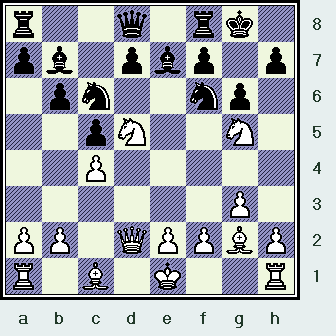
11.Qd2!N,
{See the diagram below.}
A new move (TN) to master-level chess ... M. Botvinnik claimed that Korchnoi must have prepared this idea in advance.
|
|
r2q1rk1/pb1pbp1p/1pn2np1/2pN2N1/2P5/6P1/PP1QPPBP/R1B1K2R b
This is the current situation ... my analysis indicates that Black may already face some grave difficulties.
[ In a previous effort, White played the try: 11.h4!?; but Black drew
the game without seeming to ever be in any serious trouble.C. Maderna - J. Bolbochan; / Mar del Plata, ARG; 1942. ]
11...Nxd5?!;
(Ugh.)
{Diagram.}
This move causes the second player a great deal of difficulties. Now Black will face an attack from just three of White's pieces, but it turns out to be an extremely precarious situation for young Anatoly Karpov.
|
|
r2q1rk1/pb1pbp1p/1pn3p1/2pn2N1/2P5/6P1/PP1QPPBP/R1B1K2R w
"Karpov thought for eight minutes over this weak move."
'?' - GM Victor Korchnoi
[ See the excellent volume, "My Best Games" (with White, Vol. I);
game # 19 and page # 75. ]
Black gets a bad game ... and an extremely ugly pawn skeleton after 11...Re8.
(But this still may be the best move for second party here.)
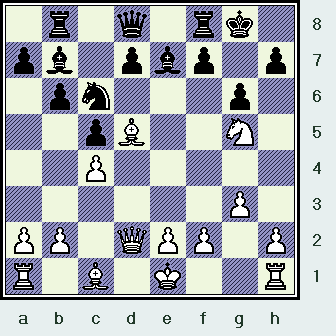
12.Bxd5 Rb8?;
(A blunder?) {Diagram
below.}
There can be no other explanation for such a move ... other than the fact that Karpov must have missed his opponent's reply.
Black may already be lost here, but this move gives away the farm.
[This game is annotated in the July 2006 issue of the BCF magazine, "Chess," beginning on page # 27.
Korchnoi makes the comment, <<That I later learned that this move was in Karpov's own "copy book.">>
If so, I imagine that whoever was really responsible for this analysis was quickly hustled off to the harsh
environs of a Siberian work camp!]
|
|
1r1q1rk1/pb1pbp1p/1pn3p1/2pB2N1/2P5/6P1/PP1QPP1P/R1B1K2R w
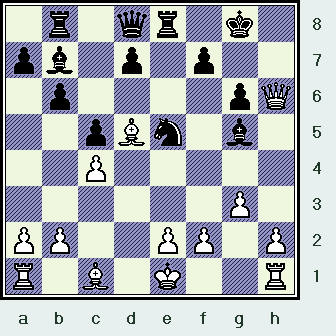
Take a look at this position.
[ After the following continuation of: >/= 12...Bxg5[]; 13.Qxg5 Qxg5;
(This looks nearly forced, Fritz gives 13...Nb4!?; but in that line -
White eventually winds up with two Bishops for a Rook ...
and a won game.)14.Bxg5 Na5; 15.Bxb7 Nxb7; 16.0-0-0, '±' {Diagram?}
White has a positionally won game, but this is still better than getting
mated or losing the Queen! (Analysis by - GM A. Matanovic.) ]
It is White to move in this position.
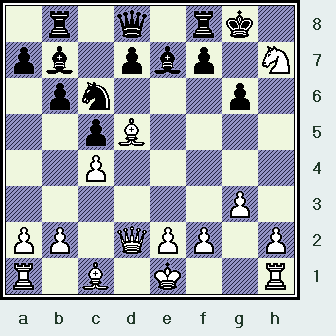
13.Nxh7!!, (Delightful, yes?)
{Diagram.}
There can be no doubt that this move came as a shock to Karpov, press at the match said that he turned White as a sheet after this incredible shot by GM V. Korchnoi.
|
|
1r1q1rk1/pb1pbp1N/1pn3p1/2pB4/2P5/6P1/PP1QPP1P/R1B1K2R b
Tal is said to have "laughed out loud" when he saw that this move was played.
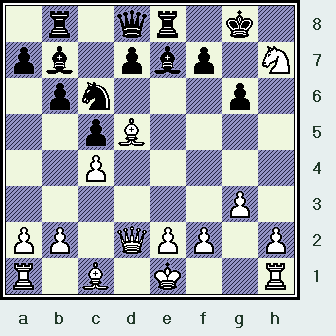
13...Re8;
(Forced?) {Diagram.}
Black cannot take the Knight, so he tries to prevent the loss of his Rook on the f8-square.
|
|
1r1qr1k1/pb1pbp1N/1pn3p1/2pB4/2P5/6P1/PP1QPP1P/R1B1K2R w
[ Instead, after the moves of: </= 13...Kxh7?; 14.Qh6+ Kg8; 15.Qxg6+! Kh8;
16.Qh5+! Kg8; 17.Be4! f5[]; 18.Bd5+, "+/-" and Black is rapidly mated. ]
14.Qh6! Ne5;
15.Ng5 Bxg5[]; {Diagram.}
Now here Black has no choice.
|
|
1r1qr1k1/pb1p1p2/1p4pQ/2pBn1b1/2P5/6P1/PP2PP1P/R1B1K2R w
[ </= 15...Bf6?; 16.Bxf7+ Nxf7; 17.Qh7+ Kf8; 18.Qxf7#. ]
16.Bxg5
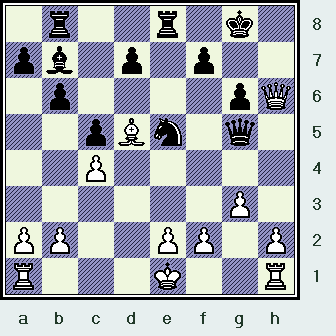
Qxg5[]; {Box.} {Diagram.}
Unfortunately for Karpov ... this was forced, as after 16...Qc8??; 17.Bf6, Black can't stop mate.
|
|
1r2r1k1/pb1p1p2/1p4pQ/2pBn1q1/2P5/6P1/PP2PP1P/R3K2R w
17.Qxg5 Bxd5;
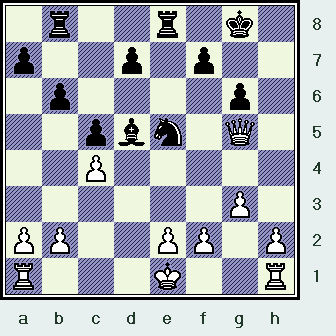
What next? {Diagram.}
Now take a look at this position, please study it carefully.
|
|
1r2r1k1/p2p1p2/1p4p1/2pbn1Q1/2P5/6P1/PP2PP1P/R3K2R w
Can White take the Bishop on the d5-square?
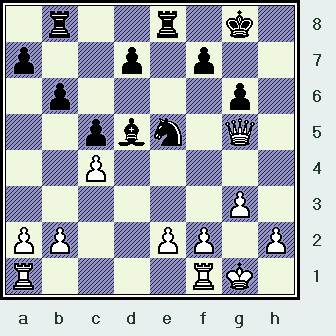
18.0-0!,
(bye-bye)
{Diagram.}
This avoids Black's last possible resource. (Apparently Korchnoi was not sure if castling would be allowed here, and has to ask the arbiter if this move was legal!)
|
|
1r2r1k1/p2p1p2/1p4p1/2pbn1Q1/2P5/6P1/PP2PP1P/R4RK1 b
[ Of course not: 18.cxd5?? Nf3+; winning the White Queen (on g5),
because of the Knight fork. ("-/+") ]
18...Bxc4;
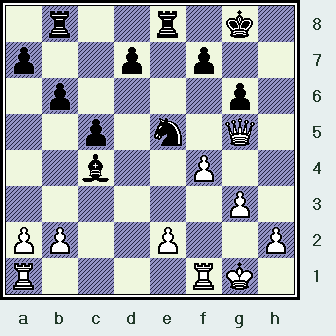
19.f4!, "+/-" (Resigns.)
{See the final diagram - just below.}
Black throws in the towel, two pieces are no match for the mighty White Queen, not with the current situation on the board.
|
|
1r2r1k1/p2p1p2/1p4p1/2p1n1Q1/2b2P2/6P1/PP2P2P/R4RK1 b
A
marvelous game by Korchnoi ...
who played with great verve and energy in this contest. (When I went over this game at chess club on Sunday; July 30th, 2006 ... I knew that I had to add it to my collection of short games.)
I have seen this game in many books and magazines over the years, but the best help -- in trying to annotate this historic struggle -- was a 'Chess Digest' pamphlet on the actual 1974 match.
Copyright (c) A.J. Goldsby, 2006. All rights reserved.
The analysis for this page was prepared with the excellent programs, ChessBase 8.0 and ChessBase 9.0.
The HTML was polished with several different tools and programs, (mostly FP) ... the text was checked for spelling with MS Word.
The diagrams were created with the program, Chess Captor 2.25.
|
Return
to my Directions Page,
or return
to my page for the "Games
List." Go (or return) to the main (home) page of my "Angel-Fire, Games-4" website. Go (or return) to the main (home) page of my big Geo-Cities web-site. Go (or return) to my GC page on the best chess players of all time. Go (or return) to my GC page on some of the best chess games that were ever played. Check out some more annotated games. (Page 1 of my "Annotated Games" on my GC website.) Go (or return) to my "More Short Games" Page, (Vol. IV). Take a look at some of the annotated games ... on the main page of my "Down-Loads" website. Visit my big "Angel-Fire" website, and take a look at a few of the annotated games that are there. (Or ... use the "back" button on your web browser.) ************************************************************************* Final posting on: Monday; July 31st, 2006. (Contact me ... about this analysis.) This (web) page was actually created in July, 2006. This page was last updated on 05/30/13 . Copyright (c) A.J. Goldsby I Copyright (©) A.J. Goldsby, and A.J.'s Enterprises.® Copyright (©) A.J. Goldsby, 2013. All rights reserved.
|