|
**************************************************************************** GM
V. Ivanchuk (2680) -
GM A. Yusupov
(2585)
|
|
|

*************************
One of the most brilliant games of
modern times. The attack Yusupov
mounts has been studied
and admired
by countless chess players.
A side note is that there was a virtual
revolution going on back home, (In old
"Mother Russia.");
for both parties.
{While this game was being played.}
So it was amazing that these players
could
even concentrate on the game.
The final product is one of the most
amazing chess games since Anderssen
played his "Immortal"
and "Ever-Green"
games. (GM Y. Seirawan, who was
present as a commentator, confessed
to
often feeling like a confused amateur
during the creation of this super-brilliancy.)
This was the ninth game of the match,
and a tie-breaker as well ... and was
played at the time limit
of:
The first 45 moves / in ONE (1) hour!!
(Then 15 minutes for every 20 moves
thereafter.)
*************************
The ratings are very close to exact and come from a CB chart showing the actual FIDE ratings.
Jeff Sonas gives the following ratings
for these two players:
GM Vassily Ivanchuk - 2765
(Informant - 2735) GM Artur Yusupov - (No rating.) (Informant - 2625)
****************************************************************************
1.c4,
The English Opening is certainly OK for White, and probably leads to a solid
edge for the
first player.
[ Ivanchuk is an extremely versatile
player, who could open with any
opening. But the
database shows
that he currently favors: 1.d4,
{Diag?} as his main opening move. ]
Black responds with ...e5. Note how
both players consistently develop
their pieces
during the opening.
1...e5!?;
This is one of Karpov's favorite lines.
The only problem with this move is
that White can often play a Sicilian ...
but with an extra tempo because the
colors are reversed.
[ Black could play the move:
1...Nf6!?;
{Diagram?}
which is also a popular response.
(With this move the second player
is offering to play one
of the many
different lines of various "Indian"
openings.) ]
2.g3!?,
While this is a little unusual, it is not
bad. Yusupov has a reputation as
being very
well-versed in opening
theory, and Ivanchuk was probably
trying to get him out
of his normal
lines.
Also - in several modern lines of the
English - Black plays a very early ...Bb4; and usually
gets a
good game.
Ivanchuk obviously wishes to avoid
this approach by Yusupov.
*******
[ The main lines probably are:
2.Nc3 Nf6; 3.Nf3 Nc6; 4.g3,
"+/=" {Diagram?}
with a good game for White.
[ See MCO-14; page # 666. ] ]
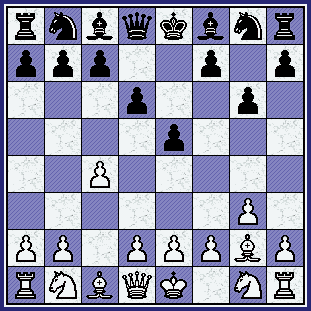
2...d6; 3.Bg2 g6!?;
{See
the diagram given - just below.}
It could be a trifle early for this
fianchetto.
*************************
|
|
*************************
Some authors and writers have
criticized this move for Black. But
since it does not lose
by force ... and really just amounts to a simple
transposition ... I don't see what
the
"hub-bub" is all about.
*******
[ Another possible line is:
3...Nc6; 4.Nc3 g6; 5.e3 Bg7; 6.Nge2!?,
"+/=" {Diag?}
when White is only a tiny bit
better in this position.
According to ChessBase's on-line
database, there are over 1000
examples of this position!
The first
example occurred in the 1930's.
(There is also a game of Botvinnik's
from that
period as well.)
The most meaningful (relatively
current) example I could find was
the encounter:
GM M. Krasenkow - GM M.
Sadler; Malmo, (Sweden); 1995.
(The game was drawn in under 30
moves - I don't think either player
really
wanted a fight that day.)
]
Both
sides continue to develop sensibly.
4.d4! Nd7;
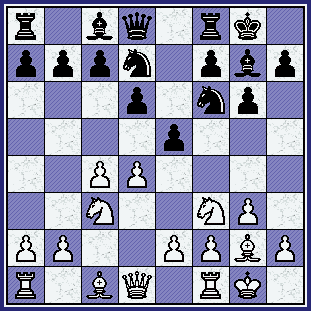
5.Nc3 Bg7; 6.Nf3 Ngf6; 7.0-0 0-0;
{See
the diagram, below.}
Both sides have developed fairly
consistently and also in a pretty
straight-forward manner.
(White is probably a tad better
in this position.)
*************************
|
|
*************************
To be honest, I think we have
transposed out of the English and
into the Fianchetto Variation
of
"The King's Indian Defense."
(See MCO-14, page # 608.)
The Mammoth Book says this was
(probably) a surprise to Ivanchuk,
as Yusupov hardly ever
uses this
particular opening. (Although I found
quite a few examples in the database,
especially
from Yusupov's early years.)
8.Qc2!?,
Certainly respectable, but not
the main line anymore.
(GM A. Soltis recommends that
Black now exchange on d4 and
he says that the second player
has a satisfactory game.)
Being that this is a "quick" game,
Ivanchuk (understandably) wants to
get Yusupov out of book
as quickly
possible!
*******
[ The main line is:
(>/=)
8.e4 c6; 9.h3 exd4!?;
{Diagram?}
Black can play nearly six different
moves here, according to theory.
(...Re8; ...Qb6; ...Qa5; ...a6; etc.)
And now - according to MCO -
the most often played moves are:
10.Nxd4 Re8; 11.Rb1 a5;
12.Re1 Nc5; 13.b3 Nh5!?; 14.Be3 Qe7;
15.Qd2 Qf8!?; 16.Rbd1 Nf6;
{Diagram?}
The end of the column.
17.Qc2 Nfd7; 18.f4,
"+/=" {Diagram?}
White seems to be a fuzz better
in this position.
"As often happens in this variation,
White has a space advantage."
- GM Nick de Firmian. (MCO)
GM. A. Wojtkiewicz - Bjarnsson; New York Open, 1994.
[ See MCO-14, page # 608; column # 61, and note # (b.). ] ]
*******
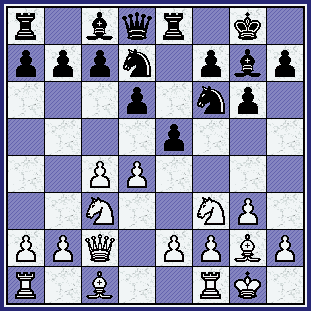
8...Re8!?;
{See the diagram, just below.}
This is one of the main lines here. (The other main line here is ...c6.)
*************************
|
|
*************************
Several authors - most notably
GM Andrew Soltis - have criticized
this move and even awarded
dubious
or question marks. But since this
is a theoretical MAIN LINE ... and is
analyzed in about
a dozen books that
I own on the "King's Indian Defence,"
{opening} ... it is VERY hard to agree
with Soltis ... or even understand why
he is so critical.
********
[ Soltis says that Yusupov should
play the move:
8...exd4!; "~"
{Diagram?}
and Black has already equalized.
(BUT ... neither theory, nor computer
analysis supports this assessment!)
NOTE:
GM Yasser Seirawan also
states that ...exd4!
is the best move
in this position for Black. (But
statistically speaking, Black's recent
results
after the exchange in the
center, have been dismal. See the
note after Black's
next move,
...c6.);
***
Black could also play ...P-QB3
(...c6); in this position:
8...c6;
9.e4!? Qe7; 10.Rd1!? exd4!?; 11.Nxd4 Re8!?;
12.b3 Nc5;
13.f3 Nfd7;
14.Rb1 Ne5; 15.Nce2!? a5;
"~" {Diagram?}
Black is probably close to equality
in this position.
(Play has transposed
to a well-known line.)
See the game:
GM V. Salov - GM G.
Kasparov; Super-GM Tournament
/
Linares, (ESP); 1991. (The game eventually ended in a
draw
in around 35 moves.) ]
*******
{Editorial
note: To understand why Rd1 is so good ... you would really have to
play
through some of the lines and variations
in a few of the sources listed in the bibliography.
Or ... you can simply take my word for
it.}
9.Rd1! c6;
('!?')
A common idea in these lines,
Black wants to play ...Qe7; but
does not want to worry
about
White playing Nd5. The pawn on
c6 keeps White's pieces off d5 and
also b5. And
now Black has the option
of possibly playing ...Qb6 or ...Qa5.
GM Yasser Seirawan gives Black's ninth move an exclam here.
'!' - GM Yasser Seirawan.
*************************
[ More often played is:
9...e4!?; 10.Ng5
e3!; 11.f4!?, {Diagram?}
Given as FORCED by many books,
but ... is it? Really?
(MCO does not
give any comment at this point.)
***
( After the moves: (>/=) = 11.Bxe3!? Rxe3!; 12.fxe3 Ng4!;
13.Nf3!?,
13...Nxe3; 14.Qd3 Nxd1; 15.Rxd1 c6; "=" {Diagram?}
the game appears to be very
finely balanced. )
***
11...h6; 12.Nge4 Nxe4;
13.Bxe4!? Nf6; 14.Bg2 Ng4; 15.d5 Nf2;
16.Rf1 Bf5;
{Diagram?}
The end of the column.
17.Qb3 Nh3+; 18.Kh1 Nf2+;
19.Kg1 Qc8; 20.Nd1 Nxd1;
21.Qxd1 Be4;
"=/+" {Diagram?}
... "and White found himself seriously
cramped by the Black Pawn on e3."
- GM Nick de
Firmian.
Maiwald - Ketevan; Germany, 1994.
[ See MCO-14; page # 608, col. # 66, and also note # (n.). ];
************
Here ... now that White's Rook is
on the d-file, I do not think the
exchange in the
center is wise:
9...exd4!?; ('?!')
10.Nxd4 a6!?; 11.b3 Rb8;
12.Bb2, "+/="
{Diag?}
White has a very clear advantage
in this position, and according to the
database -
(recently)
the first player
has scored close to 75% ... from this position!!
(A nice game is:)
S. Mamedyarov
(2585) -
Zia Rahman (2521);
ADCF Masters Tourney/2003.
{White won a fairly long game,
but there he used 12.h3 instead
of Bb2.} ]
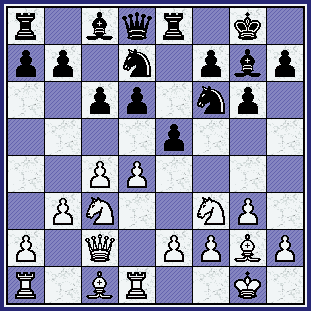
*************************
10.b3!?,
{See the diagram, just below.}
A modern move. More and more, players are questioning the older and
accepted ways of playing
the position
or opening, and looking to strike out
on completely new and different paths.
*************************
|
|
*************************
Seirawan like this so much, he awards this move both praise - and an exclam.
'!' - GM Yasser Seirawan.
[ More often played is:
10.e4 Qe7; 11.b3 exd4;
12.Nxd4 Nc5; 13.f3 a5; "~"
{D?}
and this position is either just a tiny
bit better for White ... or Black has
come very
close to equalizing.
See the encounter:
GM Josif Dorfman (2590) - GM Joe Gallagher
(2470);
(City) Championship Tournament/Paris,
(FRA); 1990.
(White won a very long game, but
I am sure the opening was not at
fault!) ]
10...Qe7;
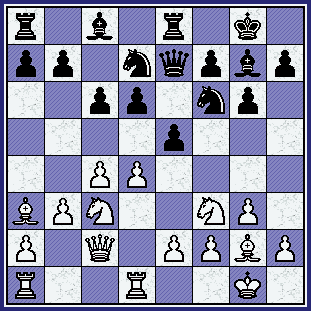
11.Ba3!?, {See the
diagram, just below.}
Ivanchuk does not wish to play the
main line ... and is obviously trying
to draw Black into
a position where
the Bishop on a3 is a significant
menace to Black.
*************************
|
|
*************************
(Was this a prepared weapon?)
'?!' - GM Yasser Seirawan. (I don't agree with this.)
*******
[ Seirawan says that it is better for
White to play: (>/=)
11.e4! exd4; 12.Nxd4,
"+/=" {Diagram?}
and White maintains a clear edge.
(This is a transposition back to one
of the "book" lines ...
see the note
after Black's eighth move.);
***
ECO recommends:
11.e3!?, "="
{Diagram?}
which leads to equality, and poses
no real problems for Black. ]
*******
Now Yusupov realizes that with
White's Bishop on a3 and the White
Rook on d1,
he cannot allow the
center to be opened. (Play a few lines with
your computer,
and this will quickly become obvious.)
11...e4!;
"A double-edged decision." - Iakov Damsky.
'!' - GM Yasser Seirawan.
[ Black can also exchange here:
11...exd4!?; 12.Rxd4!? Nc5;
13.Rad1 Bf5; 14.Qc1 Nfe4;
"=" {Diagram?}
One author claims that Black is (much)
better in this position ...
it looks
very close to level to me. {A.J.G.} ]
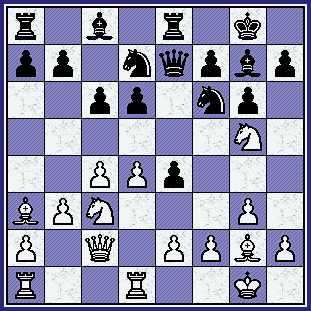
12.Ng5,
{See
the diagram ... just below.}
This could be forced for White.
*************************
|
|
*************************
The position is very rapidly building to a crescendo.
[ </= 12.Nd2!? e3; "<=>" ]
12...e3;
{Box.}
Otherwise it appears that Black
will lose this pawn.
[ Of course NOT:
</=
12...d5; (????)
13.Bxe7, ("+/-")
{Diagram?}
and Black has dropped his Queen.
]
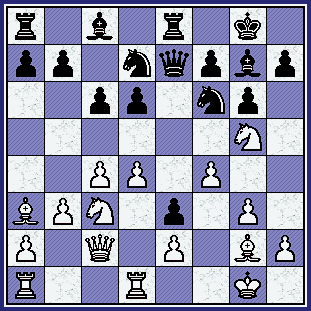
13.f4!?,
{See
the diagram just below.}
Because of the tactics, this is
nearly forced for White.
*************************
|
|
*************************
Opening theory {also} recommends
f3 here, but I am sure no good GM
has ever examined
these lines
critically. (The games and analysis are absolutely putrid.)
[ GM Yasser Seirawan
says White
MUST play: 13.f3!?,
"~" {Diagram?}
in this position. I am not arguing
with him, or saying that he is right
or wrong.
BUT f3 LOOKS VERY
UGLY TO ME!! {A.J.G.}
(Yusupov's analysis seems to
indicate that Black will {eventually}
get an advantage.
Damsky also
gives a nice line here for Black.)
Now one writer gives the
following line:
13...Nf8; 14.Nge4!? Bf5!?; (?!)
15.Qc1 Bxe4!?; 16.Nxe4 Nxe4;
17.fxe4 c5; 18.e5 Ne6; ('!?')
19.exd6!? Qxd6; {Diagram?}
While this is forced, White's next
move looks to be very doubtful.
20.Bxb7?! Nxd4;
"=/+" {Diagram?}
... "with sufficient counterplay for
Black." - Iakov
Damsky.
( This is Damsky's analysis ... I will simply state that
almost
ANYONE with a
strong computer
program could probably improve
upon this line!! {A.J.G.} );
********
Of course not: 13.fxe3?? Qxe3+;
14.Kh1 Qxg5; {Diagram?}
and Black wins a piece. ("-/+")
]
***************
Now ... as if by magic - Black's
pieces begin to spring to life.
13...Nf8; 14.b4!? Bf5;
15.Qb3 h6; 16.Nf3 Ng4; (Maybe - '!')
This is obviously nice for Black,
but he had other very playable
options here as well.
'!' - GM Yasser Seirawan.
*******
Just a note for those players who do not
have a lot of experience with this line, or
have never
studied the games of this
particular opening. (ANY "King's Indian
Defence" line!) In this opening,
White
almost always has a pawn on d5 and
plays on the Queen-side. And while the
structure here
is a little different, the
same principles still apply. (White looks
to one side of the board to create
play,
Black will almost always seek his play
on the King-side.)
*******
[ Maybe
(possibly >/=)
16...a6!?; {Diagram?}
first?
(To open the a-file for Black,
especially if White plays the way
he does in the game.) ]
*******
GM Yasser Seirawan
considers
both
White's and Black's next plays to be
worthy of an exclamation mark.
17.b5! g5!;
Black obviously intends to open lines
that will eventually lead to a violent
attack on
White's King. (Or at least
this is what A. Yusupov is hoping for!)
GM Larry Christiansen - in his very
good book on tactics and attacking
the King - lets the
moves up to this
point pass without comment. He then (now)
gives a VERY long discussion
of the
'landscape' and the general ideas here.
Basically he says that White might be
better,
but Black MUST seek his
chances on the King-side.
'!' - GM Andy Soltis. '!' - FM Graham Burgess.
*****
[ Interesting was:
17...Nf2!?;
"=/+" {Diagram?}
I think Black has the slightly better
chances in this position, but I would
also be the first to admit that I could
be mistaken! ]
*****
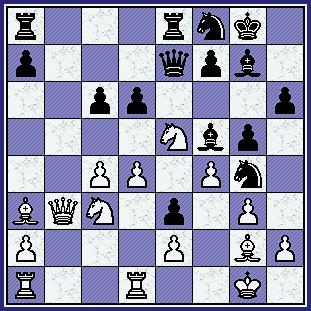
18.bxc6 bxc6;
19.Ne5!?, (Maybe - '!')
{See the diagram below.}
It takes nerves of steel to play a
move like this one, at least according
to GM Yasser Seirawan.
"There is hardly any other reasonable
move." (here) - GM Larry Christiansen.
(This is illuminating, because a few
annotators criticized this try for White!)
*************************
|
|
*************************
This move, (19.Ne5); is also the FIRST
choice of virtually EVERY SINGLE
STRONG
PROGRAM ... that I used to
test and analyze this game!!!
**************
[ Also possible was:
19.Qa4!?,
"+/=" {Diagram?}
and maybe White is a little better.
(A big emphasis on the word,
"maybe" here!);
*******
White could also try:
(>/=) 19.fxg5 hxg5;
20.Rf1, "=" {Diag?}
and the position appears pretty
close to being level.
(Yusupov felt
this might have been an improvement over the game.)
( The well-known writer and trainer (M. Dvoretsky) has suggested that
White instead play Ne5 here. But
this looks like it has not been
critically examined:
</= 20.Ne5!? Nxe5!; 21.dxe5 Rab8!; 22.Qa4 Bxe5!;
23.Rac1 Bxc3!;
24.Rxc3 c5; "~" ('!') {Diagram?} and many hours of computer-assisted analysis
strongly indicates
Black is OK ... maybe even better. ) ]
**************
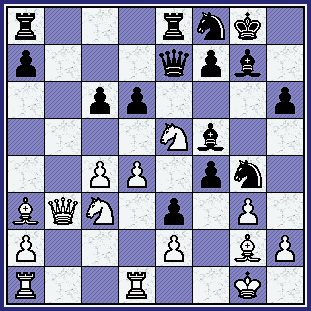
Black continues trying to make
inroads into White's King-side.
19...gxf4;
(Maybe - '!')
{See the diagram - just below.}
This is probably best for Black.
*************************
|
|
*************************
Further eroding White's King-side.
'!' - GM Larry Christiansen.
('!' - GM Andrew Soltis.)
*******
[ Certainly NOT: </=
19...Nxe5?; 20.fxe5!,
'±'
and Black will lose his d-pawn.
***
Also inadvisable for Black was: </= 19...Rac8?!;
20.fxg5 Qxg5;
21.Nxc6, '±' (Maybe "+/-")
{Diagram?} and White has a HUGE edge.
]
*******
20.Nxc6,
"White collects the harvest."
- GM Yasser Seirawan.
**************
[ After the moves:
20.Bxc6!? fxg3!; 21.Bxa8?
gxh2+!; 22.Kg2 Nf2!;
"/+" {Diagram?}
Black is clearly better.
(Black may have a winning attack
against the badly exposed White
King!);
*******
Seirawan points out the line: (</=) 20.gxf4?! Bxe5!;
21.fxe5,
21...Qh4;
"/+" {Diagram?} and Black is close to winning. ]
**************
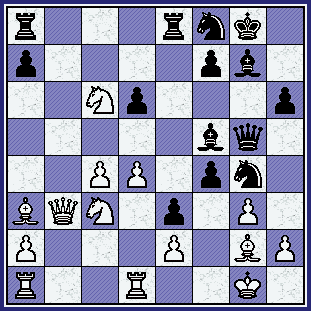
20...Qg5!;
{See the diagram ... immediately below.}
Black abandons material concerns ... and heads for fame and glory.
*************************
|
|
*************************
I remember when I first went over this
heroic struggle ...
I had the very clear
impression that White was winning
here.(!)
[ </= 20...Qe6!?; 21.Nd5, '±' ]
GM Yasser Seirawan says both of
the upcoming moves by BOTH of
the players
merit praise. ('!' - GM Yasser Seirawan.)
21.Bxd6! Ng6!;
This is best says Seirawan.
'!' - GM Yasser Seirawan.
"Yusupov piles up the pressure ..." (on the King-side)
- GM Larry Christiansen. (Christiansen also awards an exclam
to this move.)
[ Interesting was:
21...Nxh2!?;
"~" - GM A. Yusupov.
(The 'Mammoth Book' strongly
questions this and gives a line
that appears to be winning for
White.) ]
**************
22.Nd5!,
'±' ("+/")
White looks to be clearly on top -
in this particular position.
"The only chance. The centralized
Knight both attacks and defends."
- GM Larry Christiansen.
(Several different authors award this move an exclam here.)
**************
[ Also interesting was:
22.c5!?,
"+/=" {Diagram?}
and White is still better.
*******
Almost no one - that I am aware of -
has pointed out the try:
22.Nb8!?,
"+/=" (Maybe - '±') {Diagram?}
when White certainly looks to be
better. (Now please understand,
I
am NOT saying this is better; just
a very interesting alternative that
no commentator has mentioned.)
{My original version of this game
gives an extremely detailed analysis
line here ... which ends in a win for White.} ]
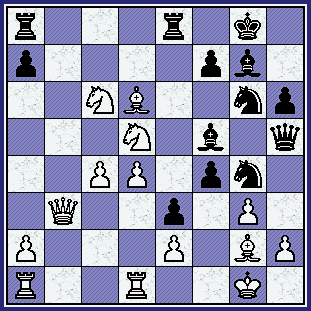
**************
22...Qh5;
('!?')
{See
the diagram, just below.}
The natural move here for Black.
*************************
|
|
*************************
Seirawan harshly criticizes this, but
I am not sure his comments are
completely justified.
(It is always
easy to come up with improvements
when you are not under tension, a
time
constraint, and can relax and
move the pieces in your study. GM
Seirawan even concedes
this point
in his excellent book!)
Both GM's Yusupov and Christiansen
seem to feel that ...Nxh2; is much
better than ...Qh5.
But I have found
some (big) holes in both of these GM's
analysis. So I would have to say that
their work does NOT support their
conclusions!! But I will also freely admit
that in a game as
complicated as this
one, the final word on this decision has
yet to be reached!
'!?' - GM John Nunn. (BCM)
**************************************************
[ GM
Yasser Seirawan says Black should
instead play the line: (>/=)
22...fxg3!; 23.Bxg3 h5!;
24.Kh1!? h4!; 25.Be1[] Nf4!;
"<=>" {Diag?}
and Black has the initiative and
appears to making progress on
the left-hand
side of the board.
(Yusupov rejected this because the
move ... fxg3; appears to allow his
opponent's
Bishop to get back to
the King-side and help defend the
White King!)
*******
BTW - I am not at all 100%
convinced this line is best for Black.
Days of computer-assisted analysis
has yet to find anything even remotely resembling
a forced win!!
****************************************************************
Black could also (again) try:
</= 22...Nxh2!?;
('!!')
{Diagram?}
The main idea of:
- GM Arthur Yusupov.
[ GM Larry Christiansen likes this
move so much that he awards
it
an exclam. ('!') ]
**********
Now the following is a fairly large
improvement over Yusupov's main
line of analysis:
23.Nxf4!?;
(Maybe - '?!')
{Diagram?}
The only move considered by
the analyst in this position.
(But taking with the Bishop on
f4 seems to win for WHITE!
See
the variations just below.)
*******
( Or perhaps: >/=
23.Bxf4!?, ('!')
"+/=" Maybe - '±' {A.J.G.}
(I think this could be best ... but most of the annotators virtually
ignore this move for White!!);
***
White should NOT play: </= 23.Kxh2? Qxg3+; 24.Kh1 Qh4+;
25.Kg1 Qf2+; 26.Kh1 Qxe2; "~" {Diagram?}
when Black has a very strong
(winning?) attack ... despite his
material
deficit. - GM Larry Christiansen. (A VERY wild line!);
***
Or White could play: 23.gxf4, {unclear?} {Diagram?}
with a very unbalanced position. )
*******
23...Qxg3;
{Diagram?}
This now looks to be best.
( Or 23...Nxf4!?; 24.Bxf4 Qh5; "~" )
24.Nxg6!?,
>/=
24...Qxg6;
('!')
{Diagram?}
This has to be the correct move.
*******
( Instead
GM A. Yusupov
only gives
the following continuation:
</= 24...Qxd6??; 25.Nge7+! Rxe7[];
26.c5?? Nf3+!; 27.exf3!?,
27...Qf6??;
{Diagram?}
and White is (much)
better. ('±') ( - ChessBase.)
{The VERY simple move of: 27...Qxc6; wins ("-/+") for Black!}
This line is SO BAD ... it looks like
the result of a mis-print ...
or
some kind of foul-up during the
translation of GM's A. Yusupov's
notes! )
*******
25.Kxh2,
{Box?}
{Diagram?}
The computer says this is forced.
*******
( </= 25.Bxh2?? Be4; ("-/+")
{Diagram?}
and it looks like White will be
mated in three or four moves.
***
Also of no help to White is: </= 25.Ne7+? Rxe7; 26.Bxe7?? Be4;
("-/+")
and once more, White will be
check-mated quickly. )
*******
25...Qxd6+; 26.Kh1 Be4;
"/+" {Diagram?}
and Black appears to be just
about winning, ("-/+"); in this
position. {A.J.G.}
******************
Now it could be that ...Nxh2 is
better than ...Qh5. But as this very
detailed
analysis demonstrated,
there is still much unexplored
territory before anyone
could say
for certain!
(NOTE: In this version, the analysis
of ...Nxh2 has been reduced to
just a
few lines! The original version is MUCH more
detailed.) ]
**************************************************
White's next move is virtually forced.
(GM Yasser Seirawan gives White's 23rd
move an exclam, but that looks to be
rather superfluous to me.)
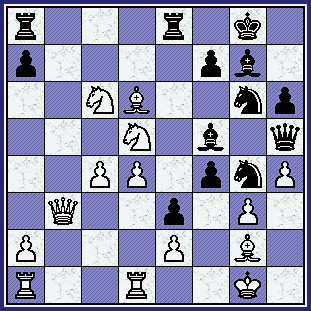
23.h4,
{See the diagram just below.}
This is not as bad as it looks ... White's strongly centralized pieces
may dominate
the board and the
play that ensues.
'!' - GM Yasser Seirawan.
*************************
|
|
*************************
An incredible position has resulted ... where Black is involved in a ...
"do-or-die" ... all-out effort on the
King-side.
*******
[ </= 23.h3?! Nf2!; "/+" ]
23...Nxh4!?;
('!' /
'!!')
This looks like a tremendously brave
and daring sacrifice to me - especially
considering the
situation. (The winner
moves on in the WCS Candidate
Matches and might eventually face the
World Champion ... in a BIG-money
match! The loser goes home.) Another
factor to consider
was the extremely
abbreviated time control this game
was played under.
'?' - GM Yasser Seirawan. ('?!' - GM Larry Christiansen.)
GM Yasser Seirawan criticizes this
move and says that >/= 23...fxg3!;
was MUCH better.
("Black gets a
clear advantage without the sacrifice.")
Yet analysis does NOT bear this out.
In fact - my analysis seems to indicate
that Black SHOULD try this sack on h4
...
I strongly suspect that without this
sacrifice, White will find a way to
defend ...
with his surplus of pawns ... and {eventually} win the game!!
(The 'Mammoth Book' gives the story
that this move was condemned by the
group of
assembled annotators. Big
deal! I am reminded of the time about
30-35 TITLED
players thought Karpov
was winning ... (a WCM game) ... until Kasparov finally
unleashed a torrent of moves that led
- practically by force - to mate.)
*******
Addendum: I must be a poor potzer
who cannot understand anything
about chess.
GM Larry Christiansen
covers about the same analytical
ground as GM Yasser Seirawan.
He
then seems to conclude that - in the
main line after 23...fxg3; - that White
is better ...
refuting what some
previous analysts thought about this
game. But then he goes on to say
that he must award Black's twenty-
third move a "dubious" appellation.
WHAT DID I MISS???!!!????!!?
****************************
[ Variation # 23B1.)
After the continuation of: (>/=)
= 23...fxg3;
{Diagram?}
Virtually ALL the annotators state
that this move was MUCH better
than the sacrifice on h4 ... but, as
my analysis line will demonstrate,
this is far from being an absolute!
24.Bxg3 Nxh4!?; {Diagram?}
I guess this is the best move
for Black. At least, it is the ONLY
move given
by several writers here.
(Maybe 24...Nf2!?; instead?)
25.Nce7+!?, ('!')
{Diagram?}
This might be the best way for
White to continue at this point.
*******
( GM Yasser Seirawan instead gives
the following line: (</=)
25.Nf4!? Qg5; 26.Nh3 Qf6; ('!') {Diagram?}
and Yaz stops here. But after a
simple move like Bh1, White looks
to be clearly better. (At least "+/=");
***
The try: 25.Qb5!?, '±' ("+/") {Diagram?}
also appears to be (very)
good for White. )
*******
25...Kh8; 26.Nf4 Qg5;
27.Bxa8, '±'
("+/") (best?)
{Diagram?}
White is clearly better ... and may
be simply winning here. ("+/-")
(If Black tries ...Nf2; then QxP/e3.)
{Most computers consider this to be a won position for White.};
**************
Variation # 23B2.)
Extremely interesting was: 23...Nf2!?;
24.Re1 Qg4; "~" {Diagram?}
when Black has a VERY strong
attack/initiative in this position.
(But whether or not the assault will
be a success is a different story,
altogether!) ]
************************
24.gxh4, ('!')
While this is nearly forced, once
again Ivanchuk is to be applauded
for the
conduct of his defense here.
'!' - GM Yasser Seirawan.
A lesser mortal would have certainly
"balked" here ... and lost. {horribly}
I should point out - as MANY authors
have over the years - that it takes
TWO (2!!!) players ... playing their
VERY BEST CHESS!!! ... to create
such an immortal game as this one.
*************************
[
Not </= 24.Bxf4??
Nxg2!; "-/+" {Diagram?}
and Black will win.
*******
The continuation of: 24.Nde7+!? Kh8;
25.gxh4, '±' ("+/")
{Diag?}
seems to CLEARLY favor WHITE.
(But
is also similar to the game.) {A
transposition?}
*******
GM Yasser Seirawan points out
that the following continuation:
</=
24.Nxf4!? Nf3+!!; 25.exf3,
{Diagram?}
This is forced.
( </= 25.Bxf3?? Qh2+; {Diagram?} and mates. )
25...Qh2+; 26.Kf1 e2+!; ("-/+")
{Diagram?}
leads to a winning attack for Black.
(Seirawan stops here.)
*******
( After the relatively simple moves:
26...e2+; 27.Ke1,
This is completely forced.
***
(Clearly worse is: </= 27.Nxe2? Rxe2!;
{Diagram?}
Surprise!
28.Kxe2!? Qxg2+; 29.Ke1 Qf2#.)
***
27...exd1Q+; 28.Kxd1 Qg1+;
29.Kd2 Qxa1; ("-/+")
{Diagram?}
Black is way ahead in material ... and threatens ...Qe1# as well.
{A.J.G.})
]
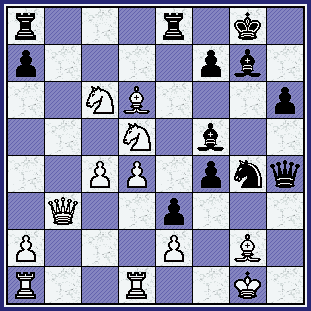
*************************
24...Qxh4;
{See the diagram
just below.}
The only move to continue the assault
on Ivanchuk's King.
('!' - NM Iakov Damsky)
*************************
|
|
*************************
The only question is ... how does Black (correctly) pursue his attack in this position?
[ Bad is:
</= 24...Kh8?;
25.Nce7, "+/-" {Diagram?}
(White is winning.) ]
25.Nde7+?!,
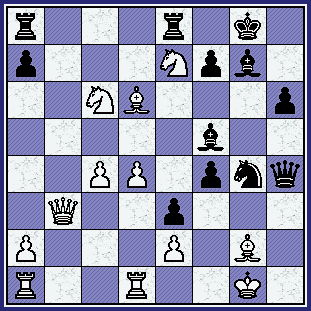
(Really - '?')
{See
the diagram just below.}
This APPEARS to be winning for
White ... but may actually lose by
force.
(Thus many GM's give this
move
{?}
a whole question mark!
And sadly,
that is exactly the rating
that this move deserves.) (In the
final analysis.)
This is also the critical moment in this wonderful and exciting contest.
*************************
|
|
*************************
Personally I think everyone is a little
bit harsh and 'over-reactive' as to
poor
GM V. Ivanchuk's play here.
Everyone seems to forget that
GM Vassily Ivanchuk
was trying ... very hard ... TO WIN THIS GAME!!!
(And I don't think the average player
would blame him. Even most boxes
say White
is winning here!)
I should also point out that I have
tested on chess programs like ChessMaster X000
and Fritz
X.0
for
close to ten years ... and they ALL
think that White is CLEARLY
winning at this point!!!!!!!!!!
**************************************************************************
ANOTHER POINT TO CONSIDER ...
is that the opinions of (and on) this
move are VERY different!!!
For
example, one old Dutch magazine
gives this move ... TWO EXCLAMS!
Another relatively well-known writer, (Iakov Damsky); gives it a single exclam. ('!')
One Yugoslav book gives it a DUBIOUS Appellation! ('?!') GM Larry Christiansen,
in his book on tactics, awards it ...
a WHOLE QUESTION MARK. ('?')
And
lastly, GM Yasser Seirawan gives it ... TWO whole question marks. ('??')
With so many VASTLY CONFLICTING
OPINIONS ...
the poor amateur can only guess who
is correct!!
**************************************************************************
[Editor: One final note - it has been written about in several places,
(see here
for one example) ...
that Ivanchuk picked up the wrong Knight by mistake. Whether or not
this is true, I am not
entirely sure. It certainly is possible, and seems like a reasonable
explanation that a player the
caliber of Ivanchuk would make this kind of mistake. A.J.G. March 1st,
2009.]
[ Several writers recommended that
White (instead) play the line: (>/=)
= 25.Bxf4! Qf2+; 26.Kh1
Qh4+;
with a draw by perpetual check.
("=") -
GM Colin McNab.
(I think this line is wrong. White
might have an improvement over
this
particular variation.);
****************************************************
The very respected author instead
seems to have found a winning line
for White:
>/=
25.Nce7+!! Kh8!; 26.Nxf5!
Qh2+; 27.Kf1 Be5!!; {Diagram?}
An amazing move. The incredible GM
group of Yasser Seirawan, American
Larry Christiansen, and British GM's
John Nunn and Willy Watson were all
looking at this game. (See Seirawan's
book, page # 233.) They came up
with
some really unbelievable lines.
28.dxe5!, {Diagram?}
This is probably best.
*******
(The Masters also looked at: 28.Bxe5+!?, {Diagram?}
which leads to complex positions.
(Several authors analyze this,
GM Larry Christiansen concludes
that Black will win - but his analysis
is fantastically complicated.);
***
GM Yasser Seirawan gives: 28.Qb7!?, {Diagram?}
which also leads to complicated
play. Seirawan's line ends in a
draw but I am sure I found at
least one (!)
win - that the GM missed.)
*******
28...Rg8!?; ('!')
{Diagram?}
With the same idea as in the game.
***
(Or 28...f3!?; 29.exf3 e2+;
30.Kxe2 Qxg2+; 31.Kd3 Qxf3+;
32.Nfe3, ("+/-") {Diagram?}
and the White King literally runs
away from Black's attack.)
***
29.Ndxe3!! fxe3!?; 30.e6!, "+/-"
{Diagram?}
and White is clearly winning here.
(Analysis by - GM Yasser Seirawan.)
Of course it should also be pointed
that it took the GM DAYS to find this wonderful line ...
whereas poor
Ivanchuk only had an hour to play
the ENTIRE GAME!!
(One can only hope that Black can find a way to improve the attack.)
(NOTE: In the original version of
this game, my analysis {of this line} was incredibly
deep
and complicated. It was edited
out ... for the sake of creating a
document that wouldn't
take 2 years
to complete and format!!) ]
**************************************************
The next few moves appear to
be (pretty much) forced.
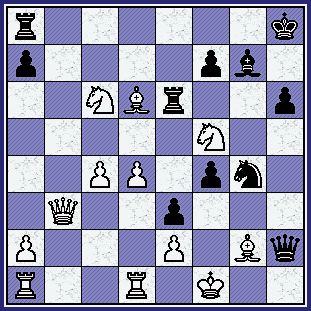
25...Kh8;
26.Nxf5 Qh2+; 27.Kf1 Re6!!; (Maybe - '!!!')
{See the diagram, below.}
What a move!
*************************
|
|
*************************
"A fantastic Rook lift. The brilliant
point of the text is getting the Rook
in FRONT of the
g7-Bishop, and
not behind it." - GM Yasser <The YAZ > Seirawan.
'!!' - GM Yasser Seirawan.
*******
[ Interesting was:
27...Nf2!?,
{Diagram?}
when Black has many interesting
attacking ideas.
(Although to be
honest, most of them probably will
not work very well!);
***
I think GM Vassily Ivanchuk expected:
27...Rg8!?; 28.Nxe3!!
Bxd4!?; {Diagram?}
This might be forced.
( Or 28...Nxe3+!?; - GM Artur Yusupov. )
29.Rxd4! Nxe3+; 30.Ke1!
Rxg2; 31.Be5+ Kg8; 32.Qd3!,
'±' {Diag?}
when White is clearly better ...
if not just winning outright.
(Line by - GM Yasser Seirawan.);
***
Some have recommended that
Black play ...Bf6! in this position.
27...Bf6!?;
{Diagram?}
(With the
idea of:) ...Bh4-f2;
...Rg8, ...Qh1, and ...Nh2. - GM A. Yusupov.
Yusupov likes this so much that
he awards himself an exclam.
( '!' - GM Artur Yusupov.)
The main line of Yusupov's analysis
runs as follows:
28.Rd3!? Bh4!; 29.Rxe3
Bf2; 30.Rxe8+ Rxe8; 31.e4?! Qg1+;
32.Ke2 Qxg2;
"/\" {Diagram?}
GM Yusupov concludes his
analysis of this line with the symbol
that means:
Black has the initiative. (I agree - Black looks to be better
{"/+"} in this position.
{A.J.G.})
As an aside - I am NOT sure that
this line represents best play!
(Especially for White!!) ]
*******
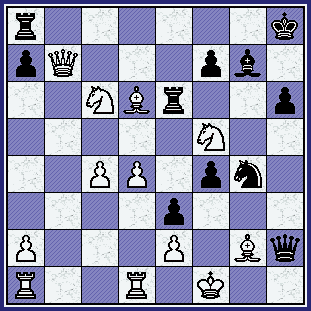
28.Qb7!?,
{See the diagram just below.}
This move ... criticized by some ... looks to flat-out win for White. (!)
(Many programs also choose this move here.)
*************************
|
|
*************************
Many pundits have attached a
whole question mark to this move ...
without even bothering to inform us
what move was better!!
[Both Yusupov and Damsky award this
move a whole question mark. ('?')
But since I have found so many errors
in the works of both of these authors
- as concerns this game - I can state
with full confidence, that their judgment
of this move is wrong ...
and the question mark is completely
UN-justified!!]
Seirawan states that after this ... (that)
Black wins.
(Albeit - in an extremely
brilliant manner!!!)
He goes on to
confess: ... "does White have a defense?
I can't find one."
- GM Yasser Seirawan.
**************
[
NOTE: In the original version of this
game, the analysis of each of the
four following main variations ... is
VERY DETAILED!!
(Probably each
line would constitute a small book!)
Variation # 28W1.)
Maybe
28.Rab1!?,
{Diagram?}
for White?
**********
Variation # 28W2.)
Also possible was:
28.c5!?, {Diagram?}
which appears - at least, at a
first
glance - to be better for White.
**********
Variation # 28W3.)
GM Artur Yusupov also suggests
that the move: 28.Rd3!?,
'±' {Diag?}
might be possible here.
**********
Variation # 28W4.)
Another interesting line is:
28.Nce7! Rxe7; {Diagram?}
The only move?
(As the analysis below shows,
this is DEFINITELY NOT
the
only possible move for Black!!)
*******
(
Another author gives: >/= 28...Rg8!!;
('!!!')
{Diagram?}
which might win for Black.
{See Larry Christiansen's book
for the extremely detailed analysis
of this amazing move.}
)
*******
29.Nxe7!?, {Diagram?}
The main move considered here,
at this point.
*****
( Or 29.Bxe7 f3; 30.exf3 e2+; 31.Kxe2 Qxg2+; 32.Kd3 Qxf3+;
{Diag?}
"--->" Black has a strong attack.
- GM Artur Yusupov.
***
Maybe: 29.c5!?, {A.J.G.} )
*****
29...Qg3; 30.Kg1,
"=" {Diagram?}
The game is drawn by Black
repeating moves.
(Black can now play simply ...Qf2+;
and ...Qh4+; {repeatedly}
White must play Kh1
and Kg1 ...
White cannot deviate
upon pain of mate.)
- GM Artur Yusupov.
]
**************
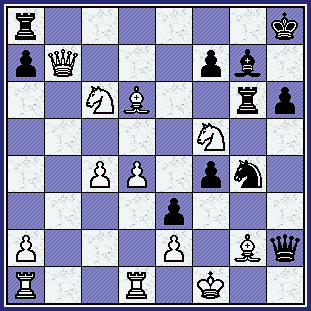
28...Rg6!!!;
(Maybe even - '!!!!')
{See the diagram just below.}
A truly amazing move, easily one of
the most wonderful and surprising
moves ...
ever played on a chess
board.
*************************
|
|
*************************
"The audience was in shock ... many
were palpably gasping at this point."
- GM Yasser Seirawan.
***
"Simply one of the most fantastic
shots in chess history." (!!!) "Black is
already TWO pieces
down ... and now
offers a Rook to set up a mating
combination - involving a Queen
sacrifice!"
- GM Larry Christiansen. (my emphasis)
***
"Like a clap of thunder!!" - Iakov Damsky.
***
GM John Emms ... in his book,
"The
Most Amazing CHESS MOVES of
All Time," ...
... considers this to be ...
one of < THE TEN GREATEST CHESS
MOVES EVER PLAYED!! >
(It's kinda hard to argue with the
GM, at least in this particular case!)
***************
[
I fully expected:
28...Rg8!?; "~"
{Diagram?}
when I first was going over this
game.
(I worked nights at a radio
station and this game was in a
chess magazine. Obviously this was
BEFORE the Internet
and TWIC!) ]
29.Qxa8+! Kh7;
Now Black threatens an incredible
check-mate. (Believe it or not.)
30.Qg8+ [],
And ... believe it or not, this too is
completely forced.
("Box" - according to GM A. Yusupov.)
'!' - FM G. Burgess. (weak)
"A dramatic method of eliminating
the attacking Rook." - GM Andy Soltis.
(Soltis also gives this move an
exclam.)
***************
[ It almost appears that White can
play the very plausible {either} Ne7,
threatening a mate ... but this meets
with an astounding refutation:
30.Nce7!? Qh1+!!; 31.Bxh1 Nh2+;
32.Ke1 Rg1#. {Diagram?}
A truly wonderful and very shocking
turn of events!!!
*******
White would also lose after:
</= 30.Nxe3?! Nxe3+;
31.Ke1 Nxc4!; {Diagram?}
***
( One author gives the grossly
inferior line of: </= 31...Rxg2; ('?') {D?}
A natural-looking move, but ... ... ... not the most alert.
32.Kd2 Rxe2+; 33.Kc3 Rc2+; 34.Kb4 Rxc4+; 35.Kb5 Qe2!;
{D?}
and Black is obviously winning
in this position. ("-/+") {Diagram?}
Line by - GM Larry Christiansen. )
***
32.Rdb1 Qxg2; 33.Kd1!? Qe4;
{Diagram?}
and Black will administer a mate ...
in very short order. ("-/+") ]
***************
The next few moves ... again ...
appear to be best.
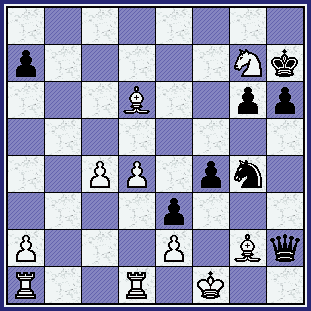
30...Kxg8; 31.Nce7+ Kh7;
32.Nxg6 fxg6; 33.Nxg7, {See
the diagram below.}
This looks to be forced.
*************************
|
|
*************************
I am not sure what else White could (reasonably) play in this position.
[ Or White can play: </=
33.c5?! gxf5; 34.c6 Nf2!; ("-/+")
{Diagram?}
but Black still wins. ]
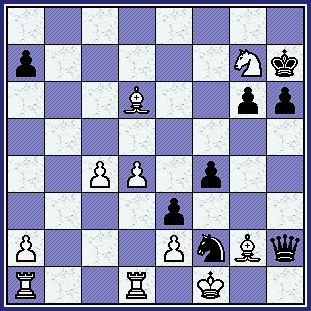
Now comes another shocker for
White. (zwischenzug)
33...Nf2!!;
{See
the diagram - - - just below.}
Yet another jolt for White ...
who
has had MANY nasty surprises in
this particular contest.
'!!' - GM Yasser Seirawan. '!!' - GM Larry Christiansen.
'!!' - GM Andrew Soltis.
"Threatening the terrible 34...Nh3!.
White must shed more material to
avert mate."
- GM Larry Christiansen.
*************************
|
|
*************************
Another incredible move that certainly deserves a diagram! (See just above.)
*******
[ Or 33...Kxg7; 34.Rab1, {Diagram?} which is not real clear. ]
Now White must give back material.
34.Bxf4,
This appears to be forced.
[ White can also play: </=
34.Rdb1?! Ne4!!; {Diagram?}
Easily the best move.
(GM John Emms ONLY gives the VASTLY inferior move: </= 34...Nh3.)
35.Ke1,
{Diagram?}
This might be forced.
( Or White could play Rb7:
35.Rb7!? Nd2+; 36.Ke1 Qg1+; 37.Bf1 Qxf1#.
Not </= 35.Bxe4? Qf2#.)
35...Qg1+; 36.Bf1 Nc3;
37.Bxf4 Qf2#.
{Diagram?}
and Black gives a mate. ]
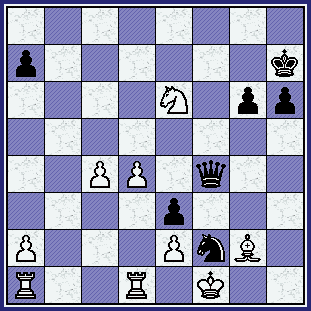
34...Qxf4; 35.Ne6,
{See the diagram just below.}
Practically the only move for White.
*************************
|
|
*************************
(Without Ne6, White quickly gets pounded.)
Actually, White does not stand badly ... at least not from a material
point of view. He just
cannot allow Black to play ...Nh3+; which would win for the second
player here.
*******
[ Probably inferior is:
</=
35.Rdb1!? Nh3+!;
{Diagram?}
Forcing the King towards the center
of the chessboard.
36.Ke1 Qh4+!;
{Diagram?}
To maintain the threat on d4.
37.Kd1 Qxd4+; 38.Ke1,
{Diagram?}
This could be forced/best.
***
( Inferior is the continuation:
</= 38.Kc2?! Qxc4+; {Diagram?}
GM Andy Soltis stops here.
39.Kb2, {Diagram?}
This is forced, as Kd1?? is easily
refuted by ...Qc3. ("-/+")
39...Qxe2+; 40.Kc3 Qxg2; 41.Ne6 Qc6+; ("-/+")
{Diagram?}
and Black picks off the Knight. )
***
38...Qh4+; 39.Kd1 Nf2+;
40.Kc2 Qxc4+; 41.Kb2 Qxe2+;
42.Ka3!? Qd3+; 43.Ka4 Kxg7;
("-/+") {Diagram?}
Black has an easy win.
(White's King is much too
exposed to try to defend here.) ]
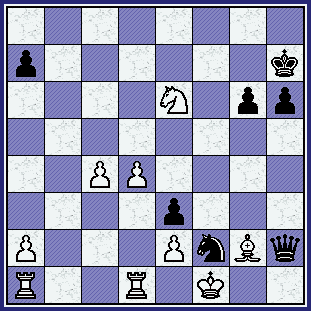
*******
35...Qh2!;
{See
the diagram given, just below.}
Back to the same threats.
'!' - GM Yasser Seirawan.
*************************
|
|
*************************
Yet another nice play by Black ...
in a contest simply filled with great,
and unusual chess moves.
[ Interesting was: 35...Qf5!?; but this is not as clear. ]
Now White is materially better ...
but cannot cope with all of Black's
threats here.
36.Rdb1 Nh3!; 37.Rb7+!?,
White is running out of moves.
[ If White plays Ke1:
37.Ke1 Qxg2; 38.Kd1 Qe4!;
"-/+" {Diagram?}
and Black will pick off the White
Knight. (N) - GM John Emms. ]
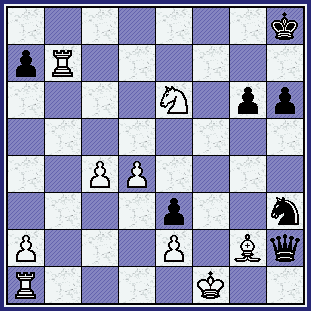
37...Kh8;
('!')
{See the diagram just below.}
To avoid any further checks - -
like the one on g7 by the White
Rook.
(If instead ... Kg8?)
*************************
|
|
*************************
I also found an IM - who was there
when this game was played - and in
his e.mail, he
assured me - that Black
put his King in the corner here.
[ Several on-line databases give
the move here as: 37...Kg8;
Of course this is incorrect, but
even some chess books ...
like the Emms volume on the most
amazing chess moves of all time ...
also repeats this error. ]
38.Rb8+,
White would have probably considered
throwing in the towel ...
but Yusupov
was reportedly very short of time here.
[ After the moves:
38.Ke1 Qg1+; 39.Bf1 Qf2+;
40.Kd1 Qxf1+; 41.Kc2,
41...Qxa1;
("-/+") {Diagram?}
White is completely lost. ]
38...Qxb8; 39.Bxh3!?,
This allows a quick mate ... but White's game was without hope.
[ 39.Ke1!? ]
39...Qg3;
('!') ("-/+")
{See
the diagram just below.}
White Resigns, (0-1) Ivanchuk has
absolutely no defence ...
to the mate on f2.
*************************
|
|
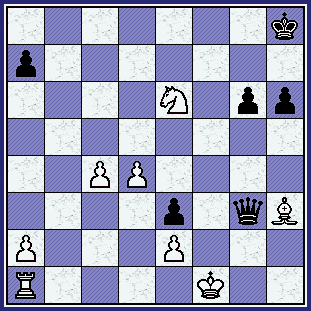
The final position of this truly wonderful and amazing game.
*************************
A modern classic and one of Yusupov's (Jussupow?)
all-time best games.
(It was also voted
as the best game of that year by the
Informant panel of judges.)
After Ivanchuk's resignation ... "the Belgian audience burst into
thunderous applause.
They had
witnessed a modern chess brilliancy
and were delighted with the efforts
of both
players. The players quietly
retreated to their rooms to follow
the military coup that was
taking
place in Moscow." - GM Yasser Seirawan.
(His most excellent book,
"Winning Chess Brilliancies.")
GM Larry Christiansen picks this
as his NUMBER TWO favorite
attacking game.
(Behind only the
wonderful masterpiece of:
G. Kasparov - V. Topalov; 1999.)
GM Christiansen goes on to state,
(as his introduction to this game):
"Artur Yusupov's Magnum Opus.
This is truly one of the most
imaginative and
beautiful games of
the (20th) Century." - GM Larry Christiansen.
(In his book on tactics and attack. See
item # 6 in the Bibliography - below.)
"A splendid performance - by both
players."
- GM Andrew Soltis.
(Soltis ranks this as one of the '100
Best' Games of the 20th Century.)
I personally do not know how to rate
such a game. It certainly is one of the
most imaginative
and brilliant games
of the whole of the 20th Century. It
also has to be - considering the time
limit that it was played under - simply
the finest specimen of "fast chess"
that I know of!!!
( << THE RAPID IMMORTAL
>>
?)
******************************************************************
(I want to point out that nearly ALL of the
exclams ... {and even the question marks} ...
in this game, come from one of the
sources listed below.)
******************************************************************
BIBLIOGRAPHY:
I consulted many different books to
annotate this game. I looked at ECO,
MCO, NCO, and
many others. {This
game was also in many of my old
chess magazines.} But the following
books were the main sources that I
used - given {mainly} in the order that
I looked at them:
# 1.) Chess INFORMANT, # 53.
{Published out of Yugoslavia.}
Also Informant # 52/592.
(The analysis in CB appears to have
been copied directly from the
Informant -
the analysis there is
also credited to GM A. Yusupov.)
# 2.) [The Mammoth Book Of:] "The
World's Greatest Chess Games,"
by GM John Nunn, GM John Emms,
and FM Graham Burgess.
[ Game # 85, page # 475. ]
An extremely deep look at 100 of the
best games of chess ever played!
Copyright (c) 1998 by all the authors.
Gambit Books, / Carroll & Graf Pub.
ISBN: # 0-7867-0587-6 (paper)
# 3.) "The Fianchetto King's
Indian," by GM Colin McNab. Copyright (c) 1996.
Chapter # 8, {Classical} page # 154.
# 4.) "The Most Amazing
CHESS
MOVES of All Time," (The top 200);
by GM John Emms. Copyright (c) 2000.
Position # 171, page # 158.
Published by Gambit Books.
ISBN: # 1-901983-29-3 (flex/paper)
# 5.) The MOST excellent book: "Winning
Chess Brilliancies," by IGM Yasser Seirawan.
Copyright
(©) 1995. Published by Microsoft Press. ISBN: # 1-55615-910-2
[His analysis takes up a whole
chapter (12), and begins on page
number # 219.]
(This book went out of print, but
now - thankfully - is being brought
back by
another publisher.)
# 6.) Now my favorite book on tactics
and attacking and even the midgame:
"Storming
The Barricades," <*****>
{A FIVE STAR book.} by GM L. Christiansen.
Copyright
(c) 2000. (Beginning on page # 166.) Published by Gambit Books.
ISBN: # 1-901983-25-0
# 7.) A book - in German! - on
GM Arthur Yusupov's best games.
(I DON'T own this book, a student
was kind enough to photo-copy the
analysis ...
and send it to me.)
# 8.) "Chess Brilliancy,"
by Iakov Damsky. (250 games from the Masters.)
Copyright (c) 2002 by the author.
Published by Everyman Chess.
ISBN: # 1-857744-274-1
(Damsky's analysis of this grand
contest leaves MUCH to be desired!)
# 9.) "Chess Highlights
Of The 20th Century,"
('The Best Chess 1900-1999
In A Historical Context.') by FM Graham Burgess.
Copyright
(c) 1999. Published by Gambit Books.
ISBN: # 1-901983-21-8 (hard-back)
FM Graham Burgess has a very good
reputation as an analyst. Here he does a <definite>
sub-standard
job. He
also awards a fistful of question marks
that simply cannot be justified.
# 10.) THE ONE HUNDRED BEST
"The
100 Best Chess Games Of The
20th Century, Ranked." {Game # 80, page #
206.}
By GM Andrew Soltis.
Copyright (c) 2000 - by the author.
Published by McFarland & Co. Books ISBN: # 0-7864-0926-6 (hard-back)
*******
# 2, # 5, and # 6 feature easily the best and the most interesting analysis of this game.
******************************************************************
Copyright (c) A.J. Goldsby I.
Copyright (©) A.J. Goldsby. Copyright (c) A.J.G;
2003 - 2005.
Copyright (©) A.J.
Goldsby, 2006. All rights reserved.
0 - 1
For this game, the HTML code was initially generated by the program, ChessBase 8.0
